Guanine nucleotide-binding protein G(t) subunit alpha-3 (Gustducin alpha-3 chain)
1_MGSGI 6_ SSESK 11_ ESAKR 16_ SKELE 21_ KKLQE 26_ DAERD 31_ ARTVK 36_ LLLLG 41_ AGESG 46_ KSTIV 51_ KQMKI 56_ IHKNG 61_ YSEQE 66_ CMEFK 71_ AVIYS 76_ NTLQS 81_ ILAIV 86_ KAMTT 91_ LGIDY 96_ VNPRS 101_ AEDQR 106_ QLYAM 111_ ANTLE 116_ DGGMT 121_ PQLAE 126_ VIKRL 131_ WRDPG 136_ IQACF 141_ ERASE 146_ YQLND 151_ SAAYY 156_ LNDLD 161_ RITAS 166_ GYVPN 171_ EQDVL 176_ HSRVK 181_ TTGII 186_ ETQFS 191_ FKDLH 196_ FRMFD 201_ VGGQR 206_ SERKK 211_ WIHCF 216_ EGVTC 221_ IIFCA 226_ ALSAY 231_ DMVLV 236_ EDEEV 241_ NRMHE 246_ SLHLF 251_ NSICN 256_ HKYFS 261_ TTSIV 266_ LFLNK 271_ KDIFQ 276_ EKVTK 281_ VHLSI 286_ CFPEY 291_ TGPNT 296_ FEDAG 301_ NYIKN 306_ QFLDL 311_ NLKKE 316_ DKEIY 321_ SHMTC 326_ ATDTQ 331_ NVKFV 336_ FDAVT 341_ DIIIK 346_ENLKD
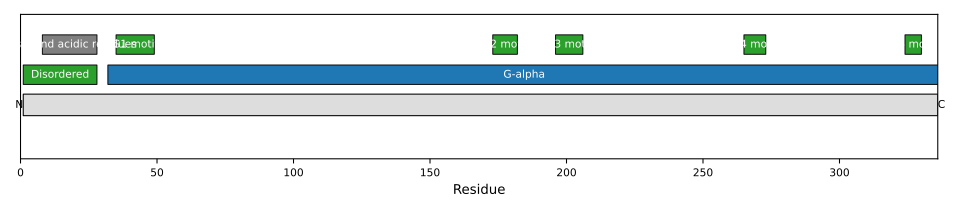
1: Guanine nucleotide-binding protein (G protein) alpha subunit playing a prominent role in bitter and sweet taste transduction as well as in umami (monosodium glutamate, monopotassium glutamate, and inosine monophosphate) taste transduction (PubMed:38600377, PubMed:38776963). Transduction by this alpha subunit involves coupling of specific cell-surface receptors with a cGMP-phosphodiesterase; Activation of phosphodiesterase lowers intracellular levels of cAMP and cGMP which may open a cyclic nucleotide-suppressible cation channel leading to influx of calcium, ultimately leading to release of neurotransmitter. Indeed, denatonium and strychnine induce transient reduction in cAMP and cGMP in taste tissue, whereas this decrease is inhibited by GNAT3 antibody. Gustducin heterotrimer transduces response to bitter and sweet compounds via regulation of phosphodiesterase for alpha subunit, as well as via activation of phospholipase C for beta and gamma subunits, with ultimate increase inositol trisphosphate and increase of intracellular Calcium. GNAT3 can functionally couple to taste receptors to transmit intracellular signal: receptor heterodimer TAS1R2/TAS1R3 senses sweetness and TAS1R1/TAS1R3 transduces umami taste, whereas the T2R family GPCRs such as TAS2R14 act as bitter sensors (PubMed:38600377, PubMed:38776963). Also functions as lumenal sugar sensors in the gut to control the expression of the Na+-glucose transporter SGLT1 in response to dietaty sugar, as well as the secretion of Glucagon-like peptide-1, GLP-1 and glucose-dependent insulinotropic polypeptide, GIP. Thus, may modulate the gut capacity to absorb sugars, with implications in malabsorption syndromes and diet-related disorders including diabetes and obesity