Potassium channel subfamily K member 1 (Inward rectifying potassium channel protein TWIK-1) (Potassium channel K2P1) (Potassium channel KCNO1)
1_MLQSL 6_ AGSSC 11_ VRLVE 16_ RHRSA 21_ WCFGF 26_ LVLGY 31_ LLYLV 36_ FGAVV 41_ FSSVE 46_ LPYED 51_ LLRQE 56_ LRKLK 61_ RRFLE 66_ EHECL 71_ SEQQL 76_ EQFLG 81_ RVLEA 86_ SNYGV 91_ SVLSN 96_ ASGNW 101_ NWDFT 106_ SALFF 111_ ASTVL 116_ STTGY 121_ GHTVP 126_ LSDGG 131_ KAFCI 136_ IYSVI 141_ GIPFT 146_ LLFLT 151_ AVVQR 156_ ITVHV 161_ TRRPV 166_ LYFHI 171_ RWGFS 176_ KQVVA 181_ IVHAV 186_ LLGFV 191_ TVSCF 196_ FFIPA 201_ AVFSV 206_ LEDDW 211_ NFLES 216_ FYFCF 221_ ISLST 226_ IGLGD 231_ YVPGE 236_ GYNQK 241_ FRELY 246_ KIGIT 251_ CYLLL 256_ GLIAM 261_ LVVLE 266_ TFCEL 271_ HELKK 276_ FRKMF 281_ YVKKD 286_ KDEDQ 291_ VHIIE 296_ HDQLS 301_ FSSIT 306_ DQAAG 311_ MKEDQ 316_ KQNEP 321_ FVATQ 326_ SSACV 331_DGPAN
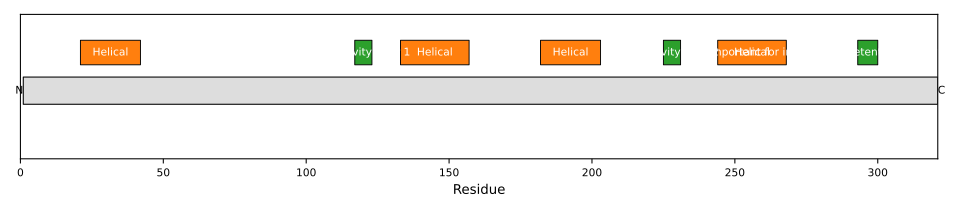
1: Ion channel that contributes to passive transmembrane potassium transport and to the regulation of the resting membrane potential in brain astrocytes, but also in kidney and in other tissues (PubMed:15820677, PubMed:21653227). Forms dimeric channels through which potassium ions pass in accordance with their electrochemical gradient. The channel is selective for K(+) ions at physiological potassium concentrations and at neutral pH, but becomes permeable to Na(+) at subphysiological K(+) levels and upon acidification of the extracellular medium (PubMed:21653227, PubMed:22431633). The homodimer has very low potassium channel activity, when expressed in heterologous systems, and can function as weakly inward rectifying potassium channel (PubMed:15820677, PubMed:21653227, PubMed:22431633, PubMed:23169818, PubMed:25001086, PubMed:8605869, PubMed:8978667). Channel activity is modulated by activation of serotonin receptors (By similarity). Heterodimeric channels containing KCNK1 and KCNK2 have much higher activity, and may represent the predominant form in astrocytes (By similarity). Heterodimeric channels containing KCNK1 and KCNK3 or KCNK9 have much higher activity (PubMed:23169818). Heterodimeric channels formed by KCNK1 and KCNK9 may contribute to halothane-sensitive currents (PubMed:23169818). Mediates outward rectifying potassium currents in dentate gyrus granule cells and contributes to the regulation of their resting membrane potential (By similarity). Contributes to the regulation of action potential firing in dentate gyrus granule cells and down-regulates their intrinsic excitability (By similarity). In astrocytes, the heterodimer formed by KCNK1 and KCNK2 is required for rapid glutamate release in response to activation of G-protein coupled receptors, such as F2R and CNR1 (By similarity). Required for normal ion and water transport in the kidney (By similarity). Contributes to the regulation of the resting membrane potential of pancreatic beta cells (By similarity). The low channel activity of homodimeric KCNK1 may be due to sumoylation (PubMed:15820677, PubMed:20498050, PubMed:23169818). The low channel activity may be due to rapid internalization from the cell membrane and retention in recycling endosomes (PubMed:19959478). Permeable to monovalent cations with ion selectivity for K(+) > Rb(+) >> NH4(+) >> Cs(+) = Na(+) = Li(+)