Amyloid beta precursor protein binding family B member 1 (Amyloid-beta A4 precursor protein-binding family B member 1) (Protein Fe65)
1_MSVPS 6_ SLSQS 11_ AINAN 16_ SHGGP 21_ ALSLP 26_ LPLHA 31_ AHNQL 36_ LNAKL 41_ QATAV 46_ GPKDL 51_ RSAMG 56_ EGGGP 61_ EPGPA 66_ NAKWL 71_ KEGQN 76_ QLRRA 81_ ATAHR 86_ DQNRN 91_ VTLTL 96_ AEEAS 101_ QEPEM 106_ APLGP 111_ KGLIH 116_ LYSEL 121_ ELSAH 126_ NAANR 131_ GLRGP 136_ GLIIS 141_ TQEQG 146_ PDEGE 151_ EKAAG 156_ EAEEE 161_ EEDDD 166_ DEEEE 171_ EDLSS 176_ PPGLP 181_ EPLES 186_ VEAPP 191_ RPQAL 196_ TDGPR 201_ EHSKS 206_ ASLLF 211_ GMRNS 216_ AASDE 221_ DSSWA 226_ TLSQG 231_ SPSYG 236_ SPEDT 241_ DSFWN 246_ PNAFE 251_ TDSDL 256_ PAGWM 261_ RVQDT 266_ SGTYY 271_ WHIPT 276_ GTTQW 281_ EPPGR 286_ ASPSQ 291_ GSSPQ 296_ EESQL 301_ TWTGF 306_ AHGEG 311_ FEDGE 316_ FWKDE 321_ PSDEA 326_ PMELG 331_ LKEPE 336_ EGTLT 341_ FPAQS 346_ LSPEP 351_ LPQEE 356_ EKLPP 361_ RNTNP 366_ GIKCF 371_ AVRSL 376_ GWVEM 381_ TEEEL 386_ APGRS 391_ SVAVN 396_ NCIRQ 401_ LSYHK 406_ NNLHD 411_ PMSGG 416_ WGEGK 421_ DLLLQ 426_ LEDET 431_ LKLVE 436_ PQSQA 441_ LLHAQ 446_ PIISI 451_ RVWGV 456_ GRDSG 461_ RERDF 466_ AYVAR 471_ DKLTQ 476_ MLKCH 481_ VFRCE 486_ APAKN 491_ IATSL 496_ HEICS 501_ KIMAE 506_ RRNAR 511_ CLVNG 516_ LSLDH 521_ SKLVD 526_ VPFQV 531_ EFPAP 536_ KNELV 541_ QKFQV 546_ YYLGN 551_ VPVAK 556_ PVGVD 561_ VINGA 566_ LESVL 571_ SSSSR 576_ EQWTP 581_ SHVSV 586_ APATL 591_ TILHQ 596_ QTEAV 601_ LGECR 606_ VRFLS 611_ FLAVG 616_ RDVHT 621_ FAFIM 626_ AAGPA 631_ SFCCH 636_ MFWCE 641_ PNAAS 646_ LSEAV 651_ QAACM 656_ LRYQK 661_ CLDAR 666_ SQAST 671_ SCLPA 676_ PPAES 681_ VARRV 686_ GWTVR 691_ RGVQS 696_ LWGSL 701_KPKRL
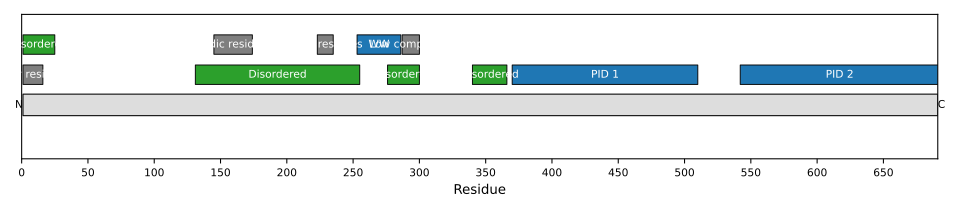
1: Transcription coregulator that can have both coactivator and corepressor functions (PubMed:15031292, PubMed:18468999, PubMed:18922798, PubMed:25342469, PubMed:33938178). Adapter protein that forms a transcriptionally active complex with the gamma-secretase-derived amyloid precursor protein (APP) intracellular domain (PubMed:15031292, PubMed:18468999, PubMed:18922798, PubMed:25342469). Plays a central role in the response to DNA damage by translocating to the nucleus and inducing apoptosis (PubMed:15031292, PubMed:18468999, PubMed:18922798, PubMed:25342469). May act by specifically recognizing and binding histone H2AX phosphorylated on 'Tyr-142' (H2AXY142ph) at double-strand breaks (DSBs), recruiting other pro-apoptosis factors such as MAPK8/JNK1 (PubMed:19234442). Required for histone H4 acetylation at double-strand breaks (DSBs) (PubMed:19234442). Its ability to specifically bind modified histones and chromatin modifying enzymes such as KAT5/TIP60, probably explains its transcription activation activity (PubMed:33938178). Functions in association with TSHZ3, SET and HDAC factors as a transcriptional repressor, that inhibits the expression of CASP4 (PubMed:19343227). Associates with chromatin in a region surrounding the CASP4 transcriptional start site(s) (PubMed:19343227). Involved in hippocampal neurite branching and neuromuscular junction formation, as a result plays a role in spatial memory functioning (By similarity). Plays a role in the maintenance of lens transparency (By similarity). May play a role in muscle cell strength (By similarity). Acts as a molecular adapter that functions in neurite outgrowth by activating the RAC1-ARF6 axis upon insulin treatment (PubMed:36250347)