Aryl hydrocarbon receptor nuclear translocator-like protein 1 (Basic-helix-loop-helix-PAS protein MOP3) (Brain and muscle ARNT-like 1) (Class E basic helix-loop-helix protein 5) (bHLHe5) (Member of PAS protein 3) (PAS domain-containing protein 3) (bHLH-PAS protein JAP3)
1_MADQR 6_ MDISS 11_ TISDF 16_ MSPGP 21_ TDLLS 26_ SSLGT 31_ SGVDC 36_ NRKRK 41_ GSSTD 46_ YQESM 51_ DTDKD 56_ DPHGR 61_ LEYTE 66_ HQGRI 71_ KNARE 76_ AHSQI 81_ EKRRR 86_ DKMNS 91_ FIDEL 96_ ASLVP 101_ TCNAM 106_ SRKLD 111_ KLTVL 116_ RMAVQ 121_ HMKTL 126_ RGATN 131_ PYTEA 136_ NYKPT 141_ FLSDD 146_ ELKHL 151_ ILRAA 156_ DGFLF 161_ VVGCD 166_ RGKIL 171_ FVSES 176_ VFKIL 181_ NYSQN 186_ DLIGQ 191_ SLFDY 196_ LHPKD 201_ IAKVK 206_ EQLSS 211_ SDTAP 216_ RERLI 221_ DAKTG 226_ LPVKT 231_ DITPG 236_ PSRLC 241_ SGARR 246_ SFFCR 251_ MKCNR 256_ PSVKV 261_ EDKDF 266_ PSTCS 271_ KKKAD 276_ RKSFC 281_ TIHST 286_ GYLKS 291_ WPPTK 296_ MGLDE 301_ DNEPD 306_ NEGCN 311_ LSCLV 316_ AIGRL 321_ HSHVV 326_ PQPVN 331_ GEIRV 336_ KSMEY 341_ VSRHA 346_ IDGKF 351_ VFVDQ 356_ RATAI 361_ LAYLP 366_ QELLG 371_ TSCYE 376_ YFHQD 381_ DIGHL 386_ AECHR 391_ QVLQT 396_ REKIT 401_ TNCYK 406_ FKIKD 411_ GSFIT 416_ LRSRW 421_ FSFMN 426_ PWTKE 431_ VEYIV 436_ STNTV 441_ VLANV 446_ LEGGD 451_ PTFPQ 456_ LTASP 461_ HSMDS 466_ MLPSG 471_ EGGPK 476_ RTHPT 481_ VPGIP 486_ GGTRA 491_ GAGKI 496_ GRMIA 501_ EEIME 506_ IHRIR 511_ GSSPS 516_ SCGSS 521_ PLNIT 526_ STPPP 531_ DASSP 536_ GGKKI 541_ LNGGT 546_ PDIPS 551_ SGLLS 556_ GQAQE 561_ NPGYP 566_ YSDSS 571_ SILGE 576_ NPHIG 581_ IDMID 586_ NDQGS 591_ SSPSN 596_ DEAAM 601_ AVIMS 606_ LLEAD 611_ AGLGG 616_ PVDFS 621_DLPWP
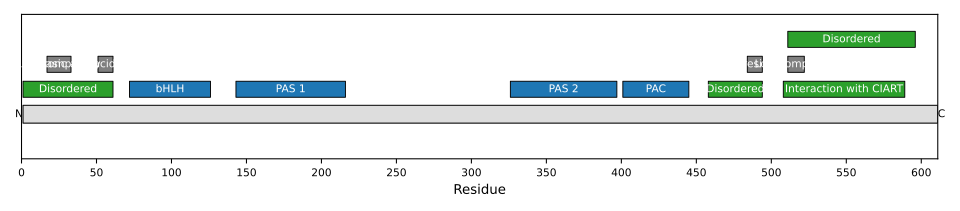
1: Transcriptional activator which forms a core component of the circadian clock. The circadian clock, an internal time-keeping system, regulates various physiological processes through the generation of approximately 24 hour circadian rhythms in gene expression, which are translated into rhythms in metabolism and behavior. It is derived from the Latin roots 'circa' (about) and 'diem' (day) and acts as an important regulator of a wide array of physiological functions including metabolism, sleep, body temperature, blood pressure, endocrine, immune, cardiovascular, and renal function. Consists of two major components: the central clock, residing in the suprachiasmatic nucleus (SCN) of the brain, and the peripheral clocks that are present in nearly every tissue and organ system. Both the central and peripheral clocks can be reset by environmental cues, also known as Zeitgebers (German for 'timegivers'). The predominant Zeitgeber for the central clock is light, which is sensed by retina and signals directly to the SCN. The central clock entrains the peripheral clocks through neuronal and hormonal signals, body temperature and feeding-related cues, aligning all clocks with the external light/dark cycle. Circadian rhythms allow an organism to achieve temporal homeostasis with its environment at the molecular level by regulating gene expression to create a peak of protein expression once every 24 hours to control when a particular physiological process is most active with respect to the solar day. Transcription and translation of core clock components (CLOCK, NPAS2, BMAL1, BMAL2, PER1, PER2, PER3, CRY1 and CRY2) plays a critical role in rhythm generation, whereas delays imposed by post-translational modifications (PTMs) are important for determining the period (tau) of the rhythms (tau refers to the period of a rhythm and is the length, in time, of one complete cycle). A diurnal rhythm is synchronized with the day/night cycle, while the ultradian and infradian rhythms have a period shorter and longer than 24 hours, respectively. Disruptions in the circadian rhythms contribute to the pathology of cardiovascular diseases, cancer, metabolic syndromes and aging. A transcription/translation feedback loop (TTFL) forms the core of the molecular circadian clock mechanism. Transcription factors, CLOCK or NPAS2 and BMAL1 or BMAL2, form the positive limb of the feedback loop, act in the form of a heterodimer and activate the transcription of core clock genes and clock-controlled genes (involved in key metabolic processes), harboring E-box elements (5'-CACGTG-3') within their promoters. The core clock genes: PER1/2/3 and CRY1/2 which are transcriptional repressors form the negative limb of the feedback loop and interact with the CLOCK|NPAS2-BMAL1|BMAL2 heterodimer inhibiting its activity and thereby negatively regulating their own expression. This heterodimer also activates nuclear receptors NR1D1/2 and RORA/B/G, which form a second feedback loop and which activate and repress BMAL1 transcription, respectively. BMAL1 positively regulates myogenesis and negatively regulates adipogenesis via the transcriptional control of the genes of the canonical Wnt signaling pathway. Plays a role in normal pancreatic beta-cell function; regulates glucose-stimulated insulin secretion via the regulation of antioxidant genes NFE2L2/NRF2 and its targets SESN2, PRDX3, CCLC and CCLM. Negatively regulates the mTORC1 signaling pathway; regulates the expression of MTOR and DEPTOR. Controls diurnal oscillations of Ly6C inflammatory monocytes; rhythmic recruitment of the PRC2 complex imparts diurnal variation to chemokine expression that is necessary to sustain Ly6C monocyte rhythms. Regulates the expression of HSD3B2, STAR, PTGS2, CYP11A1, CYP19A1 and LHCGR in the ovary and also the genes involved in hair growth. Plays an important role in adult hippocampal neurogenesis by regulating the timely entry of neural stem/progenitor cells (NSPCs) into the cell cycle and the number of cell divisions that take place prior to cell-cycle exit. Regulates the circadian expression of CIART and KLF11. The CLOCK-BMAL1 heterodimer regulates the circadian expression of SERPINE1/PAI1, VWF, B3, CCRN4L/NOC, NAMPT, DBP, MYOD1, PPARGC1A, PPARGC1B, SIRT1, GYS2, F7, NGFR, GNRHR, BHLHE40/DEC1, ATF4, MTA1, KLF10 and also genes implicated in glucose and lipid metabolism. Promotes rhythmic chromatin opening, regulating the DNA accessibility of other transcription factors. The NPAS2-BMAL1 heterodimer positively regulates the expression of MAOA, F7 and LDHA and modulates the circadian rhythm of daytime contrast sensitivity by regulating the rhythmic expression of adenylate cyclase type 1 (ADCY1) in the retina. The preferred binding motif for the CLOCK-BMAL1 heterodimer is 5'-CACGTGA-3', which contains a flanking adenine nucleotide at the 3-prime end of the canonical 6-nucleotide E-box sequence (PubMed:23229515). CLOCK specifically binds to the half-site 5'-CAC-3', while BMAL1 binds to the half-site 5'-GTGA-3' (PubMed:23229515). The CLOCK-BMAL1 heterodimer also recognizes the non-canonical E-box motifs 5'-AACGTGA-3' and 5'-CATGTGA-3' (PubMed:23229515). Essential for the rhythmic interaction of CLOCK with ASS1 and plays a critical role in positively regulating CLOCK-mediated acetylation of ASS1 (PubMed:28985504). Plays a role in protecting against lethal sepsis by limiting the expression of immune checkpoint protein CD274 in macrophages in a PKM2-dependent manner (By similarity). Regulates the diurnal rhythms of skeletal muscle metabolism via transcriptional activation of genes promoting triglyceride synthesis (DGAT2) and metabolic efficiency (COQ10B) (By similarity)
2: (Microbial infection) Regulates SARS coronavirus-2/SARS-CoV-2 entry and replication in lung epithelial cells probably through the post-transcriptional regulation of ACE2 and interferon-stimulated gene expression