Dynamin-1-like protein (EC 3.6.5.5) (Dnm1p/Vps1p-like protein) (DVLP) (Dynamin family member proline-rich carboxyl-terminal domain less) (Dymple) (Dynamin-like protein) (Dynamin-like protein 4) (Dynamin-like protein IV) (HdynIV) (Dynamin-related protein 1)
1_MEALI 6_ PVINK 11_ LQDVF 16_ NTVGA 21_ DIIQL 26_ PQIVV 31_ VGTQS 36_ SGKSS 41_ VLESL 46_ VGRDL 51_ LPRGT 56_ GIVTR 61_ RPLIL 66_ QLVHV 71_ SQEDK 76_ RKTTG 81_ EENGV 86_ EAEEW 91_ GKFLH 96_ TKNKL 101_ YTDFD 106_ EIRQE 111_ IENET 116_ ERISG 121_ NNKGV 126_ SPEPI 131_ HLKIF 136_ SPNVV 141_ NLTLV 146_ DLPGM 151_ TKVPV 156_ GDQPK 161_ DIELQ 166_ IRELI 171_ LRFIS 176_ NPNSI 181_ ILAVT 186_ AANTD 191_ MATSE 196_ ALKIS 201_ REVDP 206_ DGRRT 211_ LAVIT 216_ KLDLM 221_ DAGTD 226_ AMDVL 231_ MGRVI 236_ PVKLG 241_ IIGVV 246_ NRSQL 251_ DINNK 256_ KSVTD 261_ SIRDE 266_ YAFLQ 271_ KKYPS 276_ LANRN 281_ GTKYL 286_ ARTLN 291_ RLLMH 296_ HIRDC 301_ LPELK 306_ TRINV 311_ LAAQY 316_ QSLLN 321_ SYGEP 326_ VDDKS 331_ ATLLQ 336_ LITKF 341_ ATEYC 346_ NTIEG 351_ TAKYI 356_ ETSEL 361_ CGGAR 366_ ICYIF 371_ HETFG 376_ RTLES 381_ VDPLG 386_ GLNTI 391_ DILTA 396_ IRNAT 401_ GPRPA 406_ LFVPE 411_ VSFEL 416_ LVKRQ 421_ IKRLE 426_ EPSLR 431_ CVELV 436_ HEEMQ 441_ RIIQH 446_ CSNYS 451_ TQELL 456_ RFPKL 461_ HDAIV 466_ EVVTC 471_ LLRKR 476_ LPVTN 481_ EMVHN 486_ LVAIE 491_ LAYIN 496_ TKHPD 501_ FADAC 506_ GLMNN 511_ NIEEQ 516_ RRNRL 521_ ARELP 526_ SAVSR 531_ DKSSK 536_ VPSAL 541_ APASQ 546_ EPSPA 551_ ASAEA 556_ DGKLI 561_ QDSRR 566_ ETKNV 571_ ASGGG 576_ GVGDG 581_ VQEPT 586_ TGNWR 591_ GMLKT 596_ SKAEE 601_ LLAEE 606_ KSKPI 611_ PIMPA 616_ SPQKG 621_ HAVNL 626_ LDVPV 631_ PVARK 636_ LSARE 641_ QRDCE 646_ VIERL 651_ IKSYF 656_ LIVRK 661_ NIQDS 666_ VPKAV 671_ MHFLV 676_ NHVKD 681_ TLQSE 686_ LVGQL 691_ YKSSL 696_ LDDLL 701_ TESED 706_ MAQRR 711_ KEAAD 716_ MLKAL 721_ QGASQ 726_ IIAEI 731_RETHL
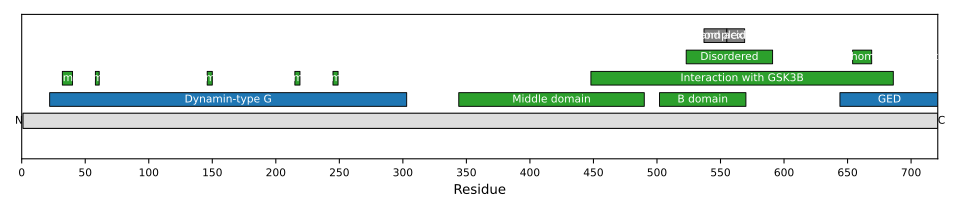
1: Functions in mitochondrial and peroxisomal division (PubMed:11514614, PubMed:12499366, PubMed:17301055, PubMed:17460227, PubMed:17553808, PubMed:18695047, PubMed:18838687, PubMed:19342591, PubMed:19411255, PubMed:19638400, PubMed:23283981, PubMed:23530241, PubMed:23921378, PubMed:26992161, PubMed:27145208, PubMed:27145933, PubMed:27301544, PubMed:27328748, PubMed:29478834, PubMed:32439975, PubMed:32484300, PubMed:9570752, PubMed:9786947). Mediates membrane fission through oligomerization into membrane-associated tubular structures that wrap around the scission site to constrict and sever the mitochondrial membrane through a GTP hydrolysis-dependent mechanism (PubMed:23530241, PubMed:23584531, PubMed:33850055). The specific recruitment at scission sites is mediated by membrane receptors like MFF, MIEF1 and MIEF2 for mitochondrial membranes (PubMed:23283981, PubMed:23921378, PubMed:29899447). While the recruitment by the membrane receptors is GTP-dependent, the following hydrolysis of GTP induces the dissociation from the receptors and allows DNM1L filaments to curl into closed rings that are probably sufficient to sever a double membrane (PubMed:29899447). Acts downstream of PINK1 to promote mitochondrial fission in a PRKN-dependent manner (PubMed:32484300). Plays an important role in mitochondrial fission during mitosis (PubMed:19411255, PubMed:26992161, PubMed:27301544, PubMed:27328748). Through its function in mitochondrial division, ensures the survival of at least some types of postmitotic neurons, including Purkinje cells, by suppressing oxidative damage (By similarity). Required for normal brain development, including that of cerebellum (PubMed:17460227, PubMed:26992161, PubMed:27145208, PubMed:27301544, PubMed:27328748). Facilitates developmentally regulated apoptosis during neural tube formation (By similarity). Required for a normal rate of cytochrome c release and caspase activation during apoptosis; this requirement may depend upon the cell type and the physiological apoptotic cues (By similarity). Required for formation of endocytic vesicles (PubMed:20688057, PubMed:23792689, PubMed:9570752). Proposed to regulate synaptic vesicle membrane dynamics through association with BCL2L1 isoform Bcl-X(L) which stimulates its GTPase activity in synaptic vesicles; the function may require its recruitment by MFF to clathrin-containing vesicles (PubMed:17015472, PubMed:23792689). Required for programmed necrosis execution (PubMed:22265414). Rhythmic control of its activity following phosphorylation at Ser-637 is essential for the circadian control of mitochondrial ATP production (PubMed:29478834)
2: Inhibits peroxisomal division when overexpressed
3: Inhibits peroxisomal division when overexpressed