Nuclear receptor subfamily 5 group A member 2 (Alpha-1-fetoprotein transcription factor) (B1-binding factor) (hB1F) (CYP7A promoter-binding factor) (Hepatocytic transcription factor) (Liver receptor homolog 1) (LRH-1)
1_MSSNS 6_ DTGDL 11_ QESLK 16_ HGLTP 21_ IGAGL 26_ PDRHG 31_ SPIPA 36_ RGRLV 41_ MLPKV 46_ ETEAL 51_ GLARS 56_ HGEQG 61_ QMPEN 66_ MQVSQ 71_ FKMVN 76_ YSYDE 81_ DLEEL 86_ CPVCG 91_ DKVSG 96_ YHYGL 101_ LTCES 106_ CKGFF 111_ KRTVQ 116_ NNKRY 121_ TCIEN 126_ QNCQI 131_ DKTQR 136_ KRCPY 141_ CRFQK 146_ CLSVG 151_ MKLEA 156_ VRADR 161_ MRGGR 166_ NKFGP 171_ MYKRD 176_ RALKQ 181_ QKKAL 186_ IRANG 191_ LKLEA 196_ MSQVI 201_ QAMPS 206_ DLTIS 211_ SAIQN 216_ IHSAS 221_ KGLPL 226_ NHAAL 231_ PPTDY 236_ DRSPF 241_ VTSPI 246_ SMTMP 251_ PHGSL 256_ QGYQT 261_ YGHFP 266_ SRAIK 271_ SEYPD 276_ PYTSS 281_ PESIM 286_ GYSYM 291_ DSYQT 296_ SSPAS 301_ IPHLI 306_ LELLK 311_ CEPDE 316_ PQVQA 321_ KIMAY 326_ LQQEQ 331_ ANRSK 336_ HEKLS 341_ TFGLM 346_ CKMAD 351_ QTLFS 356_ IVEWA 361_ RSSIF 366_ FRELK 371_ VDDQM 376_ KLLQN 381_ CWSEL 386_ LILDH 391_ IYRQV 396_ VHGKE 401_ GSIFL 406_ VTGQQ 411_ VDYSI 416_ IASQA 421_ GATLN 426_ NLMSH 431_ AQELV 436_ AKLRS 441_ LQFDQ 446_ REFVC 451_ LKFLV 456_ LFSLD 461_ VKNLE 466_ NFQLV 471_ EGVQE 476_ QVNAA 481_ LLDYT 486_ MCNYP 491_ QQTEK 496_ FGQLL 501_ LRLPE 506_ IRAIS 511_ MQAEE 516_ YLYYK 521_ HLNGD 526_ VPYNN 531_ LLIEM 536_LHAKR
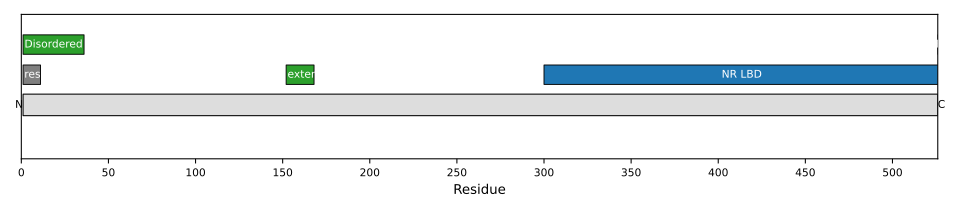
1: Orphan nuclear receptor that binds DNA as a monomer to the 5'-TCAAGGCCA-3' sequence and controls expression of target genes: regulates key biological processes, such as early embryonic development, cholesterol and bile acid synthesis pathways, as well as liver and pancreas morphogenesis (PubMed:16289203, PubMed:18410128, PubMed:21614002, PubMed:32433991, PubMed:38409506, PubMed:9786908). Ligand-binding causes conformational change which causes recruitment of coactivators, promoting target gene activation (PubMed:21614002). The specific ligand is unknown, but specific phospholipids, such as phosphatidylethanolamine, phosphatidylserine, dilauroyl phosphatidylcholine and diundecanoyl phosphatidylcholine can act as ligand in vitro (PubMed:15707893, PubMed:15723037, PubMed:15897460, PubMed:21614002, PubMed:22504882, PubMed:23737522, PubMed:26416531, PubMed:26553876). Acts as a pioneer transcription factor, which unwraps target DNA from histones and elicits local opening of closed chromatin (PubMed:38409506). Plays a central role during preimplantation stages of embryonic development (By similarity). Plays a minor role in zygotic genome activation (ZGA) by regulating a small set of two-cell stage genes (By similarity). Plays a major role in morula development (2-16 cells embryos) by acting as a master regulator at the 8-cell stage, controlling expression of lineage-specifying transcription factors and genes involved in mitosis, telomere maintenance and DNA repair (By similarity). Zygotic NR5A2 binds to both closed and open chromatin with other transcription factors, often at SINE B1/Alu repeats DNA elements, promoting chromatin accessibility at nearby regulatory regions (By similarity). Also involved in the epiblast stage of development and embryonic stem cell pluripotency, by promoting expression of POU5F1/OCT4 (PubMed:27984042). Regulates other processes later in development, such as formation of connective tissue in lower jaw and middle ear, neural stem cell differentiation, ovarian follicle development and Sertoli cell differentiation (By similarity). Involved in exocrine pancreas development and acinar cell differentiation (By similarity). Acts as an essential transcriptional regulator of lipid metabolism (PubMed:20159957). Key regulator of cholesterol 7-alpha-hydroxylase gene (CYP7A) expression in liver (PubMed:10359768). Also acts as a negative regulator of inflammation in different organs, such as, liver and pancreas (PubMed:20159957). Protects against intestinal inflammation via its ability to regulate glucocorticoid production (By similarity). Plays an anti-inflammatory role during the hepatic acute phase response by acting as a corepressor: inhibits the hepatic acute phase response by preventing dissociation of the N-Cor corepressor complex (PubMed:20159957). Acts as a regulator of immunity by promoting lymphocyte T-cell development, proliferation and effector functions (By similarity). Also involved in resolution of endoplasmic reticulum stress in the liver (By similarity)
2: In constrast to isoform 1 and isoform 2, does not induce cholesterol 7-alpha-hydroxylase gene (CYP7A) promoter activity
3: (Microbial infection) Plays a crucial role for hepatitis B virus gene transcription and DNA replication. Mechanistically, synergistically cooperates with HNF1A to up-regulate the activity of one of the critical cis-elements in the hepatitis B virus genome enhancer II (ENII)