Delta-like protein 1 (Drosophila Delta homolog 1) (Delta1) (H-Delta-1)
1_MGSRC 6_ ALALA 11_ VLSAL 16_ LCQVW 21_ SSGVF 26_ ELKLQ 31_ EFVNK 36_ KGLLG 41_ NRNCC 46_ RGGAG 51_ PPPCA 56_ CRTFF 61_ RVCLK 66_ HYQAS 71_ VSPEP 76_ PCTYG 81_ SAVTP 86_ VLGVD 91_ SFSLP 96_ DGGGA 101_ DSAFS 106_ NPIRF 111_ PFGFT 116_ WPGTF 121_ SLIIE 126_ ALHTD 131_ SPDDL 136_ ATENP 141_ ERLIS 146_ RLATQ 151_ RHLTV 156_ GEEWS 161_ QDLHS 166_ SGRTD 171_ LKYSY 176_ RFVCD 181_ EHYYG 186_ EGCSV 191_ FCRPR 196_ DDAFG 201_ HFTCG 206_ ERGEK 211_ VCNPG 216_ WKGPY 221_ CTEPI 226_ CLPGC 231_ DEQHG 236_ FCDKP 241_ GECKC 246_ RVGWQ 251_ GRYCD 256_ ECIRY 261_ PGCLH 266_ GTCQQ 271_ PWQCN 276_ CQEGW 281_ GGLFC 286_ NQDLN 291_ YCTHH 296_ KPCKN 301_ GATCT 306_ NTGQG 311_ SYTCS 316_ CRPGY 321_ TGATC 326_ ELGID 331_ ECDPS 336_ PCKNG 341_ GSCTD 346_ LENSY 351_ SCTCP 356_ PGFYG 361_ KICEL 366_ SAMTC 371_ ADGPC 376_ FNGGR 381_ CSDSP 386_ DGGYS 391_ CRCPV 396_ GYSGF 401_ NCEKK 406_ IDYCS 411_ SSPCS 416_ NGAKC 421_ VDLGD 426_ AYLCR 431_ CQAGF 436_ SGRHC 441_ DDNVD 446_ DCASS 451_ PCANG 456_ GTCRD 461_ GVNDF 466_ SCTCP 471_ PGYTG 476_ RNCSA 481_ PVSRC 486_ EHAPC 491_ HNGAT 496_ CHERG 501_ HRYVC 506_ ECARG 511_ YGGPN 516_ CQFLL 521_ PELPP 526_ GPAVV 531_ DLTEK 536_ LEGQG 541_ GPFPW 546_ VAVCA 551_ GVILV 556_ LMLLL 561_ GCAAV 566_ VVCVR 571_ LRLQK 576_ HRPPA 581_ DPCRG 586_ ETETM 591_ NNLAN 596_ CQREK 601_ DISVS 606_ IIGAT 611_ QIKNT 616_ NKKAD 621_ FHGDH 626_ SADKN 631_ GFKAR 636_ YPAVD 641_ YNLVQ 646_ DLKGD 651_ DTAVR 656_ DAHSK 661_ RDTKC 666_ QPQGS 671_ SGEEK 676_ GTPTT 681_ LRGGE 686_ ASERK 691_ RPDSG 696_ CSTSK 701_ DTKYQ 706_ SVYVI 711_ SEEKD 716_ECVIA
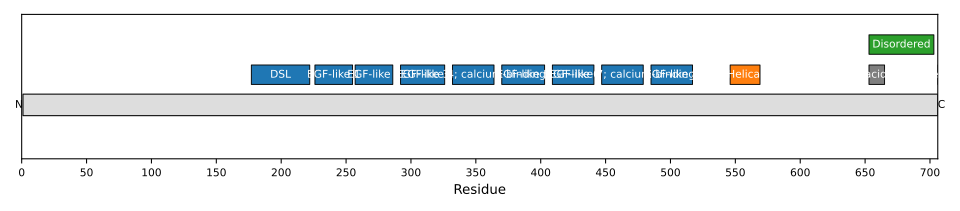
1: Transmembrane ligand protein of NOTCH1, NOTCH2 and NOTCH3 receptors that binds the extracellular domain (ECD) of Notch receptor in a cis and trans fashion manner (PubMed:11006133). Following transinteraction, ligand cells produce mechanical force that depends of a clathrin-mediated endocytosis, requiring ligand ubiquitination, EPN1 interaction, and actin polymerisation; these events promote Notch receptor extracellular domain (NECD) transendocytosis and triggers Notch signaling through induction of cleavage, hyperphosphorylation, and nuclear accumulation of the intracellular domain of Notch receptors (NICD) (By similarity). Is required for embryonic development and maintenance of adult stem cells in many different tissues and immune systeme; the DLL1-induced Notch signaling is mediated through an intercellular communication that regulates cell lineage, cell specification, cell patterning and morphogenesis through effects on differentiation and proliferation (PubMed:11581320). Plays a role in brain development at different level, namely by regulating neuronal differentiation of neural precursor cells via cell-cell interaction, most likely through the lateral inhibitory system in an endogenous level dependent-manner. During neocortex development, Dll1-Notch signaling transmission is mediated by dynamic interactions between intermediate neurogenic progenitors and radial glia; the cell-cell interactions are mediated via dynamic and transient elongation processes, likely to reactivate/maintain Notch activity in neighboring progenitors, and coordinate progenitor cell division and differentiation across radial and zonal boundaries. During cerebellar development, regulates Bergmann glial monolayer formation and its morphological maturation through a Notch signaling pathway. At the retina and spinal cord level, regulates neurogenesis by preventing the premature differentiation of neural progenitors and also by maintaining progenitors in spinal cord through Notch signaling pathway. Also controls neurogenesis of the neural tube in a progenitor domain-specific fashion along the dorsoventral axis. Maintains quiescence of neural stem cells and plays a role as a fate determinant that segregates asymmetrically to one daughter cell during neural stem cells mitosis, resulting in neuronal differentiation in Dll1-inheriting cell. Plays a role in immune systeme development, namely the development of all T-cells and marginal zone (MZ) B-cells (By similarity). Blocks the differentiation of progenitor cells into the B-cell lineage while promoting the emergence of a population of cells with the characteristics of a T-cell/NK-cell precursor (PubMed:11581320). Also plays a role during muscle development. During early development, inhibits myoblasts differentiation from the medial dermomyotomal lip and later regulates progenitor cell differentiation. Directly modulates cell adhesion and basal lamina formation in satellite cells through Notch signaling. Maintains myogenic progenitors pool by suppressing differentiation through down-regulation of MYOD1 and is required for satellite cell homing and PAX7 expression. During craniofacial and trunk myogenesis suppresses differentiation of cranial mesoderm-derived and somite-derived muscle via MYOD1 regulation but in cranial mesoderm-derived progenitors, is neither required for satellite cell homing nor for PAX7 expression. Also plays a role during pancreatic cell development. During type B pancreatic cell development, may be involved in the initiation of proximodistal patterning in the early pancreatic epithelium. Stimulates multipotent pancreatic progenitor cells proliferation and pancreatic growth by maintaining HES1 expression and PTF1A protein levels. During fetal stages of development, is required to maintain arterial identity and the responsiveness of arterial endothelial cells for VEGFA through regulation of KDR activation and NRP1 expression. Controls sprouting angiogenesis and subsequent vertical branch formation through regulation on tip cell differentiation. Negatively regulates goblet cell differentiation in intestine and controls secretory fat commitment through lateral inhibition in small intestine. Plays a role during inner ear development; negatively regulates auditory hair cell differentiation. Plays a role during nephron development through Notch signaling pathway. Regulates growth, blood pressure and energy homeostasis (By similarity)