ATP-dependent RNA helicase DDX3X (EC 3.6.4.13) (CAP-Rf) (DEAD box protein 3, X-chromosomal) (DEAD box, X isoform) (DBX) (Helicase-like protein 2) (HLP2)
1_MSHVA 6_ VENAL 11_ GLDQQ 16_ FAGLD 21_ LNSSD 26_ NQSGG 31_ STASK 36_ GRYIP 41_ PHLRN 46_ REATK 51_ GFYDK 56_ DSSGW 61_ SSSKD 66_ KDAYS 71_ SFGSR 76_ SDSRG 81_ KSSFF 86_ SDRGS 91_ GSRGR 96_ FDDRG 101_ RSDYD 106_ GIGSR 111_ GDRSG 116_ FGKFE 121_ RGGNS 126_ RWCDK 131_ SDEDD 136_ WSKPL 141_ PPSER 146_ LEQEL 151_ FSGGN 156_ TGINF 161_ EKYDD 166_ IPVEA 171_ TGNNC 176_ PPHIE 181_ SFSDV 186_ EMGEI 191_ IMGNI 196_ ELTRY 201_ TRPTP 206_ VQKHA 211_ IPIIK 216_ EKRDL 221_ MACAQ 226_ TGSGK 231_ TAAFL 236_ LPILS 241_ QIYSD 246_ GPGEA 251_ LRAMK 256_ ENGRY 261_ GRRKQ 266_ YPISL 271_ VLAPT 276_ RELAV 281_ QIYEE 286_ ARKFS 291_ YRSRV 296_ RPCVV 301_ YGGAD 306_ IGQQI 311_ RDLER 316_ GCHLL 321_ VATPG 326_ RLVDM 331_ MERGK 336_ IGLDF 341_ CKYLV 346_ LDEAD 351_ RMLDM 356_ GFEPQ 361_ IRRIV 366_ EQDTM 371_ PPKGV 376_ RHTMM 381_ FSATF 386_ PKEIQ 391_ MLARD 396_ FLDEY 401_ IFLAV 406_ GRVGS 411_ TSENI 416_ TQKVV 421_ WVEES 426_ DKRSF 431_ LLDLL 436_ NATGK 441_ DSLTL 446_ VFVET 451_ KKGAD 456_ SLEDF 461_ LYHEG 466_ YACTS 471_ IHGDR 476_ SQRDR 481_ EEALH 486_ QFRSG 491_ KSPIL 496_ VATAV 501_ AARGL 506_ DISNV 511_ KHVIN 516_ FDLPS 521_ DIEEY 526_ VHRIG 531_ RTGRV 536_ GNLGL 541_ ATSFF 546_ NERNI 551_ NITKD 556_ LLDLL 561_ VEAKQ 566_ EVPSW 571_ LENMA 576_ YEHHY 581_ KGSSR 586_ GRSKS 591_ SRFSG 596_ GFGAR 601_ DYRQS 606_ SGASS 611_ SSFSS 616_ SRASS 621_ SRSGG 626_ GGHGS 631_ SRGFG 636_ GGGYG 641_ GFYNS 646_ DGYGG 651_ NYNSQ 656_GVDWW
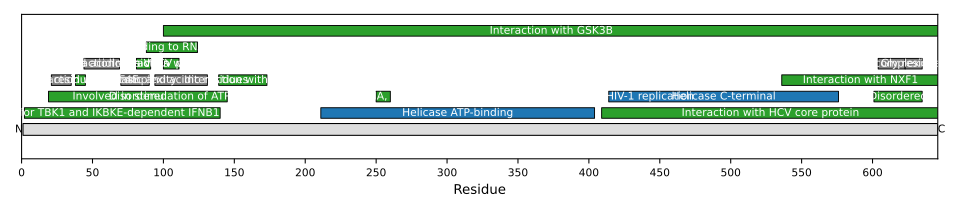
1: Multifunctional ATP-dependent RNA helicase (PubMed:17357160, PubMed:21589879, PubMed:31575075). The ATPase activity can be stimulated by various ribo-and deoxynucleic acids indicative for a relaxed substrate specificity (PubMed:29222110). In vitro can unwind partially double-stranded DNA with a preference for 5'-single-stranded DNA overhangs (PubMed:17357160, PubMed:21589879). Binds RNA G-quadruplex (rG4s) structures, including those located in the 5'-UTR of NRAS mRNA (PubMed:30256975). Involved in many cellular processes, which do not necessarily require its ATPase/helicase catalytic activities (Probable). Involved in transcription regulation (PubMed:16818630, PubMed:18264132). Positively regulates CDKN1A/WAF1/CIP1 transcription in an SP1-dependent manner, hence inhibits cell growth. This function requires its ATPase, but not helicase activity (PubMed:16818630, PubMed:18264132). CDKN1A up-regulation may be cell-type specific (PubMed:18264132). Binds CDH1/E-cadherin promoter and represses its transcription (PubMed:18264132). Potentiates HNF4A-mediated MTTP transcriptional activation; this function requires ATPase, but not helicase activity. Facilitates HNF4A acetylation, possibly catalyzed by CREBBP/EP300, thereby increasing the DNA-binding affinity of HNF4 to its response element. In addition, disrupts the interaction between HNF4 and SHP that forms inactive heterodimers and enhances the formation of active HNF4 homodimers. By promoting HNF4A-induced MTTP expression, may play a role in lipid homeostasis (PubMed:28128295). May positively regulate TP53 transcription (PubMed:28842590). Associates with mRNPs, predominantly with spliced mRNAs carrying an exon junction complex (EJC) (PubMed:17095540, PubMed:18596238). Involved in the regulation of translation initiation (PubMed:17667941, PubMed:18628297, PubMed:22872150). Not involved in the general process of translation, but promotes efficient translation of selected complex mRNAs, containing highly structured 5'-untranslated regions (UTR) (PubMed:20837705, PubMed:22872150). This function depends on helicase activity (PubMed:20837705, PubMed:22872150). Might facilitate translation by resolving secondary structures of 5'-UTRs during ribosome scanning (PubMed:20837705). Alternatively, may act prior to 43S ribosomal scanning and promote 43S pre-initiation complex entry to mRNAs exhibiting specific RNA motifs, by performing local remodeling of transcript structures located close to the cap moiety (PubMed:22872150). Independently of its ATPase activity, promotes the assembly of functional 80S ribosomes and disassembles from ribosomes prior to the translation elongation process (PubMed:22323517). Positively regulates the translation of cyclin E1/CCNE1 mRNA and consequently promotes G1/S-phase transition during the cell cycle (PubMed:20837705). May activate TP53 translation (PubMed:28842590). Required for endoplasmic reticulum stress-induced ATF4 mRNA translation (PubMed:29062139). Independently of its ATPase/helicase activity, enhances IRES-mediated translation; this activity requires interaction with EIF4E (PubMed:17667941, PubMed:22323517). Independently of its ATPase/helicase activity, has also been shown specifically repress cap-dependent translation, possibly by acting on translation initiation factor EIF4E (PubMed:17667941). Involved in innate immunity, acting as a viral RNA sensor. Binds viral RNAs and promotes the production of type I interferon (IFN-alpha and IFN-beta) (PubMed:20127681, PubMed:21170385, PubMed:31575075). Potentiate MAVS/RIGI-mediated induction of IFNB in early stages of infection (PubMed:20127681, PubMed:21170385, PubMed:33674311). Enhances IFNB1 expression via IRF3/IRF7 pathway and participates in NFKB activation in the presence of MAVS and TBK1 (PubMed:18583960, PubMed:18636090, PubMed:19913487, PubMed:21170385, PubMed:27980081). Involved in TBK1 and IKBKE-dependent IRF3 activation leading to IFNB induction, acts as a scaffolding adapter that links IKBKE and IRF3 and coordinates their activation (PubMed:23478265). Involved in the TLR7/TLR8 signaling pathway leading to type I interferon induction, including IFNA4 production. In this context, acts as an upstream regulator of IRF7 activation by MAP3K14/NIK and CHUK/IKKA. Stimulates CHUK autophosphorylation and activation following physiological activation of the TLR7 and TLR8 pathways, leading to MAP3K14/CHUK-mediated activatory phosphorylation of IRF7 (PubMed:30341167). Also stimulates MAP3K14/CHUK-dependent NF-kappa-B signaling (PubMed:30341167). Negatively regulates TNF-induced IL6 and IL8 expression, via the NF-kappa-B pathway. May act by interacting with RELA/p65 and trapping it in the cytoplasm (PubMed:27736973). May also bind IFNB promoter; the function is independent of IRF3 (PubMed:18583960). Involved in both stress and inflammatory responses (By similarity). Independently of its ATPase/helicase activity, required for efficient stress granule assembly through its interaction with EIF4E, hence promotes survival in stressed cells (PubMed:21883093). Independently of its helicase activity, regulates NLRP3 inflammasome assembly through interaction with NLRP3 and hence promotes cell death by pyroptosis during inflammation. This function is independent of helicase activity (By similarity). Therefore DDX3X availability may be used to interpret stress signals and choose between pro-survival stress granules and pyroptotic NLRP3 inflammasomes and serve as a live-or-die checkpoint in stressed cells (By similarity). In association with GSK3A/B, negatively regulates extrinsic apoptotic signaling pathway via death domain receptors, including TNFRSF10B, slowing down the rate of CASP3 activation following death receptor stimulation (PubMed:18846110). Cleavage by caspases may inactivate DDX3X and relieve the inhibition (PubMed:18846110). Independently of its ATPase/helicase activity, allosteric activator of CSNK1E. Stimulates CSNK1E-mediated phosphorylation of DVL2, thereby involved in the positive regulation of Wnt/beta-catenin signaling pathway. Also activates CSNK1A1 and CSNK1D in vitro, but it is uncertain if these targets are physiologically relevant (PubMed:23413191, PubMed:29222110). ATPase and casein kinase-activating functions are mutually exclusive (PubMed:29222110). May be involved in mitotic chromosome segregation (PubMed:21730191)
2: (Microbial infection) Facilitates hepatitis C virus (HCV) replication (PubMed:29899501). During infection, HCV core protein inhibits the interaction between MAVS and DDX3X and therefore impairs MAVS-dependent INFB induction and might recruit DDX3X to HCV replication complex (PubMed:21170385)
3: (Microbial infection) Facilitates HIV-1 replication (PubMed:15507209, PubMed:18583960, PubMed:21589879, PubMed:22872150, PubMed:29899501). Acts as a cofactor for XPO1-mediated nuclear export of HIV-1 Rev RNAs (PubMed:15507209, PubMed:18583960, PubMed:29899501). This function is strongly stimulated in the presence of TBK1 and requires DDX3X ATPase activity (PubMed:18583960)
4: (Microbial infection) Facilitates Zika virus (ZIKV) replication
5: (Microbial infection) Facilitates Dengue virus (DENV) replication
6: (Microbial infection) Facilitates Venezuelan equine encephalitis virus (VEEV) replication