Atypical chemokine receptor 2 (C-C chemokine receptor D6) (Chemokine receptor CCR-10) (Chemokine receptor CCR-9) (Chemokine-binding protein 2) (Chemokine-binding protein D6)
1_MAATA 6_ SPQPL 11_ ATEDA 16_ DSENS 21_ SFYYY 26_ DYLDE 31_ VAFML 36_ CRKDA 41_ VVSFG 46_ KVFLP 51_ VFYSL 56_ IFVLG 61_ LSGNL 66_ LLLMV 71_ LLRYV 76_ PRRRM 81_ VEIYL 86_ LNLAI 91_ SNLLF 96_ LVTLP 101_ FWGIS 106_ VAWHW 111_ VFGSF 116_ LCKMV 121_ STLYT 126_ INFYS 131_ GIFFI 136_ SCMSL 141_ DKYLE 146_ IVHAQ 151_ PYHRL 156_ RTRAK 161_ SLLLA 166_ TIVWA 171_ VSLAV 176_ SIPDM 181_ VFVQT 186_ HENPK 191_ GVWNC 196_ HADFG 201_ GHGTI 206_ WKLFL 211_ RFQQN 216_ LLGFL 221_ LPLLA 226_ MIFFY 231_ SRIGC 236_ VLVRL 241_ RPAGQ 246_ GRALK 251_ IAAAL 256_ VVAFF 261_ VLWFP 266_ YNLTL 271_ FLHTL 276_ LDLQV 281_ FGNCE 286_ VSQHL 291_ DYALQ 296_ VTESI 301_ AFLHC 306_ CFSPI 311_ LYAFS 316_ SHRFR 321_ QYLKA 326_ FLAAV 331_ LGWHL 336_ APGTA 341_ QASLS 346_ SCSES 351_ SILTA 356_ QEEMT 361_ GMNDL 366_ GERQS 371_ ENYPN 376_KEDVG
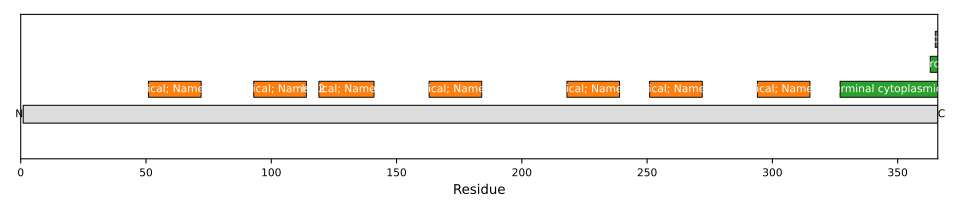
1: Atypical chemokine receptor that controls chemokine levels and localization via high-affinity chemokine binding that is uncoupled from classic ligand-driven signal transduction cascades, resulting instead in chemokine sequestration, degradation, or transcytosis. Also known as interceptor (internalizing receptor) or chemokine-scavenging receptor or chemokine decoy receptor. Acts as a receptor for chemokines including CCL2, CCL3, CCL3L1, CCL4, CCL5, CCL7, CCL8, CCL11, CCL13, CCL17, CCL22, CCL23, CCL24, SCYA2/MCP-1, SCY3/MIP-1-alpha, SCYA5/RANTES and SCYA7/MCP-3. Upon active ligand stimulation, activates a beta-arrestin 1 (ARRB1)-dependent, G protein-independent signaling pathway that results in the phosphorylation of the actin-binding protein cofilin (CFL1) through a RAC1-PAK1-LIMK1 signaling pathway. Activation of this pathway results in up-regulation of ACKR2 from endosomal compartment to cell membrane, increasing its efficiency in chemokine uptake and degradation. By scavenging chemokines in tissues, on the surfaces of lymphatic vessels, and in placenta, plays an essential role in the resolution (termination) of the inflammatory response and in the regulation of adaptive immune responses. Plays a major role in the immune silencing of macrophages during the resolution of inflammation. Acts as a regulator of inflammatory leukocyte interactions with lymphatic endothelial cells (LECs) and is required for immature/mature dendritic cells discrimination by LECs