Phospholipid phosphatase 3 (EC 3.1.3.-) (EC 3.1.3.4) (Lipid phosphate phosphohydrolase 3) (PAP2-beta) (Phosphatidate phosphohydrolase type 2b) (Phosphatidic acid phosphatase 2b) (PAP-2b) (PAP2b) (Vascular endothelial growth factor and type I collagen-inducible protein) (VCIP)
1_MQNYK 6_ YDKAI 11_ VPESK 16_ NGGSP 21_ ALNNN 26_ PRRSG 31_ SKRVL 36_ LICLD 41_ LFCLF 46_ MAGLP 51_ FLIIE 56_ TSTIK 61_ PYHRG 66_ FYCND 71_ ESIKY 76_ PLKTG 81_ ETIND 86_ AVLCA 91_ VGIVI 96_ AILAI 101_ ITGEF 106_ YRIYY 111_ LKKSR 116_ STIQN 121_ PYVAA 126_ LYKQV 131_ GCFLF 136_ GCAIS 141_ QSFTD 146_ IAKVS 151_ IGRLR 156_ PHFLS 161_ VCNPD 166_ FSQIN 171_ CSEGY 176_ IQNYR 181_ CRGDD 186_ SKVQE 191_ ARKSF 196_ FSGHA 201_ SFSMY 206_ TMLYL 211_ VLYLQ 216_ ARFTW 221_ RGARL 226_ LRPLL 231_ QFTLI 236_ MMAFY 241_ TGLSR 246_ VSDHK 251_ HHPSD 256_ VLAGF 261_ AQGAL 266_ VACCI 271_ VFFVS 276_ DLFKT 281_ KTTLS 286_ LPAPA 291_ IRKEI 296_ LSPVD 301_ IIDRN 306_NHHNM
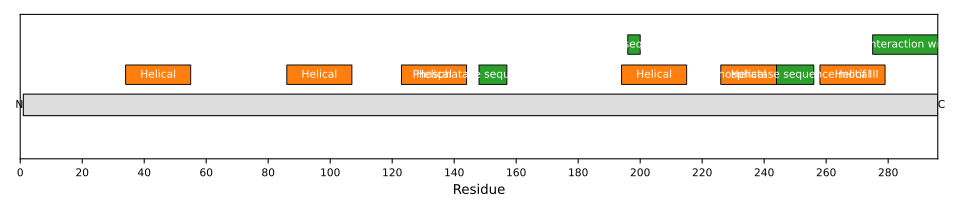
1: Magnesium-independent phospholipid phosphatase of the plasma membrane that catalyzes the dephosphorylation of a variety of glycerolipid and sphingolipid phosphate esters including phosphatidate/PA, lysophosphatidate/LPA, diacylglycerol pyrophosphate/DGPP, sphingosine 1-phosphate/S1P and ceramide 1-phosphate/C1P (PubMed:27694435, PubMed:9607309, PubMed:9705349). Also acts on N-oleoyl ethanolamine phosphate/N-(9Z-octadecenoyl)-ethanolamine phosphate, a potential physiological compound (PubMed:9607309). Has both an extracellular and an intracellular phosphatase activity, allowing the hydrolysis and the cellular uptake of these bioactive lipid mediators from the milieu, regulating signal transduction in different cellular processes (PubMed:23591818, PubMed:27694435, PubMed:9607309). Through the dephosphorylation of extracellular sphingosine-1-phosphate and the regulation of its extra- and intracellular availability, plays a role in vascular homeostasis, regulating endothelial cell migration, adhesion, survival, proliferation and the production of pro-inflammatory cytokines (PubMed:27694435). By maintaining the appropriate levels of this lipid in the cerebellum, also ensure its proper development and function (By similarity). Through its intracellular lipid phosphatase activity may act in early compartments of the secretory pathway, regulating the formation of Golgi to endoplasmic reticulum retrograde transport carriers (PubMed:23591818)
2: Independently of this phosphatase activity may also function in the Wnt signaling pathway and the stabilization of beta-catenin/CTNNB1, thereby regulating cell proliferation, migration and differentiation in angiogenesis or yet in tumor growth (PubMed:20123964, PubMed:21569306). Also plays a role in integrin-mediated cell-cell adhesion in angiogenesis (PubMed:12660161, PubMed:16099422)