Serine/threonine-protein kinase Chk1 (EC 2.7.11.1) (CHK1 checkpoint homolog) (Cell cycle checkpoint kinase) (Checkpoint kinase-1)
1_MAVPF 6_ VEDWD 11_ LVQTL 16_ GEGAY 21_ GEVQL 26_ AVNRV 31_ TEEAV 36_ AVKIV 41_ DMKRA 46_ VDCPE 51_ NIKKE 56_ ICINK 61_ MLNHE 66_ NVVKF 71_ YGHRR 76_ EGNIQ 81_ YLFLE 86_ YCSGG 91_ ELFDR 96_ IEPDI 101_ GMPEP 106_ DAQRF 111_ FHQLM 116_ AGVVY 121_ LHGIG 126_ ITHRD 131_ IKPEN 136_ LLLDE 141_ RDNLK 146_ ISDFG 151_ LATVF 156_ RYNNR 161_ ERLLN 166_ KMCGT 171_ LPYVA 176_ PELLK 181_ RREFH 186_ AEPVD 191_ VWSCG 196_ IVLTA 201_ MLAGE 206_ LPWDQ 211_ PSDSC 216_ QEYSD 221_ WKEKK 226_ TYLNP 231_ WKKID 236_ SAPLA 241_ LLHKI 246_ LVENP 251_ SARIT 256_ IPDIK 261_ KDRWY 266_ NKPLK 271_ KGAKR 276_ PRVTS 281_ GGVSE 286_ SPSGF 291_ SKHIQ 296_ SNLDF 301_ SPVNS 306_ ASSEE 311_ NVKYS 316_ SSQPE 321_ PRTGL 326_ SLWDT 331_ SPSYI 336_ DKLVQ 341_ GISFS 346_ QPTCP 351_ DHMLL 356_ NSQLL 361_ GTPGS 366_ SQNPW 371_ QRLVK 376_ RMTRF 381_ FTKLD 386_ ADKSY 391_ QCLKE 396_ TCEKL 401_ GYQWK 406_ KSCMN 411_ QVTIS 416_ TTDRR 421_ NNKLI 426_ FKVNL 431_ LEMDD 436_ KILVD 441_ FRLSK 446_ GDGLE 451_ FKRHF 456_ LKIKG 461_ KLIDI 466_ VSSQK 471_IWLPA
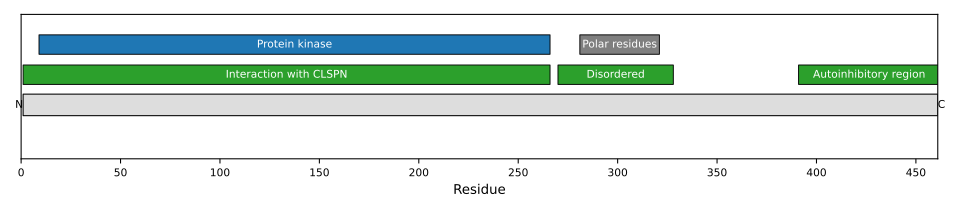
1: Serine/threonine-protein kinase which is required for checkpoint-mediated cell cycle arrest and activation of DNA repair in response to the presence of DNA damage or unreplicated DNA (PubMed:11535615, PubMed:12399544, PubMed:12446774, PubMed:14559997, PubMed:14988723, PubMed:15311285, PubMed:15650047, PubMed:15665856, PubMed:32357935). May also negatively regulate cell cycle progression during unperturbed cell cycles (PubMed:11535615, PubMed:12399544, PubMed:12446774, PubMed:14559997, PubMed:14988723, PubMed:15311285, PubMed:15650047, PubMed:15665856). This regulation is achieved by a number of mechanisms that together help to preserve the integrity of the genome (PubMed:11535615, PubMed:12399544, PubMed:12446774, PubMed:14559997, PubMed:14988723, PubMed:15311285, PubMed:15650047, PubMed:15665856). Recognizes the substrate consensus sequence [R-X-X-S/T] (PubMed:11535615, PubMed:12399544, PubMed:12446774, PubMed:14559997, PubMed:14988723, PubMed:15311285, PubMed:15650047, PubMed:15665856). Binds to and phosphorylates CDC25A, CDC25B and CDC25C (PubMed:12676583, PubMed:12676925, PubMed:12759351, PubMed:14559997, PubMed:14681206, PubMed:19734889, PubMed:9278511). Phosphorylation of CDC25A at 'Ser-178' and 'Thr-507' and phosphorylation of CDC25C at 'Ser-216' creates binding sites for 14-3-3 proteins which inhibit CDC25A and CDC25C (PubMed:9278511). Phosphorylation of CDC25A at 'Ser-76', 'Ser-124', 'Ser-178', 'Ser-279' and 'Ser-293' promotes proteolysis of CDC25A (PubMed:12676583, PubMed:12676925, PubMed:12759351, PubMed:14681206, PubMed:19734889, PubMed:9278511). Phosphorylation of CDC25A at 'Ser-76' primes the protein for subsequent phosphorylation at 'Ser-79', 'Ser-82' and 'Ser-88' by NEK11, which is required for polyubiquitination and degradation of CDCD25A (PubMed:19734889, PubMed:20090422, PubMed:9278511). Inhibition of CDC25 leads to increased inhibitory tyrosine phosphorylation of CDK-cyclin complexes and blocks cell cycle progression (PubMed:9278511). Also phosphorylates NEK6 (PubMed:18728393). Binds to and phosphorylates RAD51 at 'Thr-309', which promotes the release of RAD51 from BRCA2 and enhances the association of RAD51 with chromatin, thereby promoting DNA repair by homologous recombination (PubMed:15665856). Phosphorylates multiple sites within the C-terminus of TP53, which promotes activation of TP53 by acetylation and promotes cell cycle arrest and suppression of cellular proliferation (PubMed:10673501, PubMed:15659650, PubMed:16511572). Also promotes repair of DNA cross-links through phosphorylation of FANCE (PubMed:17296736). Binds to and phosphorylates TLK1 at 'Ser-743', which prevents the TLK1-dependent phosphorylation of the chromatin assembly factor ASF1A (PubMed:12660173, PubMed:12955071). This may enhance chromatin assembly both in the presence or absence of DNA damage (PubMed:12660173, PubMed:12955071). May also play a role in replication fork maintenance through regulation of PCNA (PubMed:18451105). May regulate the transcription of genes that regulate cell-cycle progression through the phosphorylation of histones (By similarity). Phosphorylates histone H3.1 (to form H3T11ph), which leads to epigenetic inhibition of a subset of genes (By similarity). May also phosphorylate RB1 to promote its interaction with the E2F family of transcription factors and subsequent cell cycle arrest (PubMed:17380128). Phosphorylates SPRTN, promoting SPRTN recruitment to chromatin (PubMed:31316063). Reduces replication stress and activates the G2/M checkpoint, by phosphorylating and inactivating PABIR1/FAM122A and promoting the serine/threonine-protein phosphatase 2A-mediated dephosphorylation and stabilization of WEE1 levels and activity (PubMed:33108758)
2: Endogenous repressor of isoform 1, interacts with, and antagonizes CHK1 to promote the S to G2/M phase transition