Inhibitor of nuclear factor kappa-B kinase subunit beta (I-kappa-B-kinase beta) (IKK-B) (IKK-beta) (IkBKB) (EC 2.7.11.10) (I-kappa-B kinase 2) (IKK2) (Nuclear factor NF-kappa-B inhibitor kinase beta) (NFKBIKB) (Serine/threonine protein kinase IKBKB) (EC 2.7.11.1)
1_MSWSP 6_ SLTTQ 11_ TCGAW 16_ EMKER 21_ LGTGG 26_ FGNVI 31_ RWHNQ 36_ ETGEQ 41_ IAIKQ 46_ CRQEL 51_ SPRNR 56_ ERWCL 61_ EIQIM 66_ RRLTH 71_ PNVVA 76_ ARDVP 81_ EGMQN 86_ LAPND 91_ LPLLA 96_ MEYCQ 101_ GGDLR 106_ KYLNQ 111_ FENCC 116_ GLREG 121_ AILTL 126_ LSDIA 131_ SALRY 136_ LHENR 141_ IIHRD 146_ LKPEN 151_ IVLQQ 156_ GEQRL 161_ IHKII 166_ DLGYA 171_ KELDQ 176_ GSLCT 181_ SFVGT 186_ LQYLA 191_ PELLE 196_ QQKYT 201_ VTVDY 206_ WSFGT 211_ LAFEC 216_ ITGFR 221_ PFLPN 226_ WQPVQ 231_ WHSKV 236_ RQKSE 241_ VDIVV 246_ SEDLN 251_ GTVKF 256_ SSSLP 261_ YPNNL 266_ NSVLA 271_ ERLEK 276_ WLQLM 281_ LMWHP 286_ RQRGT 291_ DPTYG 296_ PNGCF 301_ KALDD 306_ ILNLK 311_ LVHIL 316_ NMVTG 321_ TIHTY 326_ PVTED 331_ ESLQS 336_ LKARI 341_ QQDTG 346_ IPEED 351_ QELLQ 356_ EAGLA 361_ LIPDK 366_ PATQC 371_ ISDGK 376_ LNEGH 381_ TLDMD 386_ LVFLF 391_ DNSKI 396_ TYETQ 401_ ISPRP 406_ QPESV 411_ SCILQ 416_ EPKRN 421_ LAFFQ 426_ LRKVW 431_ GQVWH 436_ SIQTL 441_ KEDCN 446_ RLQQG 451_ QRAAM 456_ MNLLR 461_ NNSCL 466_ SKMKN 471_ SMASM 476_ SQQLK 481_ AKLDF 486_ FKTSI 491_ QIDLE 496_ KYSEQ 501_ TEFGI 506_ TSDKL 511_ LLAWR 516_ EMEQA 521_ VELCG 526_ RENEV 531_ KLLVE 536_ RMMAL 541_ QTDIV 546_ DLQRS 551_ PMGRK 556_ QGGTL 561_ DDLEE 566_ QAREL 571_ YRRLR 576_ EKPRD 581_ QRTEG 586_ DSQEM 591_ VRLLL 596_ QAIQS 601_ FEKKV 606_ RVIYT 611_ QLSKT 616_ VVCKQ 621_ KALEL 626_ LPKVE 631_ EVVSL 636_ MNEDE 641_ KTVVR 646_ LQEKR 651_ QKELW 656_ NLLKI 661_ ACSKV 666_ RGPVS 671_ GSPDS 676_ MNASR 681_ LSQPG 686_ QLMSQ 691_ PSTAS 696_ NSLPE 701_ PAKKS 706_ EELVA 711_ EAHNL 716_ CTLLE 721_ NAIQD 726_ TVREQ 731_ DQSFT 736_ ALDWS 741_ WLQTE 746_ EEEHS 751_CLEQA
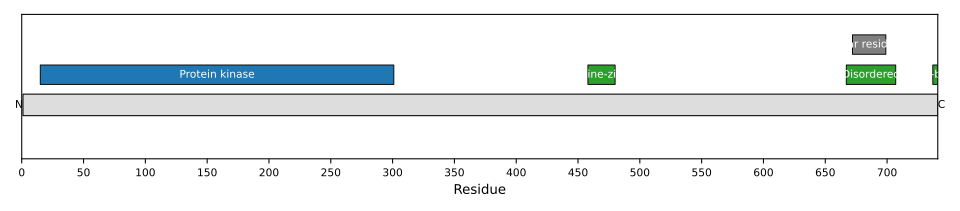
1: Serine kinase that plays an essential role in the NF-kappa-B signaling pathway which is activated by multiple stimuli such as inflammatory cytokines, bacterial or viral products, DNA damages or other cellular stresses (PubMed:20434986, PubMed:20797629, PubMed:21138416, PubMed:30337470, PubMed:9346484). Acts as a part of the canonical IKK complex in the conventional pathway of NF-kappa-B activation (PubMed:9346484). Phosphorylates inhibitors of NF-kappa-B on 2 critical serine residues (PubMed:20434986, PubMed:20797629, PubMed:21138416, PubMed:9346484). These modifications allow polyubiquitination of the inhibitors and subsequent degradation by the proteasome (PubMed:20434986, PubMed:20797629, PubMed:21138416, PubMed:9346484). In turn, free NF-kappa-B is translocated into the nucleus and activates the transcription of hundreds of genes involved in immune response, growth control, or protection against apoptosis (PubMed:20434986, PubMed:20797629, PubMed:21138416, PubMed:9346484). In addition to the NF-kappa-B inhibitors, phosphorylates several other components of the signaling pathway including NEMO/IKBKG, NF-kappa-B subunits RELA and NFKB1, as well as IKK-related kinases TBK1 and IKBKE (PubMed:11297557, PubMed:14673179, PubMed:20410276, PubMed:21138416). IKK-related kinase phosphorylations may prevent the overproduction of inflammatory mediators since they exert a negative regulation on canonical IKKs (PubMed:11297557, PubMed:20410276, PubMed:21138416). Phosphorylates FOXO3, mediating the TNF-dependent inactivation of this pro-apoptotic transcription factor (PubMed:15084260). Also phosphorylates other substrates including NAA10, NCOA3, BCL10 and IRS1 (PubMed:17213322, PubMed:19716809). Phosphorylates RIPK1 at 'Ser-25' which represses its kinase activity and consequently prevents TNF-mediated RIPK1-dependent cell death (By similarity). Phosphorylates the C-terminus of IRF5, stimulating IRF5 homodimerization and translocation into the nucleus (PubMed:25326418). Following bacterial lipopolysaccharide (LPS)-induced TLR4 endocytosis, phosphorylates STAT1 at 'Thr-749' which restricts interferon signaling and anti-inflammatory responses and promotes innate inflammatory responses (PubMed:38621137). IKBKB-mediated phosphorylation of STAT1 at 'Thr-749' promotes binding of STAT1 to the ARID5A promoter, resulting in transcriptional activation of ARID5A and subsequent ARID5A-mediated stabilization of IL6 (PubMed:32209697). It also promotes binding of STAT1 to the IL12B promoter and activation of IL12B transcription (PubMed:32209697)