Period circadian protein homolog 2 (hPER2) (Circadian clock protein PERIOD 2)
1_MNGYA 6_ EFPPS 11_ PSNPT 16_ KEPVE 21_ PQPSQ 26_ VPLQE 31_ DVDMS 36_ SGSSG 41_ HETNE 46_ NCSTG 51_ RDSQG 56_ SDCDD 61_ SGKEL 66_ GMLVE 71_ PPDAR 76_ QSPDT 81_ FSLMM 86_ AKSEH 91_ NPSTS 96_ GCSSD 101_ QSSKV 106_ DTHKE 111_ LIKTL 116_ KELKV 121_ HLPAD 126_ KKAKG 131_ KASTL 136_ ATLKY 141_ ALRSV 146_ KQVKA 151_ NEEYY 156_ QLLMS 161_ SEGHP 166_ CGADV 171_ PSYTV 176_ EEMES 181_ VTSEH 186_ IVKNA 191_ DMFAV 196_ AVSLV 201_ SGKIL 206_ YISDQ 211_ VASIF 216_ HCKRD 221_ AFSDA 226_ KFVEF 231_ LAPHD 236_ VGVFH 241_ SFTSP 246_ YKLPL 251_ WSMCS 256_ GADSF 261_ TQECM 266_ EEKSF 271_ FCRVS 276_ VRKSH 281_ ENEIR 286_ YHPFR 291_ MTPYL 296_ VKVRD 301_ QQGAE 306_ SQLCC 311_ LLLAE 316_ RVHSG 321_ YEAPR 326_ IPPEK 331_ RIFTT 336_ THTPN 341_ CLFQD 346_ VDERA 351_ VPLLG 356_ YLPQD 361_ LIETP 366_ VLVQL 371_ HPSDR 376_ PLMLA 381_ IHKKI 386_ LQSGG 391_ QPFDY 396_ SPIRF 401_ RARNG 406_ EYITL 411_ DTSWS 416_ SFINP 421_ WSRKI 426_ SFIIG 431_ RHKVR 436_ VGPLN 441_ EDVFA 446_ AHPCT 451_ EEKAL 456_ HPSIQ 461_ ELTEQ 466_ IHRLL 471_ LQPVP 476_ HSGSS 481_ GYGSL 486_ GSNGS 491_ HEHLM 496_ SQTSS 501_ SDSNG 506_ HEDSR 511_ RRRAE 516_ ICKNG 521_ NKTKN 526_ RSHYS 531_ HESGE 536_ QKKKS 541_ VTEMQ 546_ TNPPA 551_ EKKAV 556_ PAMEK 561_ DSLGV 566_ SFPEE 571_ LACKN 576_ QPTCS 581_ YQQIS 586_ CLDSV 591_ IRYLE 596_ SCNEA 601_ ATLKR 606_ KCEFP 611_ ANVPA 616_ LRSSD 621_ KRKAT 626_ VSPGP 631_ HAGEA 636_ EPPSR 641_ VNSRT 646_ GVGTH 651_ LTSLA 656_ LPGKA 661_ ESVAS 666_ LTSQC 671_ SYSST 676_ IVHVG 681_ DKKPQ 686_ PELEM 691_ VEDAA 696_ SGPES 701_ LDCLA 706_ GPALA 711_ CGLSQ 716_ EKEPF 721_ KKLGL 726_ TKEVL 731_ AAHTQ 736_ KEEQS 741_ FLQKF 746_ KEIRK 751_ LSIFQ 756_ SHCHY 761_ YLQER 766_ SKGQP 771_ SERTA 776_ PGLRN 781_ TSGID 786_ SPWKK 791_ TGKNR 796_ KLKSK 801_ RVKPR 806_ DSSES 811_ TGSGG 816_ PVSAR 821_ PPLVG 826_ LNATA 831_ WSPSD 836_ TSQSS 841_ CPAVP 846_ FPAPV 851_ PAAYS 856_ LPVFP 861_ APGTV 866_ AAPPA 871_ PPHAS 876_ FTVPA 881_ VPVDL 886_ QHQFA 891_ VQPPP 896_ FPAPL 901_ APVMA 906_ FMLPS 911_ YSFPS 916_ GTPNL 921_ PQAFF 926_ PSQPQ 931_ FPSHP 936_ TLTSE 941_ MASAS 946_ QPEFP 951_ SRTSI 956_ PRQPC 961_ ACPAT 966_ RATPP 971_ SAMGR 976_ ASPPL 981_ FQSRS 986_ SSPLQ 991_ LNLLQ 996_ LEEAP 1001_ EGGTG 1006_ AMGTT 1011_ GATET 1016_ AAVGA 1021_ DCKPG 1026_ TSRDQ 1031_ QPKAP 1036_ LTRDE 1041_ PSDTQ 1046_ NSDAL 1051_ STSSG 1056_ LLNLL 1061_ LNEDL 1066_ CSASG 1071_ SAASE 1076_ SLGSG 1081_ SLGCD 1086_ ASPSG 1091_ AGSSD 1096_ TSHTS 1101_ KYFGS 1106_ IDSSE 1111_ NNHKA 1116_ KMNTG 1121_ MEESE 1126_ HFIKC 1131_ VLQDP 1136_ IWLLM 1141_ ADADS 1146_ SVMMT 1151_ YQLPS 1156_ RNLEA 1161_ VLKED 1166_ REKLK 1171_ LLQKL 1176_ QPRFT 1181_ ESQKQ 1186_ ELREV 1191_ HQWMQ 1196_ TGGLP 1201_ AAIDV 1206_ AECVY 1211_ CENKE 1216_ KGNIC 1221_ IPYEE 1226_ DIPSL 1231_ GLSEV 1236_ SDTKE 1241_ DENGS 1246_PLNHR
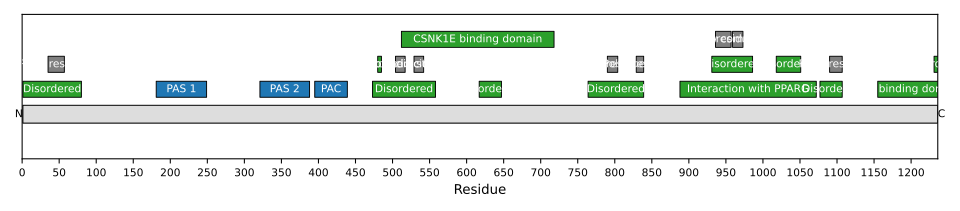
1: Transcriptional repressor which forms a core component of the circadian clock. The circadian clock, an internal time-keeping system, regulates various physiological processes through the generation of approximately 24 hour circadian rhythms in gene expression, which are translated into rhythms in metabolism and behavior. It is derived from the Latin roots 'circa' (about) and 'diem' (day) and acts as an important regulator of a wide array of physiological functions including metabolism, sleep, body temperature, blood pressure, endocrine, immune, cardiovascular, and renal function. Consists of two major components: the central clock, residing in the suprachiasmatic nucleus (SCN) of the brain, and the peripheral clocks that are present in nearly every tissue and organ system. Both the central and peripheral clocks can be reset by environmental cues, also known as Zeitgebers (German for 'timegivers'). The predominant Zeitgeber for the central clock is light, which is sensed by retina and signals directly to the SCN. The central clock entrains the peripheral clocks through neuronal and hormonal signals, body temperature and feeding-related cues, aligning all clocks with the external light/dark cycle. Circadian rhythms allow an organism to achieve temporal homeostasis with its environment at the molecular level by regulating gene expression to create a peak of protein expression once every 24 hours to control when a particular physiological process is most active with respect to the solar day. Transcription and translation of core clock components (CLOCK, NPAS2, BMAL1, BMAL2, PER1, PER2, PER3, CRY1 and CRY2) plays a critical role in rhythm generation, whereas delays imposed by post-translational modifications (PTMs) are important for determining the period (tau) of the rhythms (tau refers to the period of a rhythm and is the length, in time, of one complete cycle). A diurnal rhythm is synchronized with the day/night cycle, while the ultradian and infradian rhythms have a period shorter and longer than 24 hours, respectively. Disruptions in the circadian rhythms contribute to the pathology of cardiovascular diseases, cancer, metabolic syndrome and aging. A transcription/translation feedback loop (TTFL) forms the core of the molecular circadian clock mechanism. Transcription factors, CLOCK or NPAS2 and BMAL1 or BMAL2, form the positive limb of the feedback loop, act in the form of a heterodimer and activate the transcription of core clock genes and clock-controlled genes (involved in key metabolic processes), harboring E-box elements (5'-CACGTG-3') within their promoters. The core clock genes: PER1/2/3 and CRY1/2 which are transcriptional repressors form the negative limb of the feedback loop and interact with the CLOCK|NPAS2-BMAL1|BMAL2 heterodimer inhibiting its activity and thereby negatively regulating their own expression. This heterodimer also activates nuclear receptors NR1D1/2 and RORA/B/G, which form a second feedback loop and which activate and repress BMAL1 transcription, respectively. PER1 and PER2 proteins transport CRY1 and CRY2 into the nucleus with appropriate circadian timing, but also contribute directly to repression of clock-controlled target genes through interaction with several classes of RNA-binding proteins, helicases and others transcriptional repressors. PER appears to regulate circadian control of transcription by at least three different modes. First, interacts directly with the CLOCK-BMAL1 at the tail end of the nascent transcript peak to recruit complexes containing the SIN3-HDAC that remodel chromatin to repress transcription. Second, brings H3K9 methyltransferases such as SUV39H1 and SUV39H2 to the E-box elements of the circadian target genes, like PER2 itself or PER1. The recruitment of each repressive modifier to the DNA seems to be very precisely temporally orchestrated by the large PER complex, the deacetylases acting before than the methyltransferases. Additionally, large PER complexes are also recruited to the target genes 3' termination site through interactions with RNA-binding proteins and helicases that may play a role in transcription termination to regulate transcription independently of CLOCK-BMAL1 interactions. Recruitment of large PER complexes to the elongating polymerase at PER and CRY termination sites inhibited SETX action, impeding RNA polymerase II release and thereby repressing transcriptional reinitiation. May propagate clock information to metabolic pathways via the interaction with nuclear receptors. Coactivator of PPARA and corepressor of NR1D1, binds rhythmically at the promoter of nuclear receptors target genes like BMAL1 or G6PC1. Directly and specifically represses PPARG proadipogenic activity by blocking PPARG recruitment to target promoters and thereby inhibiting transcriptional activation. Required for fatty acid and lipid metabolism, is involved as well in the regulation of circulating insulin levels. Plays an important role in the maintenance of cardiovascular functions through the regulation of NO and vasodilatatory prostaglandins production in aortas. Controls circadian glutamate uptake in synaptic vesicles through the regulation of VGLUT1 expression. May also be involved in the regulation of inflammatory processes. Represses the CLOCK-BMAL1 induced transcription of BHLHE40/DEC1 and ATF4. Negatively regulates the formation of the TIMELESS-CRY1 complex by competing with TIMELESS for binding to CRY1