Inhibitor of nuclear factor kappa-B kinase subunit alpha (I-kappa-B kinase alpha) (IKK-A) (IKK-alpha) (IkBKA) (IkappaB kinase) (EC 2.7.11.10) (Conserved helix-loop-helix ubiquitous kinase) (I-kappa-B kinase 1) (IKK1) (Nuclear factor NF-kappa-B inhibitor kinase alpha) (NFKBIKA) (Transcription factor 16) (TCF-16)
1_MERPP 6_ GLRPG 11_ AGGPW 16_ EMRER 21_ LGTGG 26_ FGNVC 31_ LYQHR 36_ ELDLK 41_ IAIKS 46_ CRLEL 51_ STKNR 56_ ERWCH 61_ EIQIM 66_ KKLNH 71_ ANVVK 76_ ACDVP 81_ EELNI 86_ LIHDV 91_ PLLAM 96_ EYCSG 101_ GDLRK 106_ LLNKP 111_ ENCCG 116_ LKESQ 121_ ILSLL 126_ SDIGS 131_ GIRYL 136_ HENKI 141_ IHRDL 146_ KPENI 151_ VLQDV 156_ GGKII 161_ HKIID 166_ LGYAK 171_ DVDQG 176_ SLCTS 181_ FVGTL 186_ QYLAP 191_ ELFEN 196_ KPYTA 201_ TVDYW 206_ SFGTM 211_ VFECI 216_ AGYRP 221_ FLHHL 226_ QPFTW 231_ HEKIK 236_ KKDPK 241_ CIFAC 246_ EEMSG 251_ EVRFS 256_ SHLPQ 261_ PNSLC 266_ SLVVE 271_ PMENW 276_ LQLML 281_ NWDPQ 286_ QRGGP 291_ VDLTL 296_ KQPRC 301_ FVLMD 306_ HILNL 311_ KIVHI 316_ LNMTS 321_ AKIIS 326_ FLLPP 331_ DESLH 336_ SLQSR 341_ IERET 346_ GINTG 351_ SQELL 356_ SETGI 361_ SLDPR 366_ KPASQ 371_ CVLDG 376_ VRGCD 381_ SYMVY 386_ LFDKS 391_ KTVYE 396_ GPFAS 401_ RSLSD 406_ CVNYI 411_ VQDSK 416_ IQLPI 421_ IQLRK 426_ VWAEA 431_ VHYVS 436_ GLKED 441_ YSRLF 446_ QGQRA 451_ AMLSL 456_ LRYNA 461_ NLTKM 466_ KNTLI 471_ SASQQ 476_ LKAKL 481_ EFFHK 486_ SIQLD 491_ LERYS 496_ EQMTY 501_ GISSE 506_ KMLKA 511_ WKEME 516_ EKAIH 521_ YAEVG 526_ VIGYL 531_ EDQIM 536_ SLHAE 541_ IMELQ 546_ KSPYG 551_ RRQGD 556_ LMESL 561_ EQRAI 566_ DLYKQ 571_ LKHRP 576_ SDHSY 581_ SDSTE 586_ MVKII 591_ VHTVQ 596_ SQDRV 601_ LKELF 606_ GHLSK 611_ LLGCK 616_ QKIID 621_ LLPKV 626_ EVALS 631_ NIKEA 636_ DNTVM 641_ FMQGK 646_ RQKEI 651_ WHLLK 656_ IACTQ 661_ SSARS 666_ LVGSS 671_ LEGAV 676_ TPQTS 681_ AWLPP 686_ TSAEH 691_ DHSLS 696_ CVVTP 701_ QDGET 706_ SAQMI 711_ EENLN 716_ CLGHL 721_ STIIH 726_ EANEE 731_ QGNSM 736_MNLDW
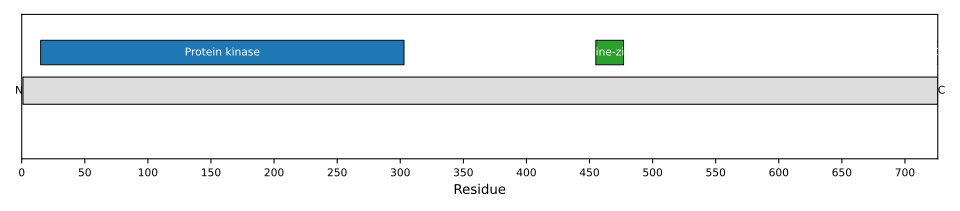
1: Serine kinase that plays an essential role in the NF-kappa-B signaling pathway which is activated by multiple stimuli such as inflammatory cytokines, bacterial or viral products, DNA damages or other cellular stresses (PubMed:18626576, PubMed:9244310, PubMed:9252186, PubMed:9346484). Acts as a part of the canonical IKK complex in the conventional pathway of NF-kappa-B activation and phosphorylates inhibitors of NF-kappa-B on serine residues (PubMed:18626576, PubMed:35952808, PubMed:9244310, PubMed:9252186, PubMed:9346484). These modifications allow polyubiquitination of the inhibitors and subsequent degradation by the proteasome (PubMed:18626576, PubMed:9244310, PubMed:9252186, PubMed:9346484). In turn, free NF-kappa-B is translocated into the nucleus and activates the transcription of hundreds of genes involved in immune response, growth control, or protection against apoptosis (PubMed:18626576, PubMed:9244310, PubMed:9252186, PubMed:9346484). Negatively regulates the pathway by phosphorylating the scaffold protein TAXBP1 and thus promoting the assembly of the A20/TNFAIP3 ubiquitin-editing complex (composed of A20/TNFAIP3, TAX1BP1, and the E3 ligases ITCH and RNF11) (PubMed:21765415). Therefore, CHUK plays a key role in the negative feedback of NF-kappa-B canonical signaling to limit inflammatory gene activation. As part of the non-canonical pathway of NF-kappa-B activation, the MAP3K14-activated CHUK/IKKA homodimer phosphorylates NFKB2/p100 associated with RelB, inducing its proteolytic processing to NFKB2/p52 and the formation of NF-kappa-B RelB-p52 complexes (PubMed:20501937). In turn, these complexes regulate genes encoding molecules involved in B-cell survival and lymphoid organogenesis. Also participates in the negative feedback of the non-canonical NF-kappa-B signaling pathway by phosphorylating and destabilizing MAP3K14/NIK. Within the nucleus, phosphorylates CREBBP and consequently increases both its transcriptional and histone acetyltransferase activities (PubMed:17434128). Modulates chromatin accessibility at NF-kappa-B-responsive promoters by phosphorylating histones H3 at 'Ser-10' that are subsequently acetylated at 'Lys-14' by CREBBP (PubMed:12789342). Additionally, phosphorylates the CREBBP-interacting protein NCOA3. Also phosphorylates FOXO3 and may regulate this pro-apoptotic transcription factor (PubMed:15084260). Phosphorylates RIPK1 at 'Ser-25' which represses its kinase activity and consequently prevents TNF-mediated RIPK1-dependent cell death (By similarity). Phosphorylates AMBRA1 following mitophagy induction, promoting AMBRA1 interaction with ATG8 family proteins and its mitophagic activity (PubMed:30217973)