Phospholipid scramblase 1 (PL scramblase 1) (Ca(2+)-dependent phospholipid scramblase 1) (Erythrocyte phospholipid scramblase) (Mg(2+)-dependent nuclease) (EC 3.1.-.-) (MmTRA1b)
1_MDKQN 6_ SQMNA 11_ SHPET 16_ NLPVG 21_ YPPQY 26_ PPTAF 31_ QGPPG 36_ YSGYP 41_ GPQVS 46_ YPPPP 51_ AGHSG 56_ PGPAG 61_ FPVPN 66_ QPVYN 71_ QPVYN 76_ QPVGA 81_ AGVPW 86_ MPAPQ 91_ PPLNC 96_ PPGLE 101_ YLSQI 106_ DQILI 111_ HQQIE 116_ LLEVL 121_ TGFET 126_ NNKYE 131_ IKNSF 136_ GQRVY 141_ FAAED 146_ TDCCT 151_ RNCCG 156_ PSRPF 161_ TLRII 166_ DNMGQ 171_ EVITL 176_ ERPLR 181_ CSSCC 186_ CPCCL 191_ QEIEI 196_ QAPPG 201_ VPIGY 206_ VIQTW 211_ HPCLP 216_ KFTIQ 221_ NEKRE 226_ DVLKI 231_ SGPCV 236_ VCSCC 241_ GDVDF 246_ EIKSL 251_ DEQCV 256_ VGKIS 261_ KHWTG 266_ ILREA 271_ FTDAD 276_ NFGIQ 281_ FPLDL 286_ DVKMK 291_ AVMIG 296_ ACFLI 301_ DFMFF 306_ ESTGS 311_QEQKS
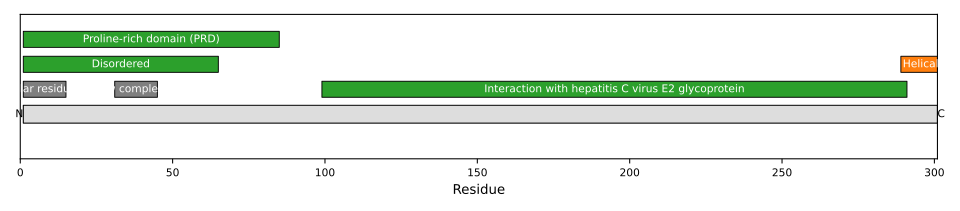
1: Catalyzes calcium-induced ATP-independent rapid bidirectional and non-specific movement of phospholipids (lipid scrambling or lipid flip-flop) between the inner and outer leaflet of the plasma membrane resulting in collapse of the phospholipid asymmetry which leads to phosphatidylserine externalization on the cell surface (PubMed:10770950, PubMed:18629440, PubMed:23590222, PubMed:23659204, PubMed:24343571, PubMed:24648509, PubMed:29748552, PubMed:32110987, PubMed:8663431, PubMed:9218461, PubMed:9485382, PubMed:9572851). Mediates calcium-dependent phosphatidylserine externalization and apoptosis in neurons via its association with TRPC5 (By similarity). Also exhibits magnesium-dependent nuclease activity against double-stranded DNA and RNA but not single-stranded DNA and can enhance DNA decatenation mediated by TOP2A (PubMed:17567603, PubMed:27206388). Negatively regulates FcR-mediated phagocytosis in differentiated macrophages (PubMed:26745724). May contribute to cytokine-regulated cell proliferation and differentiation (By similarity). May play a role in the antiviral response of interferon (IFN) by amplifying and enhancing the IFN response through increased expression of select subset of potent antiviral genes (PubMed:15308695). Inhibits the functions of viral transactivators, including human T-cell leukemia virus (HTLV)-1 protein Tax, human immunodeficiency virus (HIV)-1 Tat, human hepatitis B virus (HBV) HBx, Epstein-Barr virus (EBV) BZLF1 and human cytomegalovirus IE1 and IE2 proteins through direct interactions (PubMed:22789739, PubMed:23501106, PubMed:25365352, PubMed:31434743, PubMed:35138119). Also mediates the inhibition of influenza virus infection by preventing nuclear import of the viral nucleoprotein/NP (PubMed:29352288, PubMed:35595813). Plays a crucial role as a defense factor against SARS-CoV-2 independently of its scramblase activity by directly targeting nascent viral vesicles to prevent virus-membrane fusion and the release of viral RNA into the host-cell cytosol (PubMed:37438530)
2: (Microbial infection) Acts as an attachment receptor for HCV