Neurosecretory protein VGF [Cleaved into: Neuroendocrine regulatory peptide-1 (NERP-1); Neuroendocrine regulatory peptide-2 (NERP-2); VGF-derived peptide TLQP-21; VGF-derived peptide TLQP-62; Antimicrobial peptide VGF[554-577]]
1_MKALR 6_ LSASA 11_ LFCLL 16_ LINGL 21_ GAAPP 26_ GRPEA 31_ QPPPL 36_ SSEHK 41_ EPVAG 46_ DAVPG 51_ PKDGS 56_ APEVR 61_ GARNS 66_ EPQDE 71_ GELFQ 76_ GVDPR 81_ ALAAV 86_ LLQAL 91_ DRPAS 96_ PPAPS 101_ GSQQG 106_ PEEEA 111_ AEALL 116_ TETVR 121_ SQTHS 126_ LPAPE 131_ SPEPA 136_ APPRP 141_ QTPEN 146_ GPEAS 151_ DPSEE 156_ LEALA 161_ SLLQE 166_ LRDFS 171_ PSSAK 176_ RQQET 181_ AAAET 186_ ETRTH 191_ TLTRV 196_ NLESP 201_ GPERV 206_ WRASW 211_ GEFQA 216_ RVPER 221_ APLPP 226_ PAPSQ 231_ FQARM 236_ PDSGP 241_ LPETH 246_ KFGEG 251_ VSSPK 256_ THLGE 261_ ALAPL 266_ SKAYQ 271_ GVAAP 276_ FPKAR 281_ RPESA 286_ LLGGS 291_ EAGER 296_ LLQQG 301_ LAQVE 306_ AGRRQ 311_ AEATR 316_ QAAAQ 321_ EERLA 326_ DLASD 331_ LLLQY 336_ LLQGG 341_ ARQRG 346_ LGGRG 351_ LQEAA 356_ EERES 361_ AREEE 366_ EAEQE 371_ RRGGE 376_ ERVGE 381_ EDEEA 386_ AEAEA 391_ EAEEA 396_ ERARQ 401_ NALLF 406_ AEEED 411_ GEAGA 416_ EDKRS 421_ QEETP 426_ GHRRK 431_ EAEGT 436_ EEGGE 441_ EEDDE 446_ EMDPQ 451_ TIDSL 456_ IELST 461_ KLHLP 466_ ADDVV 471_ SIIEE 476_ VEEKR 481_ KRKKN 486_ APPEP 491_ VPPPR 496_ AAPAP 501_ THVRS 506_ PQPPP 511_ PAPAP 516_ ARDEL 521_ PDWNE 526_ VLPPW 531_ DREED 536_ EVYPP 541_ GPYHP 546_ FPNYI 551_ RPRTL 556_ QPPSA 561_ LRRRH 566_ YHHAL 571_ PPSRH 576_ YPGRE 581_ AQARR 586_ AQEEA 591_ EAEER 596_ RLQEQ 601_ EELEN 606_YIEHV
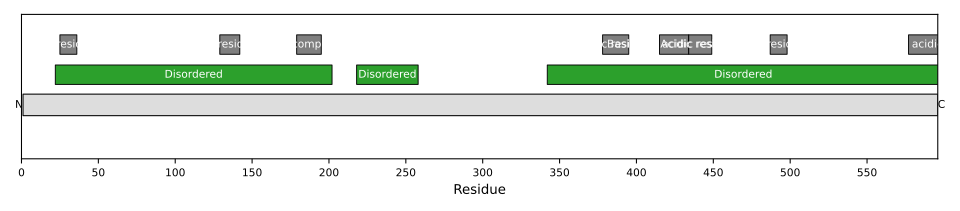
1: Secreted polyprotein that is packaged and proteolytically processed by prohormone convertases PCSK1 and PCSK2 in a cell-type-specific manner (By similarity). VGF and peptides derived from its processing play many roles in neurogenesis and neuroplasticity associated with learning, memory, depression and chronic pain (By similarity)
2: Plays a role in the control of body fluid homeostasis by regulating vasopressin release. Suppresses presynaptic glutamatergic neurons connected to vasopressin neurons
3: Plays a role in the control of body fluid homeostasis by regulating vasopressin release. Activates GABAergic interneurons which are inhibitory neurons of the nervous system and thereby suppresses presynaptic glutamatergic neurons (By similarity). Also stimulates feeding behavior in an orexin-dependent manner in the hypothalamus (By similarity). Functions as a positive regulator for the activation of orexin neurons resulting in elevated gastric acid secretion and gastric emptying (By similarity)
4: Secreted multifunctional neuropeptide that binds to different cell receptors and thereby plays multiple physiological roles including modulation of energy expenditure, pain, response to stress, gastric regulation, glucose homeostasis as well as lipolysis (By similarity). Activates the G-protein-coupled receptor C3AR1 via a folding-upon-binding mechanism leading to enhanced lipolysis in adipocytes (By similarity). Interacts with C1QBP receptor in macrophages and microglia causing increased levels of intracellular calcium and hypersensitivity (By similarity)
5: Plays a role in the regulation of memory formation and depression-related behaviors potentially by influencing synaptic plasticity and neurogenesis. Induces acute and transient activation of the NTRK2/TRKB receptor and subsequent CREB phosphorylation (By similarity). Also induces insulin secretion in insulinoma cells by increasing intracellular calcium mobilization (By similarity)
6: Has bactericidal activity against M.luteus, and antifungal activity against P. Pastoris