Solute carrier family 22 member 2 (Organic cation transporter 2) (hOCT2)
1_MPTTV 6_ DDVLE 11_ HGGEF 16_ HFFQK 21_ QMFFL 26_ LALLS 31_ ATFAP 36_ IYVGI 41_ VFLGF 46_ TPDHR 51_ CRSPG 56_ VAELS 61_ LRCGW 66_ SPAEE 71_ LNYTV 76_ PGPGP 81_ AGEAS 86_ PRQCR 91_ RYEVD 96_ WNQST 101_ FDCVD 106_ PLASL 111_ DTNRS 116_ RLPLG 121_ PCRDG 126_ WVYET 131_ PGSSI 136_ VTEFN 141_ LVCAN 146_ SWMLD 151_ LFQSS 156_ VNVGF 161_ FIGSM 166_ SIGYI 171_ ADRFG 176_ RKLCL 181_ LTTVL 186_ INAAA 191_ GVLMA 196_ ISPTY 201_ TWMLI 206_ FRLIQ 211_ GLVSK 216_ AGWLI 221_ GYILI 226_ TEFVG 231_ RRYRR 236_ TVGIF 241_ YQVAY 246_ TVGLL 251_ VLAGV 256_ AYALP 261_ HWRWL 266_ QFTVS 271_ LPNFF 276_ FLLYY 281_ WCIPE 286_ SPRWL 291_ ISQNK 296_ NAEAM 301_ RIIKH 306_ IAKKN 311_ GKSLP 316_ ASLQR 321_ LRLEE 326_ ETGKK 331_ LNPSF 336_ LDLVR 341_ TPQIR 346_ KHTMI 351_ LMYNW 356_ FTSSV 361_ LYQGL 366_ IMHMG 371_ LAGDN 376_ IYLDF 381_ FYSAL 386_ VEFPA 391_ AFMII 396_ LTIDR 401_ IGRRY 406_ PWAAS 411_ NMVAG 416_ AACLA 421_ SVFIP 426_ GDLQW 431_ LKIII 436_ SCLGR 441_ MGITM 446_ AYEIV 451_ CLVNA 456_ ELYPT 461_ FIRNL 466_ GVHIC 471_ SSMCD 476_ IGGII 481_ TPFLV 486_ YRLTN 491_ IWLEL 496_ PLMVF 501_ GVLGL 506_ VAGGL 511_ VLLLP 516_ ETKGK 521_ ALPET 526_ IEEAE 531_ NMQRP 536_ RKNKE 541_ KMIYL 546_QVQKL
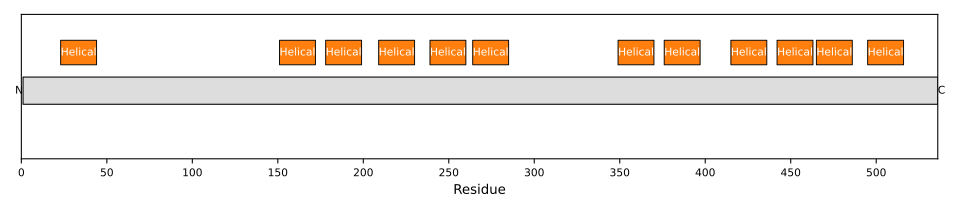
1: Electrogenic voltage-dependent transporter that mediates the transport of a variety of organic cations such as endogenous bioactive amines, cationic drugs and xenobiotics (PubMed:9260930, PubMed:9687576). Functions as a Na(+)-independent, bidirectional uniporter (PubMed:21128598, PubMed:9687576). Cation cellular uptake or release is driven by the electrochemical potential, i.e. membrane potential and concentration gradient (PubMed:15212162, PubMed:9260930, PubMed:9687576). However, may also engage electroneutral cation exchange when saturating concentrations of cation substrates are reached (By similarity). Predominantly expressed at the basolateral membrane of hepatocytes and proximal tubules and involved in the uptake and disposition of cationic compounds by hepatic and renal clearance from the blood flow (PubMed:15783073). Implicated in monoamine neurotransmitters uptake such as histamine, dopamine, adrenaline/epinephrine, noradrenaline/norepinephrine, serotonin and tyramine, thereby supporting a physiological role in the central nervous system by regulating interstitial concentrations of neurotransmitters (PubMed:16581093, PubMed:17460754, PubMed:9687576). Also capable of transporting dopaminergic neuromodulators cyclo(his-pro), salsolinol and N-methyl-salsolinol, thereby involved in the maintenance of dopaminergic cell integrity in the central nervous system (PubMed:17460754). Mediates the bidirectional transport of acetylcholine (ACh) at the apical membrane of ciliated cell in airway epithelium, thereby playing a role in luminal release of ACh from bronchial epithelium (PubMed:15817714). Also transports guanidine and endogenous monoamines such as vitamin B1/thiamine, creatinine and N-1-methylnicotinamide (NMN) (PubMed:12089365, PubMed:15212162, PubMed:17072098, PubMed:24961373, PubMed:9260930). Mediates the uptake and efflux of quaternary ammonium compound choline (PubMed:9260930). Mediates the bidirectional transport of polyamine agmatine and the uptake of polyamines putrescine and spermidine (PubMed:12538837, PubMed:21128598). Able to transport non-amine endogenous compounds such as prostaglandin E2 (PGE2) and prostaglandin F2-alpha (PGF2-alpha) (PubMed:11907186). Also involved in the uptake of xenobiotic 4-(4-(dimethylamino)styryl)-N-methylpyridinium (ASP) (PubMed:12395288, PubMed:16394027). May contribute to regulate the transport of organic compounds in testis across the blood-testis-barrier (Probable)
2: In contrast with isoform 1, not able to transport guanidine, creatinine, cimetidine and metformin