Solute carrier family 22 member 1 (Organic cation transporter 1) (hOCT1)
1_MPTVD 6_ DILEQ 11_ VGESG 16_ WFQKQ 21_ AFLIL 26_ CLLSA 31_ AFAPI 36_ CVGIV 41_ FLGFT 46_ PDHHC 51_ QSPGV 56_ AELSQ 61_ RCGWS 66_ PAEEL 71_ NYTVP 76_ GLGPA 81_ GEAFL 86_ GQCRR 91_ YEVDW 96_ NQSAL 101_ SCVDP 106_ LASLA 111_ TNRSH 116_ LPLGP 121_ CQDGW 126_ VYDTP 131_ GSSIV 136_ TEFNL 141_ VCADS 146_ WKLDL 151_ FQSCL 156_ NAGFL 161_ FGSLG 166_ VGYFA 171_ DRFGR 176_ KLCLL 181_ GTVLV 186_ NAVSG 191_ VLMAF 196_ SPNYM 201_ SMLLF 206_ RLLQG 211_ LVSKG 216_ NWMAG 221_ YTLIT 226_ EFVGS 231_ GSRRT 236_ VAIMY 241_ QMAFT 246_ VGLVA 251_ LTGLA 256_ YALPH 261_ WRWLQ 266_ LAVSL 271_ PTFLF 276_ LLYYW 281_ CVPES 286_ PRWLL 291_ SQKRN 296_ TEAIK 301_ IMDHI 306_ AQKNG 311_ KLPPA 316_ DLKML 321_ SLEED 326_ VTEKL 331_ SPSFA 336_ DLFRT 341_ PRLRK 346_ RTFIL 351_ MYLWF 356_ TDSVL 361_ YQGLI 366_ LHMGA 371_ TSGNL 376_ YLDFL 381_ YSALV 386_ EIPGA 391_ FIALI 396_ TIDRV 401_ GRIYP 406_ MAMSN 411_ LLAGA 416_ ACLVM 421_ IFISP 426_ DLHWL 431_ NIIIM 436_ CVGRM 441_ GITIA 446_ IQMIC 451_ LVNAE 456_ LYPTF 461_ VRNLG 466_ VMVCS 471_ SLCDI 476_ GGIIT 481_ PFIVF 486_ RLREV 491_ WQALP 496_ LILFA 501_ VLGLL 506_ AAGVT 511_ LLLPE 516_ TKGVA 521_ LPETM 526_ KDAEN 531_ LGRKA 536_ KPKEN 541_ TIYLK 546_VQTSE
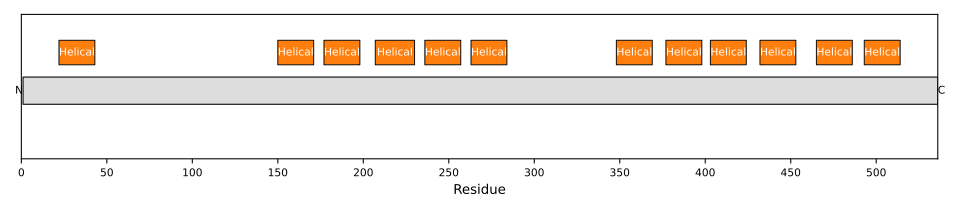
1: Electrogenic voltage-dependent transporter that mediates the transport of a variety of organic cations such as endogenous bioactive amines, cationic drugs and xenobiotics (PubMed:11388889, PubMed:11408531, PubMed:12439218, PubMed:12719534, PubMed:15389554, PubMed:16263091, PubMed:16272756, PubMed:16581093, PubMed:19536068, PubMed:21128598, PubMed:23680637, PubMed:24961373, PubMed:34040533, PubMed:9187257, PubMed:9260930, PubMed:9655880). Functions as a pH- and Na(+)-independent, bidirectional transporter (By similarity). Cation cellular uptake or release is driven by the electrochemical potential (i.e. membrane potential and concentration gradient) and substrate selectivity (By similarity). Hydrophobicity is a major requirement for recognition in polyvalent substrates and inhibitors (By similarity). Primarily expressed at the basolateral membrane of hepatocytes and proximal tubules and involved in the uptake and disposition of cationic compounds by hepatic and renal clearance from the blood flow (By similarity). Most likely functions as an uptake carrier in enterocytes contributing to the intestinal elimination of organic cations from the systemic circulation (PubMed:16263091). Transports endogenous monoamines such as N-1-methylnicotinamide (NMN), guanidine, histamine, neurotransmitters dopamine, serotonin and adrenaline (PubMed:12439218, PubMed:24961373, PubMed:35469921, PubMed:9260930). Also transports natural polyamines such as spermidine, agmatine and putrescine at low affinity, but relatively high turnover (PubMed:21128598). Involved in the hepatic uptake of vitamin B1/thiamine, hence regulating hepatic lipid and energy metabolism (PubMed:24961373). Mediates the bidirectional transport of acetylcholine (ACh) at the apical membrane of ciliated cell in airway epithelium, thereby playing a role in luminal release of ACh from bronchial epithelium (PubMed:15817714). Transports dopaminergic neuromodulators cyclo(his-pro) and salsolinol with lower efficency (PubMed:17460754). Also capable of transporting non-amine endogenous compounds such as prostaglandin E2 (PGE2) and prostaglandin F2-alpha (PGF2-alpha) (PubMed:11907186). May contribute to the transport of cationic compounds in testes across the blood-testis-barrier (Probable). Also involved in the uptake of xenobiotics tributylmethylammonium (TBuMA), quinidine, N-methyl-quinine (NMQ), N-methyl-quinidine (NMQD) N-(4,4-azo-n-pentyl)-quinuclidine (APQ), azidoprocainamide methoiodide (AMP), N-(4,4-azo-n-pentyl)-21-deoxyajmalinium (APDA) and 4-(4-(dimethylamino)styryl)-N-methylpyridinium (ASP) (PubMed:11408531, PubMed:15389554, PubMed:35469921, PubMed:9260930)
2: Mediates the uptake of 1-methyl-4-phenylpyridinium (MPP(+))
3: Not able to uptake 1-methyl-4-phenylpyridinium (MPP(+))
4: Not able to uptake 1-methyl-4-phenylpyridinium (MPP(+))
5: Not able to uptake 1-methyl-4-phenylpyridinium (MPP(+))