UDP-N-acetylglucosamine--peptide N-acetylglucosaminyltransferase 110 kDa subunit (EC 2.4.1.255) (O-GlcNAc transferase subunit p110) (O-linked N-acetylglucosamine transferase 110 kDa subunit) (OGT)
1_MASSV 6_ GNVAD 11_ STEPT 16_ KRMLS 21_ FQGLA 26_ ELAHR 31_ EYQAG 36_ DFEAA 41_ ERHCM 46_ QLWRQ 51_ EPDNT 56_ GVLLL 61_ LSSIH 66_ FQCRR 71_ LDRSA 76_ HFSTL 81_ AIKQN 86_ PLLAE 91_ AYSNL 96_ GNVYK 101_ ERGQL 106_ QEAIE 111_ HYRHA 116_ LRLKP 121_ DFIDG 126_ YINLA 131_ AALVA 136_ AGDME 141_ GAVQA 146_ YVSAL 151_ QYNPD 156_ LYCVR 161_ SDLGN 166_ LLKAL 171_ GRLEE 176_ AKACY 181_ LKAIE 186_ TQPNF 191_ AVAWS 196_ NLGCV 201_ FNAQG 206_ EIWLA 211_ IHHFE 216_ KAVTL 221_ DPNFL 226_ DAYIN 231_ LGNVL 236_ KEARI 241_ FDRAV 246_ AAYLR 251_ ALSLS 256_ PNHAV 261_ VHGNL 266_ ACVYY 271_ EQGLI 276_ DLAID 281_ TYRRA 286_ IELQP 291_ HFPDA 296_ YCNLA 301_ NALKE 306_ KGSVA 311_ EAEDC 316_ YNTAL 321_ RLCPT 326_ HADSL 331_ NNLAN 336_ IKREQ 341_ GNIEE 346_ AVRLY 351_ RKALE 356_ VFPEF 361_ AAAHS 366_ NLASV 371_ LQQQG 376_ KLQEA 381_ LMHYK 386_ EAIRI 391_ SPTFA 396_ DAYSN 401_ MGNTL 406_ KEMQD 411_ VQGAL 416_ QCYTR 421_ AIQIN 426_ PAFAD 431_ AHSNL 436_ ASIHK 441_ DSGNI 446_ PEAIA 451_ SYRTA 456_ LKLKP 461_ DFPDA 466_ YCNLA 471_ HCLQI 476_ VCDWT 481_ DYDER 486_ MKKLV 491_ SIVAD 496_ QLEKN 501_ RLPSV 506_ HPHHS 511_ MLYPL 516_ SHGFR 521_ KAIAE 526_ RHGNL 531_ CLDKI 536_ NVLHK 541_ PPYEH 546_ PKDLK 551_ LSDGR 556_ LRVGY 561_ VSSDF 566_ GNHPT 571_ SHLMQ 576_ SIPGM 581_ HNPDK 586_ FEVFC 591_ YALSP 596_ DDGTN 601_ FRVKV 606_ MAEAN 611_ HFIDL 616_ SQIPC 621_ NGKAA 626_ DRIHQ 631_ DGIHI 636_ LVNMN 641_ GYTKG 646_ ARNEL 651_ FALRP 656_ APIQA 661_ MWLGY 666_ PGTSG 671_ ALFMD 676_ YIITD 681_ QETSP 686_ AEVAE 691_ QYSEK 696_ LAYMP 701_ HTFFI 706_ GDHAN 711_ MFPHL 716_ KKKAV 721_ IDFKS 726_ NGHIY 731_ DNRIV 736_ LNGID 741_ LKAFL 746_ DSLPD 751_ VKIVK 756_ MKCPD 761_ GGDNA 766_ DSSNT 771_ ALNMP 776_ VIPMN 781_ TIAEA 786_ VIEMI 791_ NRGQI 796_ QITIN 801_ GFSIS 806_ NGLAT 811_ TQINN 816_ KAATG 821_ EEVPR 826_ TIIVT 831_ TRSQY 836_ GLPED 841_ AIVYC 846_ NFNQL 851_ YKIDP 856_ STLQM 861_ WANIL 866_ KRVPN 871_ SVLWL 876_ LRFPA 881_ VGEPN 886_ IQQYA 891_ QNMGL 896_ PQNRI 901_ IFSPV 906_ APKEE 911_ HVRRG 916_ QLADV 921_ CLDTP 926_ LCNGH 931_ TTGMD 936_ VLWAG 941_ TPMVT 946_ MPGET 951_ LASRV 956_ AASQL 961_ TCLGC 966_ LELIA 971_ KNRQE 976_ YEDIA 981_ VKLGT 986_ DLEYL 991_ KKVRG 996_ KVWKQ 1001_ RISSP 1006_ LFNTK 1011_ QYTME 1016_ LERLY 1021_ LQMWE 1026_ HYAAG 1031_ NKPDH 1036_ MIKPV 1041_EVTES
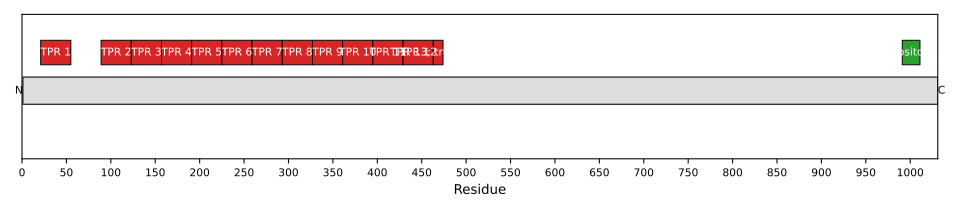
1: Catalyzes the transfer of a single N-acetylglucosamine from UDP-GlcNAc to a serine or threonine residue in cytoplasmic and nuclear proteins resulting in their modification with a beta-linked N-acetylglucosamine (O-GlcNAc) (PubMed:12150998, PubMed:15361863, PubMed:19451179, PubMed:20018868, PubMed:21240259, PubMed:21285374, PubMed:23103939, PubMed:26237509, PubMed:26369908, PubMed:26678539, PubMed:27713473, PubMed:37541260, PubMed:37962578). Glycosylates a large and diverse number of proteins including histone H2B, AKT1, AMPK, ATG4B, CAPRIN1, EZH2, FNIP1, GSDMD, KRT7, LMNA, LMNB1, LMNB2, RPTOR, HOXA1, PFKL, KMT2E/MLL5, MAPT/TAU, TET2, RBL2, RET, NOD2 and HCFC1 (PubMed:19451179, PubMed:20200153, PubMed:21285374, PubMed:22923583, PubMed:23353889, PubMed:24474760, PubMed:26237509, PubMed:26369908, PubMed:26678539, PubMed:27527864, PubMed:30699359, PubMed:34074792, PubMed:34667079, PubMed:37541260, PubMed:37962578). Can regulate their cellular processes via cross-talk between glycosylation and phosphorylation or by affecting proteolytic processing (PubMed:21285374). Involved in insulin resistance in muscle and adipocyte cells via glycosylating insulin signaling components and inhibiting the 'Thr-308' phosphorylation of AKT1, enhancing IRS1 phosphorylation and attenuating insulin signaling (By similarity). Involved in glycolysis regulation by mediating glycosylation of 6-phosphofructokinase PFKL, inhibiting its activity (PubMed:22923583). Plays a key role in chromatin structure by mediating O-GlcNAcylation of 'Ser-112' of histone H2B: recruited to CpG-rich transcription start sites of active genes via its interaction with TET proteins (TET1, TET2 or TET3) (PubMed:22121020, PubMed:23353889). As part of the NSL complex indirectly involved in acetylation of nucleosomal histone H4 on several lysine residues (PubMed:20018852). O-GlcNAcylation of 'Ser-75' of EZH2 increases its stability, and facilitating the formation of H3K27me3 by the PRC2/EED-EZH2 complex (PubMed:24474760). Stabilizes KMT2E/MLL5 by mediating its glycosylation, thereby preventing KMT2E/MLL5 ubiquitination (PubMed:26678539). Regulates circadian oscillation of the clock genes and glucose homeostasis in the liver (By similarity). Stabilizes clock proteins BMAL1 and CLOCK through O-glycosylation, which prevents their ubiquitination and subsequent degradation (By similarity). Promotes the CLOCK-BMAL1-mediated transcription of genes in the negative loop of the circadian clock such as PER1/2 and CRY1/2. O-glycosylates HCFC1 and regulates its proteolytic processing and transcriptional activity (PubMed:21285374, PubMed:28302723, PubMed:28584052). Component of a THAP1/THAP3-HCFC1-OGT complex that is required for the regulation of the transcriptional activity of RRM1 (PubMed:20200153). Regulates mitochondrial motility in neurons by mediating glycosylation of TRAK1 (By similarity). Promotes autophagy by mediating O-glycosylation of ATG4B (PubMed:27527864). Acts as a regulator of mTORC1 signaling by mediating O-glycosylation of RPTOR and FNIP1: O-GlcNAcylation of RPTOR in response to glucose sufficiency promotes activation of the mTORC1 complex (PubMed:30699359, PubMed:37541260)
2: The mitochondrial isoform (mOGT) is cytotoxic and triggers apoptosis in several cell types including INS1, an insulinoma cell line
3: Has N-acetylglucosaminyltransferase activity: glycosylates proteins, such as HNRNPU, NEUROD1, NUP62 and PDCD6IP (PubMed:31527085). Displays specific substrate selectivity compared to other isoforms (PubMed:31527085)