Histone deacetylase 3 (HD3) (EC 3.5.1.98) (Protein deacetylase HDAC3) (EC 3.5.1.-) (Protein deacylase HDAC3) (EC 3.5.1.-) (RPD3-2) (SMAP45)
1_MAKTV 6_ AYFYD 11_ PDVGN 16_ FHYGA 21_ GHPMK 26_ PHRLA 31_ LTHSL 36_ VLHYG 41_ LYKKM 46_ IVFKP 51_ YQASQ 56_ HDMCR 61_ FHSED 66_ YIDFL 71_ QRVSP 76_ TNMQG 81_ FTKSL 86_ NAFNV 91_ GDDCP 96_ VFPGL 101_ FEFCS 106_ RYTGA 111_ SLQGA 116_ TQLNN 121_ KICDI 126_ AINWA 131_ GGLHH 136_ AKKFE 141_ ASGFC 146_ YVNDI 151_ VIGIL 156_ ELLKY 161_ HPRVL 166_ YIDID 171_ IHHGD 176_ GVQEA 181_ FYLTD 186_ RVMTV 191_ SFHKY 196_ GNYFF 201_ PGTGD 206_ MYEVG 211_ AESGR 216_ YYCLN 221_ VPLRD 226_ GIDDQ 231_ SYKHL 236_ FQPVI 241_ NQVVD 246_ FYQPT 251_ CIVLQ 256_ CGADS 261_ LGCDR 266_ LGCFN 271_ LSIRG 276_ HGECV 281_ EYVKS 286_ FNIPL 291_ LVLGG 296_ GGYTV 301_ RNVAR 306_ CWTYE 311_ TSLLV 316_ EEAIS 321_ EELPY 326_ SEYFE 331_ YFAPD 336_ FTLHP 341_ DVSTR 346_ IENQN 351_ SRQYL 356_ DQIRQ 361_ TIFEN 366_ LKMLN 371_ HAPSV 376_ QIHDV 381_ PADLL 386_ TYDRT 391_ DEADA 396_ EERGP 401_ EENYS 406_ RPEAP 411_ NEFYD 416_ GDHDN 421_DKESD
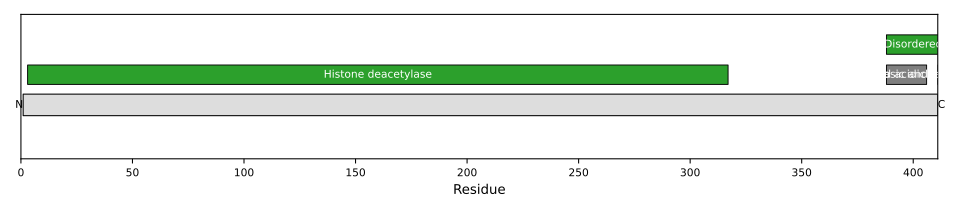
1: Histone deacetylase that catalyzes the deacetylation of lysine residues on the N-terminal part of the core histones (H2A, H2B, H3 and H4), and some other non-histone substrates (PubMed:21030595, PubMed:21444723, PubMed:23911289, PubMed:25301942, PubMed:28167758, PubMed:28497810, PubMed:32404892, PubMed:22230954). Histone deacetylation gives a tag for epigenetic repression and plays an important role in transcriptional regulation, cell cycle progression and developmental events (PubMed:23911289). Histone deacetylases act via the formation of large multiprotein complexes, such as N-Cor repressor complex, which activate the histone deacetylase activity (PubMed:23911289, PubMed:22230954). Participates in the BCL6 transcriptional repressor activity by deacetylating the H3 'Lys-27' (H3K27) on enhancer elements, antagonizing EP300 acetyltransferase activity and repressing proximal gene expression (PubMed:23911289). Acts as a molecular chaperone for shuttling phosphorylated NR2C1 to PML bodies for sumoylation (By similarity). Contributes, together with XBP1 isoform 1, to the activation of NFE2L2-mediated HMOX1 transcription factor gene expression in a PI(3)K/mTORC2/Akt-dependent signaling pathway leading to endothelial cell (EC) survival under disturbed flow/oxidative stress (PubMed:25190803). Regulates both the transcriptional activation and repression phases of the circadian clock in a deacetylase activity-independent manner (By similarity). During the activation phase, promotes the accumulation of ubiquitinated BMAL1 at the E-boxes and during the repression phase, blocks FBXL3-mediated CRY1/2 ubiquitination and promotes the interaction of CRY1 and BMAL1 (By similarity). The NCOR1-HDAC3 complex regulates the circadian expression of the core clock gene BMAL1 and the genes involved in lipid metabolism in the liver (By similarity). Also functions as a deacetylase for non-histone targets, such as KAT5, MEF2D, MAPK14, RARA and STAT3 (PubMed:15653507, PubMed:21030595, PubMed:21444723, PubMed:25301942, PubMed:28167758). Serves as a corepressor of RARA, mediating its deacetylation and repression, leading to inhibition of RARE DNA element binding (PubMed:28167758). In association with RARA, plays a role in the repression of microRNA-10a and thereby in the inflammatory response (PubMed:28167758). In addition to protein deacetylase activity, also acts as a protein-lysine deacylase by recognizing other acyl groups: catalyzes removal of (2E)-butenoyl (crotonyl), lactoyl (lactyl) and 2-hydroxyisobutanoyl (2-hydroxyisobutyryl) acyl groups from lysine residues, leading to protein decrotonylation, delactylation and de-2-hydroxyisobutyrylation, respectively (PubMed:28497810, PubMed:29192674, PubMed:34608293, PubMed:35044827). Catalyzes decrotonylation of MAPRE1/EB1 (PubMed:34608293). Mediates delactylation NBN/NBS1, thereby inhibiting DNA double-strand breaks (DSBs) via homologous recombination (HR) (PubMed:38961290)