Transmembrane protease serine 2 (EC 3.4.21.-) (Serine protease 10) [Cleaved into: Transmembrane protease serine 2 non-catalytic chain; Transmembrane protease serine 2 catalytic chain]
1_MALNS 6_ GSPPA 11_ IGPYY 16_ ENHGY 21_ QPENP 26_ YPAQP 31_ TVVPT 36_ VYEVH 41_ PAQYY 46_ PSPVP 51_ QYAPR 56_ VLTQA 61_ SNPVV 66_ CTQPK 71_ SPSGT 76_ VCTSK 81_ TKKAL 86_ CITLT 91_ LGTFL 96_ VGAAL 101_ AAGLL 106_ WKFMG 111_ SKCSN 116_ SGIEC 121_ DSSGT 126_ CINPS 131_ NWCDG 136_ VSHCP 141_ GGEDE 146_ NRCVR 151_ LYGPN 156_ FILQV 161_ YSSQR 166_ KSWHP 171_ VCQDD 176_ WNENY 181_ GRAAC 186_ RDMGY 191_ KNNFY 196_ SSQGI 201_ VDDSG 206_ STSFM 211_ KLNTS 216_ AGNVD 221_ IYKKL 226_ YHSDA 231_ CSSKA 236_ VVSLR 241_ CIACG 246_ VNLNS 251_ SRQSR 256_ IVGGE 261_ SALPG 266_ AWPWQ 271_ VSLHV 276_ QNVHV 281_ CGGSI 286_ ITPEW 291_ IVTAA 296_ HCVEK 301_ PLNNP 306_ WHWTA 311_ FAGIL 316_ RQSFM 321_ FYGAG 326_ YQVEK 331_ VISHP 336_ NYDSK 341_ TKNND 346_ IALMK 351_ LQKPL 356_ TFNDL 361_ VKPVC 366_ LPNPG 371_ MMLQP 376_ EQLCW 381_ ISGWG 386_ ATEEK 391_ GKTSE 396_ VLNAA 401_ KVLLI 406_ ETQRC 411_ NSRYV 416_ YDNLI 421_ TPAMI 426_ CAGFL 431_ QGNVD 436_ SCQGD 441_ SGGPL 446_ VTSKN 451_ NIWWL 456_ IGDTS 461_ WGSGC 466_ AKAYR 471_ PGVYG 476_ NVMVF 481_ TDWIY 486_RQMRA
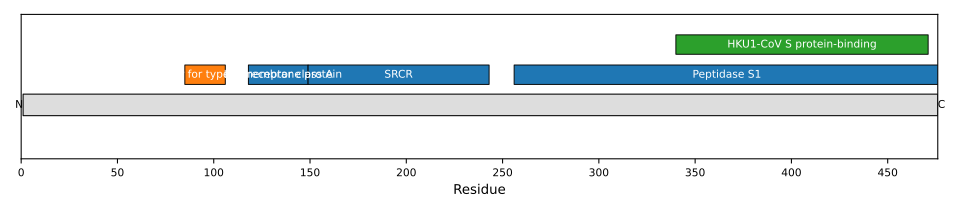
1: Plasma membrane-anchored serine protease that cleaves at arginine residues (PubMed:32703818, PubMed:35676539, PubMed:37990007, PubMed:38964328). Participates in proteolytic cascades of relevance for the normal physiologic function of the prostate (PubMed:25122198). Androgen-induced TMPRSS2 activates several substrates that include pro-hepatocyte growth factor/HGF, the protease activated receptor-2/F2RL1 or matriptase/ST14 leading to extracellular matrix disruption and metastasis of prostate cancer cells (PubMed:15537383, PubMed:25122198, PubMed:26018085). In addition, activates trigeminal neurons and contribute to both spontaneous pain and mechanical allodynia (By similarity)
2: (Microbial infection) Facilitates human coronaviruses SARS-CoV and SARS-CoV-2 infections via two independent mechanisms, proteolytic cleavage of ACE2 receptor which promotes viral uptake, and cleavage of coronavirus spike glycoproteins which activates the glycoprotein for host cell entry (PubMed:24227843, PubMed:32142651, PubMed:32404436, PubMed:33051876, PubMed:34159616, PubMed:35676539, PubMed:37990007). The cleavage of SARS-COV2 spike glycoprotein occurs between the S2 and S2' site (PubMed:32703818). Upon SARS-CoV-2 infection, increases syncytia formation by accelerating the fusion process (PubMed:33051876, PubMed:34159616, PubMed:35676539). Proteolytically cleaves and activates the spike glycoproteins of human coronavirus 229E (HCoV-229E) and human coronavirus EMC (HCoV-EMC) and the fusion glycoproteins F0 of Sendai virus (SeV), human metapneumovirus (HMPV), human parainfluenza 1, 2, 3, 4a and 4b viruses (HPIV). Essential for spread and pathogenesis of influenza A virus (strains H1N1, H3N2 and H7N9); involved in proteolytic cleavage and activation of hemagglutinin (HA) protein which is essential for viral infectivity
3: (Microbial infection) Receptor for human coronavirus HKU1-CoV, acts synergistically with disialoside glycans to facilitate the entry of the virus. After binding to cell-surface disialoside glycans, the viral S protein interacts with the inactive form of TMPRSS2 and inhibits its protease activity