Circadian locomoter output cycles protein kaput (hCLOCK) (EC 2.3.1.48) (Class E basic helix-loop-helix protein 8) (bHLHe8)
1_MLFTV 6_ SCSKM 11_ SSIVD 16_ RDDSS 21_ IFDGL 26_ VEEDD 31_ KDKAK 36_ RVSRN 41_ KSEKK 46_ RRDQF 51_ NVLIK 56_ ELGSM 61_ LPGNA 66_ RKMDK 71_ STVLQ 76_ KSIDF 81_ LRKHK 86_ EITAQ 91_ SDASE 96_ IRQDW 101_ KPTFL 106_ SNEEF 111_ TQLML 116_ EALDG 121_ FFLAI 126_ MTDGS 131_ IIYVS 136_ ESVTS 141_ LLEHL 146_ PSDLV 151_ DQSIF 156_ NFIPE 161_ GEHSE 166_ VYKIL 171_ STHLL 176_ ESDSL 181_ TPEYL 186_ KSKNQ 191_ LEFCC 196_ HMLRG 201_ TIDPK 206_ EPSTY 211_ EYVKF 216_ IGNFK 221_ SLNSV 226_ SSSAH 231_ NGFEG 236_ TIQRT 241_ HRPSY 246_ EDRVC 251_ FVATV 256_ RLATP 261_ QFIKE 266_ MCTVE 271_ EPNEE 276_ FTSRH 281_ SLEWK 286_ FLFLD 291_ HRAPP 296_ IIGYL 301_ PFEVL 306_ GTSGY 311_ DYYHV 316_ DDLEN 321_ LAKCH 326_ EHLMQ 331_ YGKGK 336_ SCYYR 341_ FLTKG 346_ QQWIW 351_ LQTHY 356_ YITYH 361_ QWNSR 366_ PEFIV 371_ CTHTV 376_ VSYAE 381_ VRAER 386_ RRELG 391_ IEESL 396_ PETAA 401_ DKSQD 406_ SGSDN 411_ RINTV 416_ SLKEA 421_ LERFD 426_ HSPTP 431_ SASSR 436_ SSRKS 441_ SHTAV 446_ SDPSS 451_ TPTKI 456_ PTDTS 461_ TPPRQ 466_ HLPAH 471_ EKMVQ 476_ RRSSF 481_ SSQSI 486_ NSQSV 491_ GSSLT 496_ QPVMS 501_ QATNL 506_ PIPQG 511_ MSQFQ 516_ FSAQL 521_ GAMQH 526_ LKDQL 531_ EQRTR 536_ MIEAN 541_ IHRQQ 546_ EELRK 551_ IQEQL 556_ QMVHG 561_ QGLQM 566_ FLQQS 571_ NPGLN 576_ FGSVQ 581_ LSSGN 586_ SSNIQ 591_ QLAPI 596_ NMQGQ 601_ VVPTN 606_ QIQSG 611_ MNTGH 616_ IGTTQ 621_ HMIQQ 626_ QTLQS 631_ TSTQS 636_ QQNVL 641_ SGHSQ 646_ QTSLP 651_ SQTQS 656_ TLTAP 661_ LYNTM 666_ VISQP 671_ AAGSM 676_ VQIPS 681_ SMPQN 686_ STQSA 691_ AVTTF 696_ TQDRQ 701_ IRFSQ 706_ GQQLV 711_ TKLVT 716_ APVAC 721_ GAVMV 726_ PSTML 731_ MGQVV 736_ TAYPT 741_ FATQQ 746_ QQSQT 751_ LSVTQ 756_ QQQQQ 761_ SSQEQ 766_ QLTSV 771_ QQPSQ 776_ AQLTQ 781_ PPQQF 786_ LQTSR 791_ LLHGN 796_ PSTQL 801_ ILSAA 806_ FPLQQ 811_ STFPQ 816_ SHHQQ 821_ HQSQQ 826_ QQQLS 831_ RHRTD 836_ SLPDP 841_SKVQP
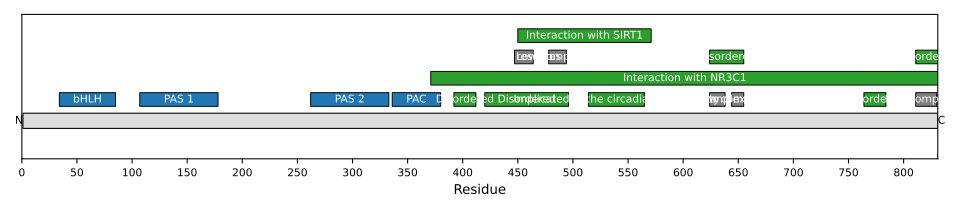
1: Transcriptional activator which forms a core component of the circadian clock. The circadian clock, an internal time-keeping system, regulates various physiological processes through the generation of approximately 24 hour circadian rhythms in gene expression, which are translated into rhythms in metabolism and behavior. It is derived from the Latin roots 'circa' (about) and 'diem' (day) and acts as an important regulator of a wide array of physiological functions including metabolism, sleep, body temperature, blood pressure, endocrine, immune, cardiovascular, and renal function. Consists of two major components: the central clock, residing in the suprachiasmatic nucleus (SCN) of the brain, and the peripheral clocks that are present in nearly every tissue and organ system. Both the central and peripheral clocks can be reset by environmental cues, also known as Zeitgebers (German for 'timegivers'). The predominant Zeitgeber for the central clock is light, which is sensed by retina and signals directly to the SCN. The central clock entrains the peripheral clocks through neuronal and hormonal signals, body temperature and feeding-related cues, aligning all clocks with the external light/dark cycle. Circadian rhythms allow an organism to achieve temporal homeostasis with its environment at the molecular level by regulating gene expression to create a peak of protein expression once every 24 hours to control when a particular physiological process is most active with respect to the solar day. Transcription and translation of core clock components (CLOCK, NPAS2, BMAL1, BMAL2, PER1, PER2, PER3, CRY1 and CRY2) plays a critical role in rhythm generation, whereas delays imposed by post-translational modifications (PTMs) are important for determining the period (tau) of the rhythms (tau refers to the period of a rhythm and is the length, in time, of one complete cycle). A diurnal rhythm is synchronized with the day/night cycle, while the ultradian and infradian rhythms have a period shorter and longer than 24 hours, respectively. Disruptions in the circadian rhythms contribute to the pathology of cardiovascular diseases, cancer, metabolic syndromes and aging. A transcription/translation feedback loop (TTFL) forms the core of the molecular circadian clock mechanism. Transcription factors, CLOCK or NPAS2 and BMAL1 or BMAL2, form the positive limb of the feedback loop, act in the form of a heterodimer and activate the transcription of core clock genes and clock-controlled genes (involved in key metabolic processes), harboring E-box elements (5'-CACGTG-3') within their promoters. The core clock genes: PER1/2/3 and CRY1/2 which are transcriptional repressors form the negative limb of the feedback loop and interact with the CLOCK|NPAS2-BMAL1|BMAL2 heterodimer inhibiting its activity and thereby negatively regulating their own expression. This heterodimer also activates nuclear receptors NR1D1/2 and RORA/B/G, which form a second feedback loop and which activate and repress BMAL1 transcription, respectively. Regulates the circadian expression of ICAM1, VCAM1, CCL2, THPO and MPL and also acts as an enhancer of the transactivation potential of NF-kappaB. Plays an important role in the homeostatic regulation of sleep. The CLOCK-BMAL1 heterodimer regulates the circadian expression of SERPINE1/PAI1, VWF, B3, CCRN4L/NOC, NAMPT, DBP, MYOD1, PPARGC1A, PPARGC1B, SIRT1, GYS2, F7, NGFR, GNRHR, BHLHE40/DEC1, ATF4, MTA1, KLF10 and also genes implicated in glucose and lipid metabolism. Promotes rhythmic chromatin opening, regulating the DNA accessibility of other transcription factors. The CLOCK-BMAL2 heterodimer activates the transcription of SERPINE1/PAI1 and BHLHE40/DEC1. The preferred binding motif for the CLOCK-BMAL1 heterodimer is 5'-CACGTGA-3', which contains a flanking adenine nucleotide at the 3-prime end of the canonical 6-nucleotide E-box sequence (PubMed:23229515). CLOCK specifically binds to the half-site 5'-CAC-3', while BMAL1 binds to the half-site 5'-GTGA-3' (PubMed:23229515). The CLOCK-BMAL1 heterodimer also recognizes the non-canonical E-box motifs 5'-AACGTGA-3' and 5'-CATGTGA-3' (PubMed:23229515). CLOCK has an intrinsic acetyltransferase activity, which enables circadian chromatin remodeling by acetylating histones and nonhistone proteins, including its own partner BMAL1. Represses glucocorticoid receptor NR3C1/GR-induced transcriptional activity by reducing the association of NR3C1/GR to glucocorticoid response elements (GREs) via the acetylation of multiple lysine residues located in its hinge region (PubMed:21980503). The acetyltransferase activity of CLOCK is as important as its transcription activity in circadian control. Acetylates metabolic enzymes IMPDH2 and NDUFA9 in a circadian manner. Facilitated by BMAL1, rhythmically interacts and acetylates argininosuccinate synthase 1 (ASS1) leading to enzymatic inhibition of ASS1 as well as the circadian oscillation of arginine biosynthesis and subsequent ureagenesis (PubMed:28985504). Drives the circadian rhythm of blood pressure through transcriptional activation of ATP1B1 (By similarity)