Period circadian protein homolog 1 (hPER1) (Circadian clock protein PERIOD 1) (Circadian pacemaker protein Rigui)
1_MSGPL 6_ EGADG 11_ GGDPR 16_ PGESF 21_ CPGGV 26_ PSPGP 31_ PQHRP 36_ CPGPS 41_ LADDT 46_ DANSN 51_ GSSGN 56_ ESNGH 61_ ESRGA 66_ SQRSS 71_ HSSSS 76_ GNGKD 81_ SALLE 86_ TTESS 91_ KSTNS 96_ QSPSP 101_ PSSSI 106_ AYSLL 111_ SASSE 116_ QDNPS 121_ TSGCS 126_ SEQSA 131_ RARTQ 136_ KELMT 141_ ALREL 146_ KLRLP 151_ PERRG 156_ KGRSG 161_ TLATL 166_ QYALA 171_ CVKQV 176_ QANQE 181_ YYQQW 186_ SLEEG 191_ EPCSM 196_ DMSTY 201_ TLEEL 206_ EHITS 211_ EYTLQ 216_ NQDTF 221_ SVAVS 226_ FLTGR 231_ IVYIS 236_ EQAAV 241_ LLRCK 246_ RDVFR 251_ GTRFS 256_ ELLAP 261_ QDVGV 266_ FYGST 271_ APSRL 276_ PTWGT 281_ GASAG 286_ SGLRD 291_ FTQEK 296_ SVFCR 301_ IRGGP 306_ DRDPG 311_ PRYQP 316_ FRLTP 321_ YVTKI 326_ RVSDG 331_ APAQP 336_ CCLLI 341_ AERIH 346_ SGYEA 351_ PRIPP 356_ DKRIF 361_ TTRHT 366_ PSCLF 371_ QDVDE 376_ RAAPL 381_ LGYLP 386_ QDLLG 391_ APVLL 396_ FLHPE 401_ DRPLM 406_ LAIHK 411_ KILQL 416_ AGQPF 421_ DHSPI 426_ RFCAR 431_ NGEYV 436_ TMDTS 441_ WAGFV 446_ HPWSR 451_ KVAFV 456_ LGRHK 461_ VRTAP 466_ LNEDV 471_ FTPPA 476_ PSPAP 481_ SLDTD 486_ IQELS 491_ EQIHR 496_ LLLQP 501_ VHSPS 506_ PTGLC 511_ GVGAV 516_ TSPGP 521_ LHSPG 526_ SSSDS 531_ NGGDA 536_ EGPGP 541_ PAPVT 546_ FQQIC 551_ KDVHL 556_ VKHQG 561_ QQLFI 566_ ESRAR 571_ PQSRP 576_ RLPAT 581_ GTFKA 586_ KALPC 591_ QSPDP 596_ ELEAG 601_ SAPVQ 606_ APLAL 611_ VPEEA 616_ ERKEA 621_ SSCSY 626_ QQINC 631_ LDSIL 636_ RYLES 641_ CNLPS 646_ TTKRK 651_ CASSS 656_ SYTTS 661_ SASDD 666_ DRQRT 671_ GPVSV 676_ GTKKD 681_ PPSAA 686_ LSGEG 691_ ATPRK 696_ EPVVG 701_ GTLSP 706_ LALAN 711_ KAESV 716_ VSVTS 721_ QCSFS 726_ STIVH 731_ VGDKK 736_ PPESD 741_ IIMME 746_ DLPGL 751_ APGPA 756_ PSPAP 761_ SPTVA 766_ PDPAP 771_ DAYRP 776_ VGLTK 781_ AVLSL 786_ HTQKE 791_ EQAFL 796_ SRFRD 801_ LGRLR 806_ GLDSS 811_ STAPS 816_ ALGER 821_ GCHHG 826_ PAPPS 831_ RRHHC 836_ RSKAK 841_ RSRHH 846_ QNPRA 851_ EAPCY 856_ VSHPS 861_ PVPPS 866_ TPWPT 871_ PPATT 876_ PFPAV 881_ VQPYP 886_ LPVFS 891_ PRGGP 896_ QPLPP 901_ APTSV 906_ PPAAF 911_ PAPLV 916_ TPMVA 921_ LVLPN 926_ YLFPT 931_ PSSYP 936_ YGALQ 941_ TPAEG 946_ PPTPA 951_ SHSPS 956_ PSLPA 961_ LAPSP 966_ PHRPD 971_ SPLFN 976_ SRCSS 981_ PLQLN 986_ LLQLE 991_ ELPRA 996_ EGAAV 1001_ AGGPG 1006_ SSAGP 1011_ PPPSA 1016_ EAAEP 1021_ EARLA 1026_ EVTES 1031_ SNQDA 1036_ LSGSS 1041_ DLLEL 1046_ LLQED 1051_ SRSGT 1056_ GSAAS 1061_ GSLGS 1066_ GLGSG 1071_ SGSGS 1076_ HEGGS 1081_ TSASI 1086_ TRSSQ 1091_ SSHTS 1096_ KYFGS 1101_ IDSSE 1106_ AEAGA 1111_ ARGGA 1116_ EPGDQ 1121_ VIKYV 1126_ LQDPI 1131_ WLLMA 1136_ NADQR 1141_ VMMTY 1146_ QVPSR 1151_ DMTSV 1156_ LKQDR 1161_ ERLRA 1166_ MQKQQ 1171_ PRFSE 1176_ DQRRE 1181_ LGAVH 1186_ SWVRK 1191_ GQLPR 1196_ ALDVM 1201_ ACVDC 1206_ GSSTQ 1211_ DPGHP 1216_ DDPLF 1221_ SELDG 1226_ LGLEP 1231_ MEEGG 1236_ GEQGS 1241_ SGGGS 1246_ GEGEG 1251_ CEEAQ 1256_ GGAKA 1261_ SSSQD 1266_ LAMEE 1271_ EEEGR 1276_ SSSSP 1281_ALPTA
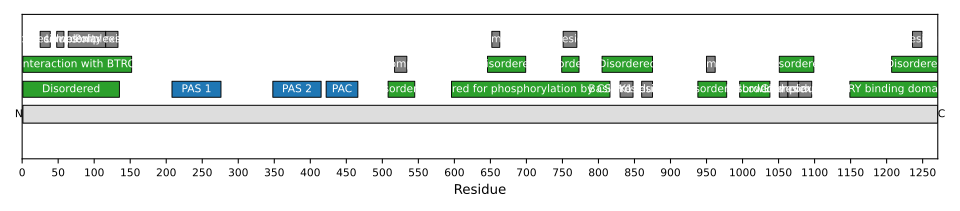
1: Transcriptional repressor which forms a core component of the circadian clock. The circadian clock, an internal time-keeping system, regulates various physiological processes through the generation of approximately 24 hour circadian rhythms in gene expression, which are translated into rhythms in metabolism and behavior. It is derived from the Latin roots 'circa' (about) and 'diem' (day) and acts as an important regulator of a wide array of physiological functions including metabolism, sleep, body temperature, blood pressure, endocrine, immune, cardiovascular, and renal function. Consists of two major components: the central clock, residing in the suprachiasmatic nucleus (SCN) of the brain, and the peripheral clocks that are present in nearly every tissue and organ system. Both the central and peripheral clocks can be reset by environmental cues, also known as Zeitgebers (German for 'timegivers'). The predominant Zeitgeber for the central clock is light, which is sensed by retina and signals directly to the SCN. The central clock entrains the peripheral clocks through neuronal and hormonal signals, body temperature and feeding-related cues, aligning all clocks with the external light/dark cycle. Circadian rhythms allow an organism to achieve temporal homeostasis with its environment at the molecular level by regulating gene expression to create a peak of protein expression once every 24 hours to control when a particular physiological process is most active with respect to the solar day. Transcription and translation of core clock components (CLOCK, NPAS2, BMAL1, BMAL2, PER1, PER2, PER3, CRY1 and CRY2) plays a critical role in rhythm generation, whereas delays imposed by post-translational modifications (PTMs) are important for determining the period (tau) of the rhythms (tau refers to the period of a rhythm and is the length, in time, of one complete cycle). A diurnal rhythm is synchronized with the day/night cycle, while the ultradian and infradian rhythms have a period shorter and longer than 24 hours, respectively. Disruptions in the circadian rhythms contribute to the pathology of cardiovascular diseases, cancer, metabolic syndromes and aging. A transcription/translation feedback loop (TTFL) forms the core of the molecular circadian clock mechanism. Transcription factors, CLOCK or NPAS2 and BMAL1 or BMAL2, form the positive limb of the feedback loop, act in the form of a heterodimer and activate the transcription of core clock genes and clock-controlled genes (involved in key metabolic processes), harboring E-box elements (5'-CACGTG-3') within their promoters. The core clock genes: PER1/2/3 and CRY1/2 which are transcriptional repressors form the negative limb of the feedback loop and interact with the CLOCK|NPAS2-BMAL1|BMAL2 heterodimer inhibiting its activity and thereby negatively regulating their own expression. This heterodimer also activates nuclear receptors NR1D1/2 and RORA/B/G, which form a second feedback loop and which activate and repress BMAL1 transcription, respectively. Regulates circadian target genes expression at post-transcriptional levels, but may not be required for the repression at transcriptional level. Controls PER2 protein decay. Represses CRY2 preventing its repression on CLOCK/BMAL1 target genes such as FXYD5 and SCNN1A in kidney and PPARA in liver. Besides its involvement in the maintenance of the circadian clock, has an important function in the regulation of several processes. Participates in the repression of glucocorticoid receptor NR3C1/GR-induced transcriptional activity by reducing the association of NR3C1/GR to glucocorticoid response elements (GREs) by BMAL1:CLOCK. Plays a role in the modulation of the neuroinflammatory state via the regulation of inflammatory mediators release, such as CCL2 and IL6. In spinal astrocytes, negatively regulates the MAPK14/p38 and MAPK8/JNK MAPK cascades as well as the subsequent activation of NFkappaB. Coordinately regulates the expression of multiple genes that are involved in the regulation of renal sodium reabsorption. Can act as gene expression activator in a gene and tissue specific manner, in kidney enhances WNK1 and SLC12A3 expression in collaboration with CLOCK. Modulates hair follicle cycling. Represses the CLOCK-BMAL1 induced transcription of BHLHE40/DEC1