Aquaporin-9 (AQP-9) (Aquaglyceroporin-9) (Small solute channel 1)
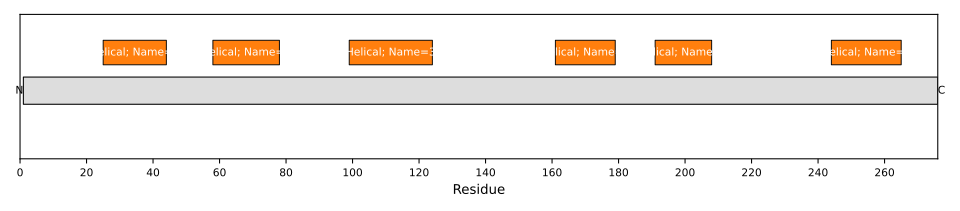
1_MQPEG 6_ AEKGK 11_ SFKQR 16_ LVLKS 21_ SLAKE 26_ TLSEF 31_ LGTFI 36_ LIVLG 41_ CGCVA 46_ QAILS 51_ RGRFG 56_ GVITI 61_ NVGFS 66_ MAVAM 71_ AIYVA 76_ GGVSG 81_ GHINP 86_ AVSLA 91_ MCLFG 96_ RMKWF 101_ KLPFY 106_ VGAQF 111_ LGAFV 116_ GAATV 121_ FGIYY 126_ DGLMS 131_ FAGGK 136_ LLIVG 141_ ENATA 146_ HIFAT 151_ YPAPY 156_ LSLAN 161_ AFADQ 166_ VVATM 171_ ILLII 176_ VFAIF 181_ DSRNL 186_ GAPRG 191_ LEPIA 196_ IGLLI 201_ IVIAS 206_ SLGLN 211_ SGCAM 216_ NPARD 221_ LSPRL 226_ FTALA 231_ GWGFE 236_ VFRAG 241_ NNFWW 246_ IPVVG 251_ PLVGA 256_ VIGGL 261_ IYVLV 266_ IEIHH 271_ PEPDS 276_ VFKTE 281_ QSEDK 286_PEKYE
1: Aquaglyceroporins form homotetrameric transmembrane channels, with each monomer independently mediating glycerol and water transport across the plasma membrane along their osmotic gradient (PubMed:10564231, PubMed:30420639, PubMed:35054513, PubMed:9514918). AQP9 is the primary route for glycerol uptake in hepatocytes, supporting hepatic gluconeogenesis (By similarity). It exhibits broad specificity and may transport various small, non-charged solutes, including carbamides, polyols, purines, and pyrimidines (PubMed:10564231). AQP9 may also facilitate hepatic urea extrusion (PubMed:10564231, PubMed:9514918). Due to its permeability to lactate, AQP9 might participate in the astrocyte-to-neuron lactate shuttle, supplying neurons with energy (PubMed:10564231, PubMed:35054513). Additionally, AQP9 is permeable to arsenite, contributing to arsenic excretion by the liver and providing partial protection against arsenic toxicity (PubMed:10564231). It is also permeable to H2O2 in vivo (PubMed:26837049). Could also be permeable to ammonium (By similarity)