Receptor-interacting serine/threonine-protein kinase 2 (EC 2.7.11.1) (CARD-containing interleukin-1 beta-converting enzyme-associated kinase) (CARD-containing IL-1 beta ICE-kinase) (RIP-like-interacting CLARP kinase) (Receptor-interacting protein 2) (RIP-2) (Tyrosine-protein kinase RIPK2) (EC 2.7.10.2)
1_MNGEA 6_ ICSAL 11_ PTIPY 16_ HKLAD 21_ LRYLS 26_ RGASG 31_ TVSSA 36_ RHADW 41_ RVQVA 46_ VKHLH 51_ IHTPL 56_ LDSER 61_ KDVLR 66_ EAEIL 71_ HKARF 76_ SYILP 81_ ILGIC 86_ NEPEF 91_ LGIVT 96_ EYMPN 101_ GSLNE 106_ LLHRK 111_ TEYPD 116_ VAWPL 121_ RFRIL 126_ HEIAL 131_ GVNYL 136_ HNMTP 141_ PLLHH 146_ DLKTQ 151_ NILLD 156_ NEFHV 161_ KIADF 166_ GLSKW 171_ RMMSL 176_ SQSRS 181_ SKSAP 186_ EGGTI 191_ IYMPP 196_ ENYEP 201_ GQKSR 206_ ASIKH 211_ DIYSY 216_ AVITW 221_ EVLSR 226_ KQPFE 231_ DVTNP 236_ LQIMY 241_ SVSQG 246_ HRPVI 251_ NEESL 256_ PYDIP 261_ HRARM 266_ ISLIE 271_ SGWAQ 276_ NPDER 281_ PSFLK 286_ CLIEL 291_ EPVLR 296_ TFEEI 301_ TFLEA 306_ VIQLK 311_ KTKLQ 316_ SVSSA 321_ IHLCD 326_ KKKME 331_ LSLNI 336_ PVNHG 341_ PQEES 346_ CGSSQ 351_ LHENS 356_ GSPET 361_ SRSLP 366_ APQDN 371_ DFLSR 376_ KAQDC 381_ YFMKL 386_ HHCPG 391_ NHSWD 396_ STISG 401_ SQRAA 406_ FCDHK 411_ TTPCS 416_ SAIIN 421_ PLSTA 426_ GNSER 431_ LQPGI 436_ AQQWI 441_ QSKRE 446_ DIVNQ 451_ MTEAC 456_ LNQSL 461_ DALLS 466_ RDLIM 471_ KEDYE 476_ LVSTK 481_ PTRTS 486_ KVRQL 491_ LDTTD 496_ IQGEE 501_ FAKVI 506_ VQKLK 511_ DNKQM 516_ GLQPY 521_ PEILV 526_ VSRSP 531_SLNLL
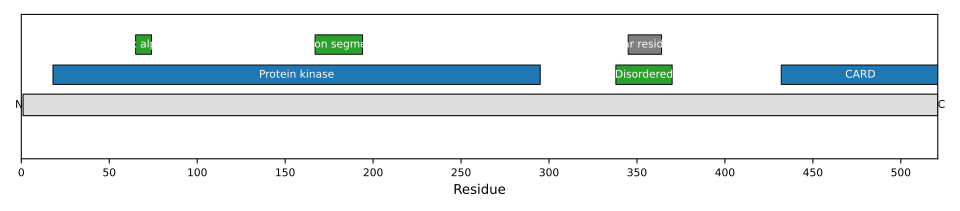
1: Serine/threonine/tyrosine-protein kinase that plays an essential role in modulation of innate and adaptive immune responses (PubMed:14638696, PubMed:17054981, PubMed:21123652, PubMed:28656966, PubMed:9575181, PubMed:9642260). Acts as a key effector of NOD1 and NOD2 signaling pathways: upon activation by bacterial peptidoglycans, NOD1 and NOD2 oligomerize and recruit RIPK2 via CARD-CARD domains, leading to the formation of RIPK2 filaments (PubMed:17054981, PubMed:17562858, PubMed:21123652, PubMed:22607974, PubMed:28656966, PubMed:29452636, PubMed:30026309). Once recruited, RIPK2 autophosphorylates and undergoes 'Lys-63'-linked polyubiquitination by E3 ubiquitin ligases XIAP, BIRC2 and BIRC3, as well as 'Met-1'-linked (linear) polyubiquitination by the LUBAC complex, becoming a scaffolding protein for downstream effectors (PubMed:22607974, PubMed:28545134, PubMed:29452636, PubMed:30026309, PubMed:30279485, PubMed:30478312). 'Met-1'-linked polyubiquitin chains attached to RIPK2 recruit IKBKG/NEMO, which undergoes 'Lys-63'-linked polyubiquitination in a RIPK2-dependent process (PubMed:17562858, PubMed:22607974, PubMed:29452636, PubMed:30026309). 'Lys-63'-linked polyubiquitin chains attached to RIPK2 serve as docking sites for TAB2 and TAB3 and mediate the recruitment of MAP3K7/TAK1 to IKBKG/NEMO, inducing subsequent activation of IKBKB/IKKB (PubMed:18079694). In turn, NF-kappa-B is released from NF-kappa-B inhibitors and translocates into the nucleus where it activates the transcription of hundreds of genes involved in immune response, growth control, or protection against apoptosis (PubMed:18079694). The protein kinase activity is dispensable for the NOD1 and NOD2 signaling pathways (PubMed:29452636, PubMed:30026309). Contributes to the tyrosine phosphorylation of the guanine exchange factor ARHGEF2 through Src tyrosine kinase leading to NF-kappa-B activation by NOD2 (PubMed:21887730). Also involved in adaptive immunity: plays a role during engagement of the T-cell receptor (TCR) in promoting BCL10 phosphorylation and subsequent NF-kappa-B activation (PubMed:14638696). Plays a role in the inactivation of RHOA in response to NGFR signaling (PubMed:26646181)