Histone-lysine N-methyltransferase SUV39H1 (EC 2.1.1.355) (Histone H3-K9 methyltransferase 1) (H3-K9-HMTase 1) (Lysine N-methyltransferase 1A) (Position-effect variegation 3-9 homolog) (Suppressor of variegation 3-9 homolog 1) (Su(var)3-9 homolog 1)
1_MAENL 6_ KGCSV 11_ CCKSS 16_ WNQLQ 21_ DLCRL 26_ AKLSC 31_ PALGI 36_ SKRNL 41_ YDFEV 46_ EYLCD 51_ YKKIR 56_ EQEYY 61_ LVKWR 66_ GYPDS 71_ ESTWE 76_ PRQNL 81_ KCVRI 86_ LKQFH 91_ KDLER 96_ ELLRR 101_ HHRSK 106_ TPRHL 111_ DPSLA 116_ NYLVQ 121_ KAKQR 126_ RALRR 131_ WEQEL 136_ NAKRS 141_ HLGRI 146_ TVENE 151_ VDLDG 156_ PPRAF 161_ VYINE 166_ YRVGE 171_ GITLN 176_ QVAVG 181_ CECQD 186_ CLWAP 191_ TGGCC 196_ PGASL 201_ HKFAY 206_ NDQGQ 211_ VRLRA 216_ GLPIY 221_ ECNSR 226_ CRCGY 231_ DCPNR 236_ VVQKG 241_ IRYDL 246_ CIFRT 251_ DDGRG 256_ WGVRT 261_ LEKIR 266_ KNSFV 271_ MEYVG 276_ EIITS 281_ EEAER 286_ RGQIY 291_ DRQGA 296_ TYLFD 301_ LDYVE 306_ DVYTV 311_ DAAYY 316_ GNISH 321_ FVNHS 326_ CDPNL 331_ QVYNV 336_ FIDNL 341_ DERLP 346_ RIAFF 351_ ATRTI 356_ RAGEE 361_ LTFDY 366_ NMQVD 371_ PVDME 376_ STRMD 381_ SNFGL 386_ AGLPG 391_ SPKKR 396_ VRIEC 401_ KCGTE 406_SCRKY
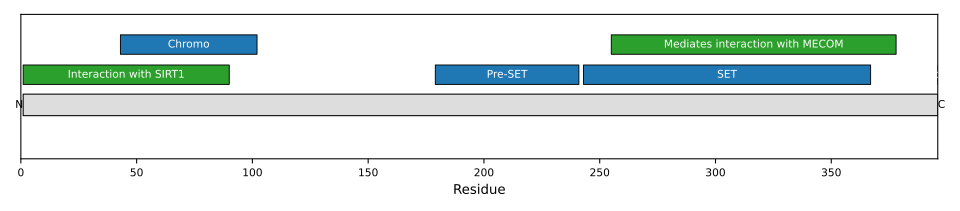
1: Histone methyltransferase that specifically trimethylates 'Lys-9' of histone H3 using monomethylated H3 'Lys-9' as substrate. Also weakly methylates histone H1 (in vitro). H3 'Lys-9' trimethylation represents a specific tag for epigenetic transcriptional repression by recruiting HP1 (CBX1, CBX3 and/or CBX5) proteins to methylated histones. Mainly functions in heterochromatin regions, thereby playing a central role in the establishment of constitutive heterochromatin at pericentric and telomere regions. H3 'Lys-9' trimethylation is also required to direct DNA methylation at pericentric repeats. SUV39H1 is targeted to histone H3 via its interaction with RB1 and is involved in many processes, such as repression of MYOD1-stimulated differentiation, regulation of the control switch for exiting the cell cycle and entering differentiation, repression by the PML-RARA fusion protein, BMP-induced repression, repression of switch recombination to IgA and regulation of telomere length. Component of the eNoSC (energy-dependent nucleolar silencing) complex, a complex that mediates silencing of rDNA in response to intracellular energy status and acts by recruiting histone-modifying enzymes. The eNoSC complex is able to sense the energy status of cell: upon glucose starvation, elevation of NAD(+)/NADP(+) ratio activates SIRT1, leading to histone H3 deacetylation followed by dimethylation of H3 at 'Lys-9' (H3K9me2) by SUV39H1 and the formation of silent chromatin in the rDNA locus. Recruited by the large PER complex to the E-box elements of the circadian target genes such as PER2 itself or PER1, contributes to the conversion of local chromatin to a heterochromatin-like repressive state through H3 'Lys-9' trimethylation
2: (Microbial infection) Plays a role in defense against mycobacterial infections. Methylates M.tuberculosis HupB on 'Lys-140', probably methylates HupB of M.bovis also. Methylation has an inhibitory effect on mycobacterial growth in the host. Macrophages expressing about 60% SUV39H1 are slightly more susceptible to M.bovis or M.tuberculosis infection. Chaetocin (an inhibitor of this enzyme) increases macrophage survival of M.tuberculosis. This protein inhibits biofilm formation by M.tuberculosis via 'Lys-140' trimethylation