Carbohydrate sulfotransferase 10 (EC 2.8.2.-) (HNK-1 sulfotransferase) (HNK-1ST) (HNK1ST) (HuHNK-1ST)
1_MHHQW 6_ LLLAA 11_ CFWVI 16_ FMFMV 21_ ASKFI 26_ TLTFK 31_ DPDVY 36_ SAKQE 41_ FLFLT 46_ TMPEV 51_ RKLPE 56_ EKHIP 61_ EELKP 66_ TGKEL 71_ PDSQL 76_ VQPLV 81_ YMERL 86_ ELIRN 91_ VCRDD 96_ ALKNL 101_ SHTPV 106_ SKFVL 111_ DRIFV 116_ CDKHK 121_ ILFCQ 126_ TPKVG 131_ NTQWK 136_ KVLIV 141_ LNGAF 146_ SSIEE 151_ IPENV 156_ VHDHE 161_ KNGLP 166_ RLSSF 171_ SDAEI 176_ QKRLK 181_ TYFKF 186_ FIVRD 191_ PFERL 196_ ISAFK 201_ DKFVH 206_ NPRFE 211_ PWYRH 216_ EIAPG 221_ IIRKY 226_ RRNRT 231_ ETRGI 236_ QFEDF 241_ VRYLG 246_ DPNHR 251_ WLDLQ 256_ FGDHI 261_ IHWVT 266_ YVELC 271_ APCEI 276_ MYSVI 281_ GHHET 286_ LEDDA 291_ PYILK 296_ EAGID 301_ HLVSY 306_ PTIPP 311_ GITVY 316_ NRTKV 321_ EHYFL 326_ GISKR 331_ DIRRL 336_ YARFE 341_ GDFKL 346_ FGYQK 351_PDFLL
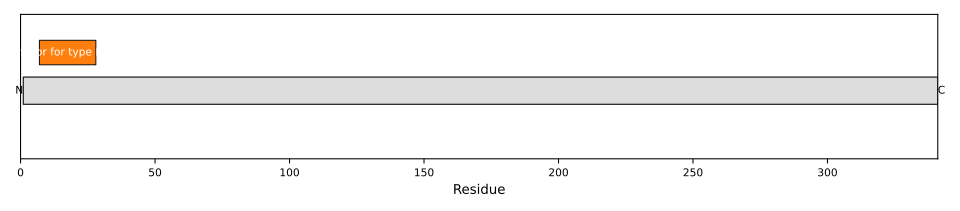
1: Catalyzes the transfer of sulfate from 3'-phosphoadenylyl sulfate (PAPS) to position 3 of terminal glucuronic acid of both protein- and lipid-linked oligosaccharides. Participates in biosynthesis of HNK-1 carbohydrate structure 3-O-sulfo-beta-D-GlcA-(1->3)-beta-D-Gal-(1->4)-D-GlcNAc-R, a sulfated glucuronyl-lactosaminyl residue carried by many neural recognition molecules, which is involved in cell interactions during ontogenetic development and in synaptic plasticity in the adult. May be indirectly involved in synapse plasticity of the hippocampus, via its role in HNK-1 biosynthesis (PubMed:9478973). Sulfates terminal glucuronyl residue of the laminin globular (LG)-domain binding epitope on DAG1/alpha-dystroglycan and prevents further polymerization by LARGE1 glycosyltransferase. Likely defines the chain length of LG epitope, conferring binding specificity to extracellular matrix components (PubMed:32149355). Plays a role in down-regulating the steroid hormones. Sulfates glucuronidated estrogens and androgens with an impact in hormone cycle and fertility. Has a preference for glucuronyl moiety at the 3-hydroxyl group of a sterol ring rather than the 17-hydroxyl group, showing high catalytic efficiency for 17beta-estradiol 3-O-(beta-D-glucuronate) and dehydroepiandrosterone 3-O-(beta-D-glucuronate) hormones (PubMed:23269668)