A-kinase anchor protein 10, mitochondrial (AKAP-10) (Dual specificity A kinase-anchoring protein 2) (D-AKAP-2) (Protein kinase A-anchoring protein 10) (PRKA10)
1_MRGAG 6_ PSPRQ 11_ SPRTL 16_ RPDPG 21_ PAMSF 26_ FRRKV 31_ KGKEQ 36_ EKTSD 41_ VKSIK 46_ ASISV 51_ HSPQK 56_ STKNH 61_ ALLEA 66_ AGPSH 71_ VAINA 76_ ISANM 81_ DSFSS 86_ SRTAT 91_ LKKQP 96_ SHMEA 101_ AHFGD 106_ LGRSC 111_ LDYQT 116_ QETKS 121_ SLSKT 126_ LEQVL 131_ HDTIV 136_ LPYFI 141_ QFMEL 146_ RRMEH 151_ LVKFW 156_ LEAES 161_ FHSTT 166_ WSRIR 171_ AHSLN 176_ TVKQS 181_ SLAEP 186_ VSPSK 191_ KHETT 196_ ASFLT 201_ DSLDK 206_ RLEDS 211_ GSAQL 216_ FMTHS 221_ EGIDL 226_ NNRTN 231_ STQNH 236_ LLLSQ 241_ ECDSA 246_ HSLRL 251_ EMARA 256_ GTHQV 261_ SMETQ 266_ ESSST 271_ LTVAS 276_ RNSPA 281_ SPLKE 286_ LSGKL 291_ MKSIE 296_ QDAVN 301_ TFTKY 306_ ISPDA 311_ AKPIP 316_ ITEAM 321_ RNDII 326_ ARICG 331_ EDGQV 336_ DPNCF 341_ VLAQS 346_ IVFSA 351_ MEQEH 356_ FSEFL 361_ RSHHF 366_ CKYQI 371_ EVLTS 376_ GTVYL 381_ ADILF 386_ CESAL 391_ FYFSE 396_ YMEKE 401_ DAVNI 406_ LQFWL 411_ AADNF 416_ QSQLA 421_ AKKGQ 426_ YDGQE 431_ AQNDA 436_ MILYD 441_ KYFSL 446_ QATHP 451_ LGFDD 456_ VVRLE 461_ IESNI 466_ CREGG 471_ PLPNC 476_ FTTPL 481_ RQAWT 486_ TMEKV 491_ FLPGF 496_ LSSNL 501_ YYKYL 506_ NDLIH 511_ SVRGD 516_ EFLGG 521_ NVSLT 526_ APGSV 531_ GPPDE 536_ SHPGS 541_ SDSSA 546_ SQSSV 551_ KKASI 556_ KILKN 561_ FDEAI 566_ IVDAA 571_ SLDPE 576_ SLYQR 581_ TYAGK 586_ MTFGR 591_ VSDLG 596_ QFIRE 601_ SEPEP 606_ DVRKS 611_ KGSMF 616_ SQAMK 621_ KWVQG 626_ NTDEA 631_ QEELA 636_ WKIAK 641_ MIVSD 646_ IMQQA 651_ QYDQP 656_LEKST
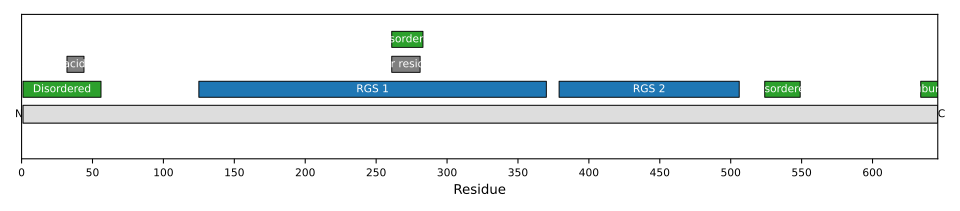
1: Differentially targeted protein that binds to type I and II regulatory subunits of protein kinase A and anchors them to the mitochondria or the plasma membrane. Although the physiological relevance between PKA and AKAPS with mitochondria is not fully understood, one idea is that BAD, a proapoptotic member, is phosphorylated and inactivated by mitochondria-anchored PKA. It cannot be excluded too that it may facilitate PKA as well as G protein signal transduction, by acting as an adapter for assembling multiprotein complexes. With its RGS domain, it could lead to the interaction to G-alpha proteins, providing a link between the signaling machinery and the downstream kinase (By similarity)