HIV Tat-specific factor 1 (Tat-SF1)
1_MSGTN 6_ LDGND 11_ EFDEQ 16_ LRMQE 21_ LYGDG 26_ KDGDT 31_ QTDAG 36_ GEPDS 41_ LGQQP 46_ TDTPY 51_ EWDLD 56_ KKAWF 61_ PKITE 66_ DFIAT 71_ YQANY 76_ GFSND 81_ GASSS 86_ TANVE 91_ DVHAR 96_ TAEEP 101_ PQEKA 106_ PEPTD 111_ ARKKG 116_ EKRKA 121_ ESGWF 126_ HVEED 131_ RNTNV 136_ YVSGL 141_ PPDIT 146_ VDEFI 151_ QLMSK 156_ FGIIM 161_ RDPQT 166_ EEFKV 171_ KLYKD 176_ NQGNL 181_ KGDGL 186_ CCYLK 191_ RESVE 196_ LALKL 201_ LDEDE 206_ IRGYK 211_ LHVEV 216_ AKFQL 221_ KGEYD 226_ ASKKK 231_ KKCKD 236_ YKKKL 241_ SMQQK 246_ QLDWR 251_ PERRA 256_ GPSRM 261_ RHERV 266_ VIIKN 271_ MFHPM 276_ DFEDD 281_ PLVLN 286_ EIRED 291_ LRVEC 296_ SKFGQ 301_ IRKLL 306_ LFDRH 311_ PDGVA 316_ SVSFR 321_ DPEEA 326_ DYCIQ 331_ TLDGR 336_ WFGGR 341_ QITAQ 346_ AWDGT 351_ TDYQV 356_ EETSR 361_ EREER 366_ LRGWE 371_ AFLNA 376_ PEANR 381_ GLRRS 386_ DSVSA 391_ SERAG 396_ PSRAR 401_ HFSEH 406_ PSTSK 411_ MNAQE 416_ TATGM 421_ AFEEP 426_ IDEKK 431_ FEKTE 436_ DGGEF 441_ EEGAS 446_ ENNAK 451_ ESSPE 456_ KEAEE 461_ GCPEK 466_ ESEEG 471_ CPKRG 476_ FEGSC 481_ SQKES 486_ EEGNP 491_ VRGSE 496_ EDSPK 501_ KESKK 506_ KTLKN 511_ DCEEN 516_ GLAKE 521_ SEDDL 526_ NKESE 531_ EEVGP 536_ TKESE 541_ EDDSE 546_ KESDE 551_ DCSEK 556_ QSEDG 561_ SEREF 566_ EENGL 571_ EKDLD 576_ EEGSE 581_ KELHE 586_ NVLDK 591_ ELEEN 596_ DSENS 601_ EFEDD 606_ GSEKV 611_ LDEEG 616_ SEREF 621_ DEDSD 626_ EKEEE 631_ EDTYE 636_ KVFDD 641_ ESDEK 646_ EDEEY 651_ ADEKG 656_ LEAAD 661_ KKAEE 666_ GDADE 671_ KLFEE 676_ SDDKE 681_ DEDAD 686_ GKEVE 691_ DADEK 696_ LFEDD 701_ DSNEK 706_ LFDEE 711_ EDSSE 716_ KLFDD 721_ SDERG 726_ TLGGF 731_ GSVEE 736_ GPLST 741_ GSSFI 746_LSSDD
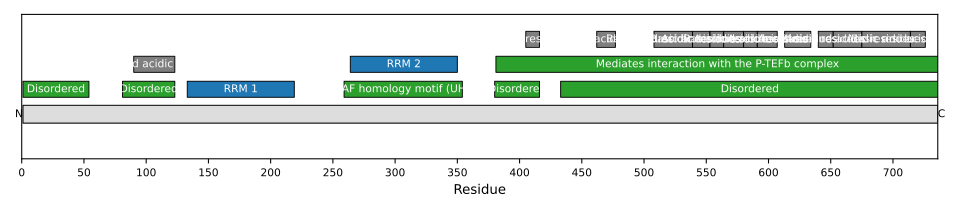
1: Component of the 17S U2 SnRNP complex of the spliceosome, a large ribonucleoprotein complex that removes introns from transcribed pre-mRNAs (PubMed:30567737, PubMed:32494006, PubMed:34822310). The 17S U2 SnRNP complex (1) directly participates in early spliceosome assembly and (2) mediates recognition of the intron branch site during pre-mRNA splicing by promoting the selection of the pre-mRNA branch-site adenosine, the nucleophile for the first step of splicing (PubMed:30567737, PubMed:32494006, PubMed:34822310). Within the 17S U2 SnRNP complex, HTATSF1 is required to stabilize the branchpoint-interacting stem loop (PubMed:34822310). HTATSF1 is displaced from the 17S U2 SnRNP complex before the stable addition of the 17S U2 SnRNP complex to the spliceosome, destabilizing the branchpoint-interacting stem loop and allowing to probe intron branch site sequences (PubMed:32494006, PubMed:34822310). Also acts as a regulator of transcriptional elongation, possibly by mediating the reciprocal stimulatory effect of splicing on transcriptional elongation (PubMed:10454543, PubMed:10913173, PubMed:11780068). Involved in double-strand break (DSB) repair via homologous recombination in S-phase by promoting the recruitment of TOPBP1 to DNA damage sites (PubMed:35597237). Mechanistically, HTATSF1 is (1) recruited to DNA damage sites in S-phase via interaction with poly-ADP-ribosylated RPA1 and (2) phosphorylated by CK2, promoting recruitment of TOPBP1, thereby facilitating RAD51 nucleofilaments formation and RPA displacement, followed by homologous recombination (PubMed:35597237)
2: (Microbial infection) In case of infection by HIV-1, it is up-regulated by the HIV-1 proteins NEF and gp120, acts as a cofactor required for the Tat-enhanced transcription of the virus