Phosphatidylinositol 4-phosphate 5-kinase type-1 gamma (PIP5K1gamma) (PtdIns(4)P-5-kinase 1 gamma) (EC 2.7.1.68) (Type I phosphatidylinositol 4-phosphate 5-kinase gamma)
1_MELEV 6_ PDEAE 11_ SAEAG 16_ AVPSE 21_ AAWAA 26_ ESGAA 31_ AGLAQ 36_ KKAAP 41_ TEVLS 46_ MTAQP 51_ GPGHG 56_ KKLGH 61_ RGVDA 66_ SGETT 71_ YKKTT 76_ SSTLK 81_ GAIQL 86_ GIGYT 91_ VGHLS 96_ SKPER 101_ DVLMQ 106_ DFYVV 111_ ESIFF 116_ PSEGS 121_ NLTPA 126_ HHFQD 131_ FRFKT 136_ YAPVA 141_ FRYFR 146_ ELFGI 151_ RPDDY 156_ LYSLC 161_ NEPLI 166_ ELSNP 171_ GASGS 176_ LFYVT 181_ SDDEF 186_ IIKTV 191_ MHKEA 196_ EFLQK 201_ LLPGY 206_ YMNLN 211_ QNPRT 216_ LLPKF 221_ YGLYC 226_ VQSGG 231_ KNIRV 236_ VVMNN 241_ ILPRV 246_ VKMHL 251_ KFDLK 256_ GSTYK 261_ RRASK 266_ KEKEK 271_ SFPTY 276_ KDLDF 281_ MQDMP 286_ EGLLL 291_ DADTF 296_ SALVK 301_ TLQRD 306_ CLVLE 311_ SFKIM 316_ DYSLL 321_ LGVHN 326_ IDQHE 331_ RERQA 336_ QGAQS 341_ TSDEK 346_ RPVGQ 351_ KALYS 356_ TAMES 361_ IQGGA 366_ ARGEA 371_ IESDD 376_ TMGGI 381_ PAVNG 386_ RGERL 391_ LLHIG 396_ IIDIL 401_ QSYRF 406_ IKKLE 411_ HTWKA 416_ LVHDG 421_ DTVSV 426_ HRPSF 431_ YAERF 436_ FKFMS 441_ NTVFR 446_ KNSSL 451_ KSSPS 456_ KKGRG 461_ GALLA 466_ VKPLG 471_ PTAAF 476_ SASQI 481_ PSERE 486_ EAQYD 491_ LRGAR 496_ SYPTL 501_ EDEGR 506_ PDLLP 511_ CTPPS 516_ FEEAT 521_ TASIA 526_ TTLSS 531_ TSLSI 536_ PERSP 541_ SETSE 546_ QPRYR 551_ RRTQS 556_ SGQDG 561_ RPQEE 566_ PPAEE 571_ DLQQI 576_ TVQVE 581_ PACSV 586_ EIVVP 591_ KEEDA 596_ GVEAS 601_ PAGAS 606_ AAVEV 611_ ETASQ 616_ ASDEE 621_ GAPAS 626_ QASDE 631_ EDAPA 636_ TDIYF 641_ PTDER 646_ SWVYS 651_ PLHYS 656_ AQAPP 661_ASDGE
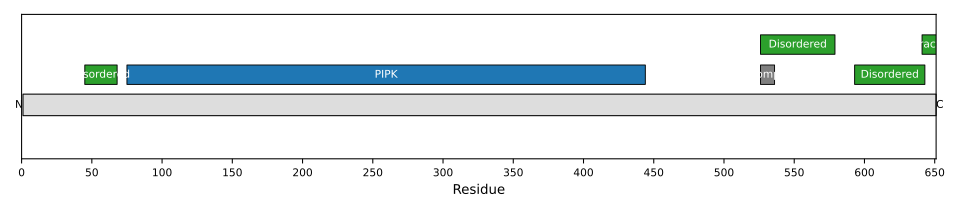
1: Catalyzes the phosphorylation of phosphatidylinositol 4-phosphate (PtdIns(4)P/PI4P) to form phosphatidylinositol 4,5-bisphosphate (PtdIns(4,5)P2/PIP2), a lipid second messenger that regulates several cellular processes such as signal transduction, vesicle trafficking, actin cytoskeleton dynamics, cell adhesion, and cell motility (PubMed:12422219, PubMed:22942276). PtdIns(4,5)P2 can directly act as a second messenger or can be utilized as a precursor to generate other second messengers: inositol 1,4,5-trisphosphate (IP3), diacylglycerol (DAG) or phosphatidylinositol-3,4,5-trisphosphate (PtdIns(3,4,5)P3/PIP3) (Probable). PIP5K1A-mediated phosphorylation of PtdIns(4)P is the predominant pathway for PtdIns(4,5)P2 synthesis (By similarity). Together with PIP5K1A, is required for phagocytosis, both enzymes regulating different types of actin remodeling at sequential steps (By similarity). Promotes particle attachment by generating the pool of PtdIns(4,5)P2 that induces controlled actin depolymerization to facilitate Fc-gamma-R clustering. Mediates RAC1-dependent reorganization of actin filaments. Required for synaptic vesicle transport (By similarity). Controls the plasma membrane pool of PtdIns(4,5)P2 implicated in synaptic vesicle endocytosis and exocytosis (PubMed:12847086). Plays a role in endocytosis mediated by clathrin and AP-2 (adaptor protein complex 2) (PubMed:12847086). Required for clathrin-coated pits assembly at the synapse (PubMed:17261850). Participates in cell junction assembly (PubMed:17261850). Modulates adherens junctions formation by facilitating CDH1/cadherin trafficking (PubMed:17261850). Required for focal adhesion dynamics. Modulates the targeting of talins (TLN1 and TLN2) to the plasma membrane and their efficient assembly into focal adhesions (PubMed:12422219). Regulates the interaction between talins (TLN1 and TLN2) and beta-integrins (PubMed:12422219). Required for uropodium formation and retraction of the cell rear during directed migration (By similarity). Has a role in growth factor-stimulated directional cell migration and adhesion (By similarity). Required for talin assembly into nascent adhesions forming at the leading edge toward the direction of the growth factor (PubMed:17635937). Negative regulator of T-cell activation and adhesion (By similarity). Negatively regulates integrin alpha-L/beta-2 (LFA-1) polarization and adhesion induced by T-cell receptor (By similarity). Together with PIP5K1A has a role during embryogenesis and together with PIP5K1B may have a role immediately after birth (By similarity)