Eukaryotic translation initiation factor 4E type 2 (eIF-4E type 2) (eIF4E type 2) (Eukaryotic translation initiation factor 4E homologous protein) (Eukaryotic translation initiation factor 4E-like 3) (eIF4E-like protein 4E-LP) (mRNA cap-binding protein 4EHP) (h4EHP) (mRNA cap-binding protein type 3)
1_MNNKF 6_ DALKD 11_ DDSGD 16_ HDQNE 21_ ENSTQ 26_ KDGEK 31_ EKTER 36_ DKNQS 41_ SSKRK 46_ AVVPG 51_ PAEHP 56_ LQYNY 61_ TFWYS 66_ RRTPG 71_ RPTSS 76_ QSYEQ 81_ NIKQI 86_ GTFAS 91_ VEQFW 96_ RFYSH 101_ MVRPG 106_ DLTGH 111_ SDFHL 116_ FKEGI 121_ KPMWE 126_ DDANK 131_ NGGKW 136_ IIRLR 141_ KGLAS 146_ RCWEN 151_ LILAM 156_ LGEQF 161_ MVGEE 166_ ICGAV 171_ VSVRF 176_ QEDII 181_ SIWNK 186_ TASDQ 191_ ATTAR 196_ IRDTL 201_ RRVLN 206_ LPPNT 211_ IMEYK 216_ THTDS 221_ IKMPG 226_ RLGPQ 231_ RLLFQ 236_NLWKP
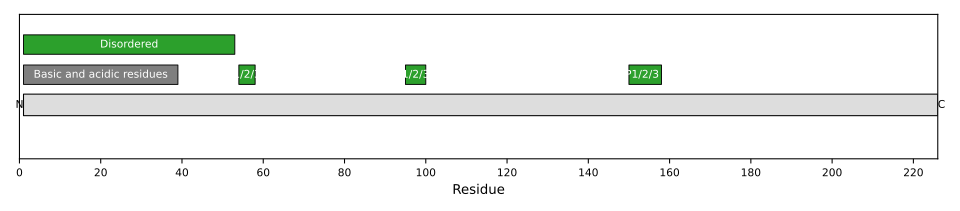
1: Recognizes and binds the 7-methylguanosine-containing mRNA cap during an early step in the initiation. Acts as a repressor of translation initiation (PubMed:17368478, PubMed:22751931, PubMed:25624349, PubMed:33581076, PubMed:9582349). In contrast to EIF4E, it is unable to bind eIF4G (EIF4G1, EIF4G2 or EIF4G3), suggesting that it acts by competing with EIF4E and block assembly of eIF4F at the cap (By similarity). In P-bodies, component of a complex that promotes miRNA-mediated translational repression (PubMed:28487484). Involved in virus-induced host response by mediating miRNA MIR34A-induced translational silencing which controls IFNB1 production by a negative feedback mechanism (PubMed:28487484, PubMed:33581076)
2: Component of the 4EHP-GYF2 complex, a multiprotein complex that acts as a repressor of translation initiation (PubMed:22751931, PubMed:35878012). In association with GIGYF2, assists ribosome-associated quality control (RQC) by sequestering the mRNA cap, blocking ribosome initiation and decreasing the translational load on problematic messages. Part of a pathway that works in parallel to RQC-mediated degradation of the stalled nascent polypeptide. GIGYF2 and EIF4E2 work downstream and independently of ZNF598, which seems to work as a scaffold that can recruit them to faulty mRNA even if alternative recruitment mechanisms may exist (PubMed:32726578)
3: (Microbial infection) Upon SARS coronavirus-2/SARS-CoV-2 infection, the interaction with non-structural protein 2 (nsp2) with GIGYF2 enhances GIGYF2 binding to EIF4E2 and increases repression of translation initiation of genes involved in antiviral innate immune response such as IFNB1