Cyclin-T2 (CycT2)
1_MASGR 6_ GASSR 11_ WFFTR 16_ EQLEN 21_ TPSRR 26_ CGVEA 31_ DKELS 36_ CRQQA 41_ ANLIQ 46_ EMGQR 51_ LNVSQ 56_ LTINT 61_ AIVYM 66_ HRFYM 71_ HHSFT 76_ KFNKN 81_ IISST 86_ ALFLA 91_ AKVEE 96_ QARKL 101_ EHVIK 106_ VAHAC 111_ LHPLE 116_ PLLDT 121_ KCDAY 126_ LQQTQ 131_ ELVIL 136_ ETIML 141_ QTLGF 146_ EITIE 151_ HPHTD 156_ VVKCT 161_ QLVRA 166_ SKDLA 171_ QTSYF 176_ MATNS 181_ LHLTT 186_ FCLQY 191_ KPTVI 196_ ACVCI 201_ HLACK 206_ WSNWE 211_ IPVST 216_ DGKHW 221_ WEYVD 226_ PTVTL 231_ ELLDE 236_ LTHEF 241_ LQILE 246_ KTPNR 251_ LKKIR 256_ NWRAN 261_ QAARK 266_ PKVDG 271_ QVSET 276_ PLLGS 281_ SLVQN 286_ SILVD 291_ SVTGV 296_ PTNPS 301_ FQKPS 306_ TSAFP 311_ APVPL 316_ NSGNI 321_ SVQDS 326_ HTSDN 331_ LSMLA 336_ TGMPS 341_ TSYGL 346_ SSHQE 351_ WPQHQ 356_ DSART 361_ EQLYS 366_ QKQET 371_ SLSGS 376_ QYNIN 381_ FQQGP 386_ SISLH 391_ SGLHH 396_ RPDKI 401_ SDHSS 406_ VKQEY 411_ THKAG 416_ SSKHH 421_ GPIST 426_ TPGII 431_ PQKMS 436_ LDKYR 441_ EKRKL 446_ ETLDL 451_ DVRDH 456_ YIAAQ 461_ VEQQH 466_ KQGQS 471_ QAASS 476_ SSVTS 481_ PIKMK 486_ IPIAN 491_ TEKYM 496_ ADKKE 501_ KSGSL 506_ KLRIP 511_ IPPTD 516_ KSASK 521_ EELKM 526_ KIKVS 531_ SSERH 536_ SSSDE 541_ GSGKS 546_ KHSSP 551_ HISRD 556_ HKEKH 561_ KEHPS 566_ SRHHT 571_ SSHKH 576_ SHSHS 581_ GSSSG 586_ GSKHS 591_ ADGIP 596_ PTVLR 601_ SPVGL 606_ SSDGI 611_ SSSSS 616_ SSRKR 621_ LHVND 626_ ASHNH 631_ HSKMS 636_ KSSKS 641_ SGSSS 646_ SSSSS 651_ VKQYI 656_ SSHNS 661_ VFNHP 666_ LPPPP 671_ PVTYQ 676_ VGYGH 681_ LSTLV 686_ KLDKK 691_ PVETN 696_ GPDAN 701_ HEYST 706_ SSQHM 711_ DYKDT 716_ FDMLD 721_SLLSA
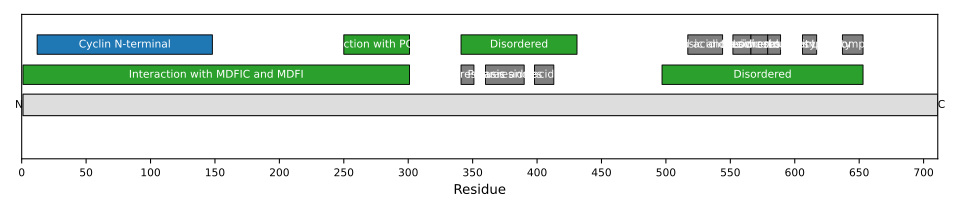
1: Regulatory subunit of the cyclin-dependent kinase pair (CDK9/cyclin T) complex, also called positive transcription elongation factor B (P-TEFB), which is proposed to facilitate the transition from abortive to production elongation by phosphorylating the CTD (carboxy-terminal domain) of the large subunit of RNA polymerase II (RNAP II) (PubMed:15563843, PubMed:9499409). The activity of this complex is regulated by binding with 7SK snRNA (PubMed:11713533). Plays a role during muscle differentiation; P-TEFB complex interacts with MYOD1; this tripartite complex promotes the transcriptional activity of MYOD1 through its CDK9-mediated phosphorylation and binds the chromatin of promoters and enhancers of muscle-specific genes; this event correlates with hyperphosphorylation of the CTD domain of RNA pol II (By similarity). In addition, enhances MYOD1-dependent transcription through interaction with PKN1 (PubMed:16331689). Involved in early embryo development (By similarity)
2: (Microbial infection) Promotes transcriptional activation of early and late herpes simplex virus 1/HHV-1 promoters