Toll-like receptor 2 (Toll/interleukin-1 receptor-like protein 4) (CD antigen CD282)
1_MPHTL 6_ WMVWV 11_ LGVII 16_ SLSKE 21_ ESSNQ 26_ ASLSC 31_ DRNGI 36_ CKGSS 41_ GSLNS 46_ IPSGL 51_ TEAVK 56_ SLDLS 61_ NNRIT 66_ YISNS 71_ DLQRC 76_ VNLQA 81_ LVLTS 86_ NGINT 91_ IEEDS 96_ FSSLG 101_ SLEHL 106_ DLSYN 111_ YLSNL 116_ SSSWF 121_ KPLSS 126_ LTFLN 131_ LLGNP 136_ YKTLG 141_ ETSLF 146_ SHLTK 151_ LQILR 156_ VGNMD 161_ TFTKI 166_ QRKDF 171_ AGLTF 176_ LEELE 181_ IDASD 186_ LQSYE 191_ PKSLK 196_ SIQNV 201_ SHLIL 206_ HMKQH 211_ ILLLE 216_ IFVDV 221_ TSSVE 226_ CLELR 231_ DTDLD 236_ TFHFS 241_ ELSTG 246_ ETNSL 251_ IKKFT 256_ FRNVK 261_ ITDES 266_ LFQVM 271_ KLLNQ 276_ ISGLL 281_ ELEFD 286_ DCTLN 291_ GVGNF 296_ RASDN 301_ DRVID 306_ PGKVE 311_ TLTIR 316_ RLHIP 321_ RFYLF 326_ YDLST 331_ LYSLT 336_ ERVKR 341_ ITVEN 346_ SKVFL 351_ VPCLL 356_ SQHLK 361_ SLEYL 366_ DLSEN 371_ LMVEE 376_ YLKNS 381_ ACEDA 386_ WPSLQ 391_ TLILR 396_ QNHLA 401_ SLEKT 406_ GETLL 411_ TLKNL 416_ TNIDI 421_ SKNSF 426_ HSMPE 431_ TCQWP 436_ EKMKY 441_ LNLSS 446_ TRIHS 451_ VTGCI 456_ PKTLE 461_ ILDVS 466_ NNNLN 471_ LFSLN 476_ LPQLK 481_ ELYIS 486_ RNKLM 491_ TLPDA 496_ SLLPM 501_ LLVLK 506_ ISRNA 511_ ITTFS 516_ KEQLD 521_ SFHTL 526_ KTLEA 531_ GGNNF 536_ ICSCE 541_ FLSFT 546_ QEQQA 551_ LAKVL 556_ IDWPA 561_ NYLCD 566_ SPSHV 571_ RGQQV 576_ QDVRL 581_ SVSEC 586_ HRTAL 591_ VSGMC 596_ CALFL 601_ LILLT 606_ GVLCH 611_ RFHGL 616_ WYMKM 621_ MWAWL 626_ QAKRK 631_ PRKAP 636_ SRNIC 641_ YDAFV 646_ SYSER 651_ DAYWV 656_ ENLMV 661_ QELEN 666_ FNPPF 671_ KLCLH 676_ KRDFI 681_ PGKWI 686_ IDNII 691_ DSIEK 696_ SHKTV 701_ FVLSE 706_ NFVKS 711_ EWCKY 716_ ELDFS 721_ HFRLF 726_ DENND 731_ AAILI 736_ LLEPI 741_ EKKAI 746_ PQRFC 751_ KLRKI 756_ MNTKT 761_ YLEWP 766_ MDEAQ 771_ REGFW 776_VNLRA
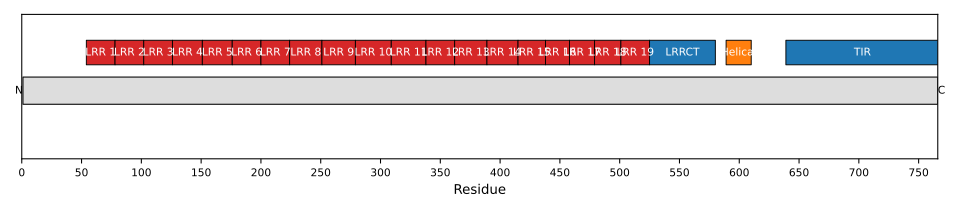
1: Cooperates with LY96 to mediate the innate immune response to bacterial lipoproteins and other microbial cell wall components. Cooperates with TLR1 or TLR6 to mediate the innate immune response to bacterial lipoproteins or lipopeptides (PubMed:17889651, PubMed:21078852). Acts via MYD88 and TRAF6, leading to NF-kappa-B activation, cytokine secretion and the inflammatory response. May also activate immune cells and promote apoptosis in response to the lipid moiety of lipoproteins (PubMed:10426995, PubMed:10426996). Recognizes mycoplasmal macrophage-activating lipopeptide-2kD (MALP-2), soluble tuberculosis factor (STF), phenol-soluble modulin (PSM) and B.burgdorferi outer surface protein A lipoprotein (OspA-L) cooperatively with TLR6 (PubMed:11441107). Stimulation of monocytes in vitro with M.tuberculosis PstS1 induces p38 MAPK and ERK1/2 activation primarily via this receptor, but also partially via TLR4 (PubMed:16622205). MAPK activation in response to bacterial peptidoglycan also occurs via this receptor (PubMed:16622205). Acts as a receptor for M.tuberculosis lipoproteins LprA, LprG, LpqH and PstS1, some lipoproteins are dependent on other coreceptors (TLR1, CD14 and/or CD36); the lipoproteins act as agonists to modulate antigen presenting cell functions in response to the pathogen (PubMed:19362712). M.tuberculosis HSP70 (dnaK) but not HSP65 (groEL-2) acts via this protein to stimulate NF-kappa-B expression (PubMed:15809303). Recognizes M.tuberculosis major T-antigen EsxA (ESAT-6) which inhibits downstream MYD88-dependent signaling (shown in mouse) (By similarity). Forms activation clusters composed of several receptors depending on the ligand, these clusters trigger signaling from the cell surface and subsequently are targeted to the Golgi in a lipid-raft dependent pathway. Forms the cluster TLR2:TLR6:CD14:CD36 in response to diacylated lipopeptides and TLR2:TLR1:CD14 in response to triacylated lipopeptides (PubMed:16880211). Required for normal uptake of M.tuberculosis, a process that is inhibited by M.tuberculosis LppM (By similarity)