Nibrin (Cell cycle regulatory protein p95) (Nijmegen breakage syndrome protein 1)
1_MWKLL 6_ PAAGP 11_ AGGEP 16_ YRLLT 21_ GVEYV 26_ VGRKN 31_ CAILI 36_ ENDQS 41_ ISRNH 46_ AVLTA 51_ NFSVT 56_ NLSQT 61_ DEIPV 66_ LTLKD 71_ NSKYG 76_ TFVNE 81_ EKMQN 86_ GFSRT 91_ LKSGD 96_ GITFG 101_ VFGSK 106_ FRIEY 111_ EPLVA 116_ CSSCL 121_ DVSGK 126_ TALNQ 131_ AILQL 136_ GGFTV 141_ NNWTE 146_ ECTHL 151_ VMVSV 156_ KVTIK 161_ TICAL 166_ ICGRP 171_ IVKPE 176_ YFTEF 181_ LKAVE 186_ SKKQP 191_ PQIES 196_ FYPPL 201_ DEPSI 206_ GSKNV 211_ DLSGR 216_ QERKQ 221_ IFKGK 226_ TFIFL 231_ NAKQH 236_ KKLSS 241_ AVVFG 246_ GGEAR 251_ LITEE 256_ NEEEH 261_ NFFLA 266_ PGTCV 271_ VDTGI 276_ TNSQT 281_ LIPDC 286_ QKKWI 291_ QSIMD 296_ MLQRQ 301_ GLRPI 306_ PEAEI 311_ GLAVI 316_ FMTTK 321_ NYCDP 326_ QGHPS 331_ TGLKT 336_ TTPGP 341_ SLSQG 346_ VSVDE 351_ KLMPS 356_ APVNT 361_ TTYVA 366_ DTESE 371_ QADTW 376_ DLSER 381_ PKEIK 386_ VSKME 391_ QKFRM 396_ LSQDA 401_ PTVKE 406_ SCKTS 411_ SNNNS 416_ MVSNT 421_ LAKMR 426_ IPNYQ 431_ LSPTK 436_ LPSIN 441_ KSKDR 446_ ASQQQ 451_ QTNSI 456_ RNYFQ 461_ PSTKK 466_ RERDE 471_ ENQEM 476_ SSCKS 481_ ARIET 486_ SCSLL 491_ EQTQP 496_ ATPSL 501_ WKNKE 506_ QHLSE 511_ NEPVD 516_ TNSDN 521_ NLFTD 526_ TDLKS 531_ IVKNS 536_ ASKSH 541_ AAEKL 546_ RSNKK 551_ REMDD 556_ VAIED 561_ EVLEQ 566_ LFKDT 571_ KPELE 576_ IDVKV 581_ QKQEE 586_ DVNVR 591_ KRPRM 596_ DIETN 601_ DTFSD 606_ EAVPE 611_ SSKIS 616_ QENEI 621_ GKKRE 626_ LKEDS 631_ LWSAK 636_ EISNN 641_ DKLQD 646_ DSEML 651_ PKKLL 656_ LTEFR 661_ SLVIK 666_ NSTSR 671_ NPSGI 676_ NDDYG 681_ QLKNF 686_ KKFKK 691_ VTYPG 696_ AGKLP 701_ HIIGG 706_ SDLIA 711_ HHARK 716_ NTELE 721_ EWLRQ 726_ EMEVQ 731_ NQHAK 736_ EESLA 741_ DDLFR 746_YNPYL
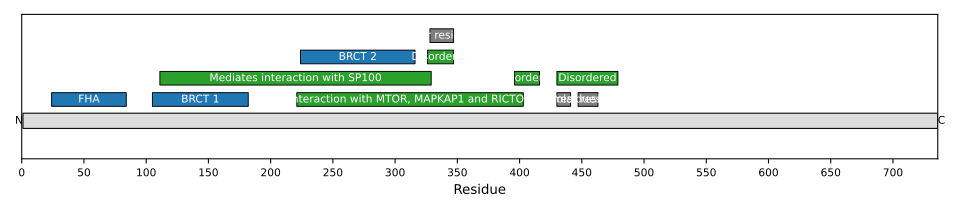
1: Component of the MRN complex, which plays a central role in double-strand break (DSB) repair, DNA recombination, maintenance of telomere integrity and meiosis (PubMed:10888888, PubMed:15616588, PubMed:18411307, PubMed:18583988, PubMed:18678890, PubMed:19759395, PubMed:23115235, PubMed:28216226, PubMed:28867292, PubMed:9705271). The MRN complex is involved in the repair of DNA double-strand breaks (DSBs) via homologous recombination (HR), an error-free mechanism which primarily occurs during S and G2 phases (PubMed:19759395, PubMed:28867292, PubMed:9705271). The complex (1) mediates the end resection of damaged DNA, which generates proper single-stranded DNA, a key initial steps in HR, and is (2) required for the recruitment of other repair factors and efficient activation of ATM and ATR upon DNA damage (PubMed:19759395, PubMed:9705271). The MRN complex possesses single-strand endonuclease activity and double-strand-specific 3'-5' exonuclease activity, which are provided by MRE11, to initiate end resection, which is required for single-strand invasion and recombination (PubMed:19759395, PubMed:28867292, PubMed:9705271). Within the MRN complex, NBN acts as a protein-protein adapter, which specifically recognizes and binds phosphorylated proteins, promoting their recruitment to DNA damage sites (PubMed:12419185, PubMed:15616588, PubMed:18411307, PubMed:18582474, PubMed:18583988, PubMed:18678890, PubMed:19759395, PubMed:19804756, PubMed:23762398, PubMed:24534091, PubMed:27814491, PubMed:27889449, PubMed:33836577). Recruits MRE11 and RAD50 components of the MRN complex to DSBs in response to DNA damage (PubMed:12419185, PubMed:18411307, PubMed:18583988, PubMed:18678890, PubMed:24534091, PubMed:26438602). Promotes the recruitment of PI3/PI4-kinase family members ATM, ATR, and probably DNA-PKcs to the DNA damage sites, activating their functions (PubMed:15064416, PubMed:15616588, PubMed:15790808, PubMed:16622404, PubMed:22464731, PubMed:30952868, PubMed:35076389). Mediates the recruitment of phosphorylated RBBP8/CtIP to DSBs, leading to cooperation between the MRN complex and RBBP8/CtIP to initiate end resection (PubMed:19759395, PubMed:27814491, PubMed:27889449, PubMed:33836577). RBBP8/CtIP specifically promotes the endonuclease activity of the MRN complex to clear DNA ends containing protein adducts (PubMed:27814491, PubMed:27889449, PubMed:30787182, PubMed:33836577). The MRN complex is also required for the processing of R-loops (PubMed:31537797). NBN also functions in telomere length maintenance via its interaction with TERF2: interaction with TERF2 during G1 phase preventing recruitment of DCLRE1B/Apollo to telomeres (PubMed:10888888, PubMed:28216226). NBN also promotes DNA repair choice at dysfunctional telomeres: NBN phosphorylation by CDK2 promotes non-homologous end joining repair at telomeres, while unphosphorylated NBN promotes microhomology-mediated end-joining (MMEJ) repair (PubMed:28216226). Enhances AKT1 phosphorylation possibly by association with the mTORC2 complex (PubMed:23762398)