Tumor necrosis factor receptor superfamily member 21 (Death receptor 6) (CD antigen CD358)
1_MGTSP 6_ SSSTA 11_ LASCS 16_ RIARR 21_ ATATM 26_ IAGSL 31_ LLLGF 36_ LSTTT 41_ AQPEQ 46_ KASNL 51_ IGTYR 56_ HVDRA 61_ TGQVL 66_ TCDKC 71_ PAGTY 76_ VSEHC 81_ TNTSL 86_ RVCSS 91_ CPVGT 96_ FTRHE 101_ NGIEK 106_ CHDCS 111_ QPCPW 116_ PMIEK 121_ LPCAA 126_ LTDRE 131_ CTCPP 136_ GMFQS 141_ NATCA 146_ PHTVC 151_ PVGWG 156_ VRKKG 161_ TETED 166_ VRCKQ 171_ CARGT 176_ FSDVP 181_ SSVMK 186_ CKAYT 191_ DCLSQ 196_ NLVVI 201_ KPGTK 206_ ETDNV 211_ CGTLP 216_ SFSSS 221_ TSPSP 226_ GTAIF 231_ PRPEH 236_ METHE 241_ VPSST 246_ YVPKG 251_ MNSTE 256_ SNSSA 261_ SVRPK 266_ VLSSI 271_ QEGTV 276_ PDNTS 281_ SARGK 286_ EDVNK 291_ TLPNL 296_ QVVNH 301_ QQGPH 306_ HRHIL 311_ KLLPS 316_ MEATG 321_ GEKSS 326_ TPIKG 331_ PKRGH 336_ PRQNL 341_ HKHFD 346_ INEHL 351_ PWMIV 356_ LFLLL 361_ VLVVI 366_ VVCSI 371_ RKSSR 376_ TLKKG 381_ PRQDP 386_ SAIVE 391_ KAGLK 396_ KSMTP 401_ TQNRE 406_ KWIYY 411_ CNGHG 416_ IDILK 421_ LVAAQ 426_ VGSQW 431_ KDIYQ 436_ FLCNA 441_ SEREV 446_ AAFSN 451_ GYTAD 456_ HERAY 461_ AALQH 466_ WTIRG 471_ PEASL 476_ AQLIS 481_ ALRQH 486_ RRNDV 491_ VEKIR 496_ GLMED 501_ TTQLE 506_ TDKLA 511_ LPMSP 516_ SPLSP 521_ SPIPS 526_ PNAKL 531_ ENSAL 536_ LTVEP 541_ SPQDK 546_ NKGFF 551_ VDESE 556_ PLLRC 561_ DSTSS 566_ GSSAL 571_ SRNGS 576_ FITKE 581_ KKDTV 586_ LRQVR 591_ LDPCD 596_ LQPIF 601_ DDMLH 606_ FLNPE 611_ ELRVI 616_ EEIPQ 621_ AEDKL 626_ DRLFE 631_ IIGVK 636_ SQEAS 641_ QTLLD 646_SVYSH
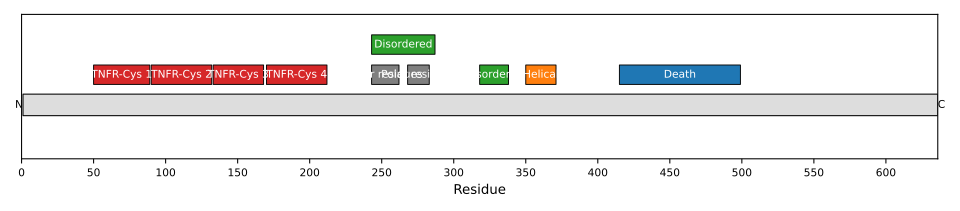
1: Promotes apoptosis, possibly via a pathway that involves the activation of NF-kappa-B. Can also promote apoptosis mediated by BAX and by the release of cytochrome c from the mitochondria into the cytoplasm. Trophic-factor deprivation triggers the cleavage of surface APP by beta-secretase to release sAPP-beta which is further cleaved to release an N-terminal fragment of APP (N-APP). Negatively regulates oligodendrocyte survival, maturation and myelination. Plays a role in signaling cascades triggered by stimulation of T-cell receptors, in the adaptive immune response and in the regulation of T-cell differentiation and proliferation. Negatively regulates T-cell responses and the release of cytokines such as IL4, IL5, IL10, IL13 and IFNG by Th2 cells. Negatively regulates the production of IgG, IgM and IgM in response to antigens. May inhibit the activation of JNK in response to T-cell stimulation. Also acts as a regulator of pyroptosis: recruits CASP8 in response to reactive oxygen species (ROS) and subsequent oxidation, leading to activation of GSDMC (PubMed:34012073)