E3 SUMO-protein ligase PIAS1 (EC 2.3.2.-) (DEAD/H box-binding protein 1) (E3 SUMO-protein transferase PIAS1) (Gu-binding protein) (GBP) (Protein inhibitor of activated STAT protein 1) (RNA helicase II-binding protein)
1_MADSA 6_ ELKQM 11_ VMSLR 16_ VSELQ 21_ VLLGY 26_ AGRNK 31_ HGRKH 36_ ELLTK 41_ ALHLL 46_ KAGCS 51_ PAVQM 56_ KIKEL 61_ YRRRF 66_ PQKIM 71_ TPADL 76_ SIPNV 81_ HSSPM 86_ PATLS 91_ PSTIP 96_ QLTYD 101_ GHPAS 106_ SPLLP 111_ VSLLG 116_ PKHEL 121_ ELPHL 126_ TSALH 131_ PVHPD 136_ IKLQK 141_ LPFYD 146_ LLDEL 151_ IKPTS 156_ LASDN 161_ SQRFR 166_ ETCFA 171_ FALTP 176_ QQVQQ 181_ ISSSM 186_ DISGT 191_ KCDFT 196_ VQVQL 201_ RFCLS 206_ ETSCP 211_ QEDHF 216_ PPNLC 221_ VKVNT 226_ KPCSL 231_ PGYLP 236_ PTKNG 241_ VEPKR 246_ PSRPI 251_ NITSL 256_ VRLST 261_ TVPNT 266_ IVVSW 271_ TAEIG 276_ RNYSM 281_ AVYLV 286_ KQLSS 291_ TVLLQ 296_ RLRAK 301_ GIRNP 306_ DHSRA 311_ LIKEK 316_ LTADP 321_ DSEIA 326_ TTSLR 331_ VSLLC 336_ PLGKM 341_ RLTIP 346_ CRALT 351_ CSHLQ 356_ CFDAT 361_ LYIQM 366_ NEKKP 371_ TWVCP 376_ VCDKK 381_ APYEH 386_ LIIDG 391_ LFMEI 396_ LKYCT 401_ DCDEI 406_ QFKED 411_ GTWAP 416_ MRSKK 421_ EVQEV 426_ SASYN 431_ GVDGC 436_ LSSTL 441_ EHQVA 446_ SHHQS 451_ SNKNK 456_ KVEVI 461_ DLTID 466_ SSSDE 471_ EEEEP 476_ SAKRT 481_ CPSLS 486_ PTSPL 491_ NNKGI 496_ LSLPH 501_ QASPV 506_ SRTPS 511_ LPAVD 516_ TSYIN 521_ TSLIQ 526_ DYRHP 531_ FHMTP 536_ MPYDL 541_ QGLDF 546_ FPFLS 551_ GDNQH 556_ YNTSL 561_ LAAAA 566_ AAVSD 571_ DQDLL 576_ HSSRF 581_ FPYTS 586_ SQMFL 591_ DQLSA 596_ GGSTS 601_ LPTTN 606_ GSSSG 611_ SNSSL 616_ VSSNS 621_ LRESH 626_ SHTVT 631_ NRSST 636_ DTASI 641_ FGIIP 646_DIISL
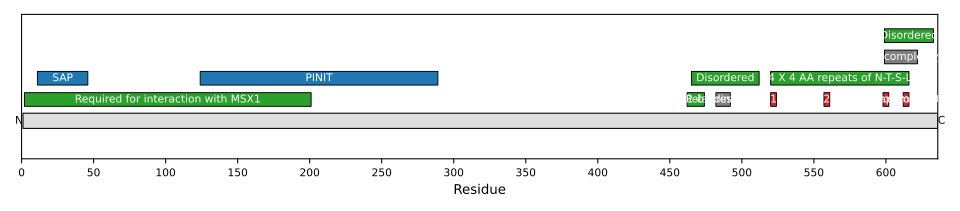
1: Functions as an E3-type small ubiquitin-like modifier (SUMO) ligase, stabilizing the interaction between UBE2I and the substrate, and as a SUMO-tethering factor (PubMed:11583632, PubMed:11867732, PubMed:14500712, PubMed:21965678, PubMed:36050397). Catalyzes sumoylation of various proteins, such as CEBPB, MRE11, MTA1, PTK2 and PML (PubMed:11583632, PubMed:11867732, PubMed:14500712, PubMed:21965678, PubMed:36050397). Plays a crucial role as a transcriptional coregulation in various cellular pathways, including the STAT pathway, the p53 pathway and the steroid hormone signaling pathway (PubMed:11583632, PubMed:11867732). In vitro, binds A/T-rich DNA (PubMed:15133049). The effects of this transcriptional coregulation, transactivation or silencing, may vary depending upon the biological context (PubMed:11583632, PubMed:11867732, PubMed:14500712, PubMed:21965678, PubMed:36050397). Mediates sumoylation of MRE11, stabilizing MRE11 on chromatin during end resection (PubMed:36050397). Sumoylates PML (at 'Lys-65' and 'Lys-160') and PML-RAR and promotes their ubiquitin-mediated degradation (By similarity). PIAS1-mediated sumoylation of PML promotes its interaction with CSNK2A1/CK2 which in turn promotes PML phosphorylation and degradation (By similarity). Enhances the sumoylation of MTA1 and may participate in its paralog-selective sumoylation (PubMed:21965678). Plays a dynamic role in adipogenesis by promoting the SUMOylation and degradation of CEBPB (By similarity). Mediates the nuclear mobility and localization of MSX1 to the nuclear periphery, whereby MSX1 is brought into the proximity of target myoblast differentiation factor genes (By similarity). Also required for the binding of MSX1 to the core enhancer region in target gene promoter regions, independent of its sumoylation activity (By similarity). Capable of binding to the core enhancer region TAAT box in the MYOD1 gene promoter (By similarity)
2: (Microbial infection) Restricts Epstein-Barr virus (EBV) lytic replication by acting as an inhibitor for transcription factors involved in lytic gene expression (PubMed:29262325). The virus can use apoptotic caspases to antagonize PIAS1-mediated restriction and express its lytic genes (PubMed:29262325)