E3 ubiquitin-protein ligase RNF8 (hRNF8) (EC 2.3.2.27) (RING finger protein 8) (RING-type E3 ubiquitin transferase RNF8)
1_MGEPG 6_ FFVTG 11_ DRAGG 16_ RSWCL 21_ RRVGM 26_ SAGWL 31_ LLEDG 36_ CEVTV 41_ GRGFG 46_ VTYQL 51_ VSKIC 56_ PLMIS 61_ RNHCV 66_ LKQNP 71_ EGQWT 76_ IMDNK 81_ SLNGV 86_ WLNRA 91_ RLEPL 96_ RVYSI 101_ HQGDY 106_ IQLGV 111_ PLENK 116_ ENAEY 121_ EYEVT 126_ EEDWE 131_ TIYPC 136_ LSPKN 141_ DQMIE 146_ KNKEL 151_ RTKRK 156_ FSLDE 161_ LAGPG 166_ AEGPS 171_ NLKSK 176_ INKVS 181_ CESGQ 186_ PVKSQ 191_ GKGEV 196_ ASTPS 201_ DNLDP 206_ KLTAL 211_ EPSKT 216_ TGAPI 221_ YPGFP 226_ KVTEV 231_ HHEQK 236_ ASNSS 241_ ASQRS 246_ LQMFK 251_ VTMSR 256_ ILRLK 261_ IQMQE 266_ KHEAV 271_ MNVKK 276_ QTQKG 281_ NSKKV 286_ VQMEQ 291_ ELQDL 296_ QSQLC 301_ AEQAQ 306_ QQARV 311_ EQLEK 316_ TFQEE 321_ EQHLQ 326_ GLEIA 331_ QGEKD 336_ LKQQL 341_ AQALQ 346_ EHWAL 351_ MEELN 356_ RSKKD 361_ FEAII 366_ QAKNK 371_ ELEQT 376_ KEEKE 381_ KMQAQ 386_ KEEVL 391_ SHMND 396_ VLENE 401_ LQCII 406_ CSEYF 411_ IEAVT 416_ LNCAH 421_ SFCSY 426_ CINEW 431_ MKRKI 436_ ECPIC 441_ RKDIK 446_ SKTYS 451_ LVLDN 456_ CINKM 461_ VNNLS 466_ SEVKE 471_ RRIVL 476_IRERK
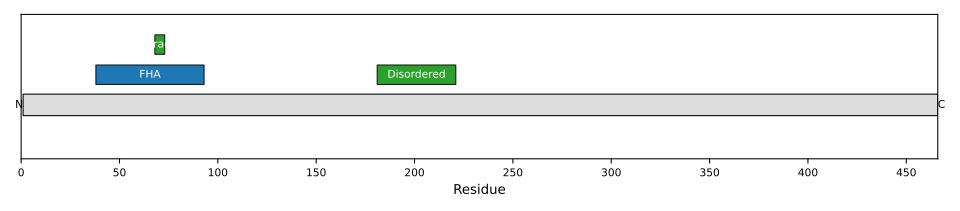
1: E3 ubiquitin-protein ligase that plays a key role in DNA damage signaling via 2 distinct roles: by mediating the 'Lys-63'-linked ubiquitination of histones H2A and H2AX and promoting the recruitment of DNA repair proteins at double-strand breaks (DSBs) sites, and by catalyzing 'Lys-48'-linked ubiquitination to remove target proteins from DNA damage sites. Following DNA DSBs, it is recruited to the sites of damage by ATM-phosphorylated MDC1 and catalyzes the 'Lys-63'-linked ubiquitination of histones H2A and H2AX, thereby promoting the formation of TP53BP1 and BRCA1 ionizing radiation-induced foci (IRIF) (PubMed:18001824, PubMed:18006705). Also controls the recruitment of UIMC1-BRCC3 (RAP80-BRCC36) and PAXIP1/PTIP to DNA damage sites (PubMed:18077395, PubMed:19202061). Promotes the recruitment of NBN to DNA damage sites by catalyzing 'Lys-6'-linked ubiquitination of NBN (PubMed:23115235). Also recruited at DNA interstrand cross-links (ICLs) sites and catalyzes 'Lys-63'-linked ubiquitination of histones H2A and H2AX, leading to recruitment of FAAP20/C1orf86 and Fanconi anemia (FA) complex, followed by interstrand cross-link repair. H2A ubiquitination also mediates the ATM-dependent transcriptional silencing at regions flanking DSBs in cis, a mechanism to avoid collision between transcription and repair intermediates. Promotes the formation of 'Lys-63'-linked polyubiquitin chains via interactions with the specific ubiquitin-conjugating UBE2N/UBC13 and ubiquitinates non-histone substrates such as PCNA. Substrates that are polyubiquitinated at 'Lys-63' are usually not targeted for degradation. Also catalyzes the formation of 'Lys-48'-linked polyubiquitin chains via interaction with the ubiquitin-conjugating UBE2L6/UBCH8, leading to degradation of substrate proteins such as CHEK2, JMJD2A/KDM4A and KU80/XRCC5: it is still unclear how the preference toward 'Lys-48'- versus 'Lys-63'-linked ubiquitination is regulated but it could be due to RNF8 ability to interact with specific E2 specific ligases. For instance, interaction with phosphorylated HERC2 promotes the association between RNF8 and UBE2N/UBC13 and favors the specific formation of 'Lys-63'-linked ubiquitin chains. Promotes non-homologous end joining (NHEJ) by promoting the 'Lys-48'-linked ubiquitination and degradation the of KU80/XRCC5. Following DNA damage, mediates the ubiquitination and degradation of JMJD2A/KDM4A in collaboration with RNF168, leading to unmask H4K20me2 mark and promote the recruitment of TP53BP1 at DNA damage sites (PubMed:11322894, PubMed:14981089, PubMed:17724460, PubMed:18001825, PubMed:18337245, PubMed:18948756, PubMed:19015238, PubMed:19124460, PubMed:19203578, PubMed:19203579, PubMed:20550933, PubMed:21558560, PubMed:21857671, PubMed:21911360, PubMed:22266820, PubMed:22373579, PubMed:22531782, PubMed:22705371, PubMed:22980979). Following DNA damage, mediates the ubiquitination and degradation of POLD4/p12, a subunit of DNA polymerase delta. In the absence of POLD4, DNA polymerase delta complex exhibits higher proofreading activity (PubMed:23233665). In addition to its function in damage signaling, also plays a role in higher-order chromatin structure by mediating extensive chromatin decondensation. Involved in the activation of ATM by promoting histone H2B ubiquitination, which indirectly triggers histone H4 'Lys-16' acetylation (H4K16ac), establishing a chromatin environment that promotes efficient activation of ATM kinase. Required in the testis, where it plays a role in the replacement of histones during spermatogenesis. At uncapped telomeres, promotes the joining of deprotected chromosome ends by inducing H2A ubiquitination and TP53BP1 recruitment, suggesting that it may enhance cancer development by aggravating telomere-induced genome instability in case of telomeric crisis. Promotes the assembly of RAD51 at DNA DSBs in the absence of BRCA1 and TP53BP1 Also involved in class switch recombination in immune system, via its role in regulation of DSBs repair (PubMed:22865450). May be required for proper exit from mitosis after spindle checkpoint activation and may regulate cytokinesis. May play a role in the regulation of RXRA-mediated transcriptional activity. Not involved in RXRA ubiquitination by UBE2E2 (PubMed:11322894, PubMed:14981089, PubMed:17724460, PubMed:18001825, PubMed:18337245, PubMed:18948756, PubMed:19015238, PubMed:19124460, PubMed:19203578, PubMed:19203579, PubMed:20550933, PubMed:21558560, PubMed:21857671, PubMed:21911360, PubMed:22266820, PubMed:22373579, PubMed:22531782, PubMed:22705371, PubMed:22980979)