Solute carrier organic anion transporter family member 2B1 (Organic anion transporter B) (OATP-B) (Organic anion transporter polypeptide-related protein 2) (OATP-RP2) (OATPRP2) (Solute carrier family 21 member 9)
1_MGPRI 6_ GPAGE 11_ VPQVP 16_ DKETK 21_ ATMGT 26_ ENTPG 31_ GKASP 36_ DPQDV 41_ RPSVF 46_ HNIKL 51_ FVLCH 56_ SLLQL 61_ AQLMI 66_ SGYLK 71_ SSIST 76_ VEKRF 81_ GLSSQ 86_ TSGLL 91_ ASFNE 96_ VGNTA 101_ LIVFV 106_ SYFGS 111_ RVHRP 116_ RMIGY 121_ GAILV 126_ ALAGL 131_ LMTLP 136_ HFISE 141_ PYRYD 146_ NTSPE 151_ DMPQD 156_ FKASL 161_ CLPTT 166_ SAPAS 171_ APSNG 176_ NCSSY 181_ TETQH 186_ LSVVG 191_ IMFVA 196_ QTLLG 201_ VGGVP 206_ IQPFG 211_ ISYID 216_ DFAHN 221_ SNSPL 226_ YLGIL 231_ FAVTM 236_ MGPGL 241_ AFGLG 246_ SLMLR 251_ LYVDI 256_ NQMPE 261_ GGISL 266_ TIKDP 271_ RWVGA 276_ WWLGF 281_ LIAAG 286_ AVALA 291_ AIPYF 296_ FFPKE 301_ MPKEK 306_ RELQF 311_ RRKVL 316_ AVTDS 321_ PARKG 326_ KDSPS 331_ KQSPG 336_ ESTKK 341_ QDGLV 346_ QIAPN 351_ LTVIQ 356_ FIKVF 361_ PRVLL 366_ QTLRH 371_ PIFLL 376_ VVLSQ 381_ VCLSS 386_ MAAGM 391_ AIFLP 396_ KFLER 401_ QFSIT 406_ ASYAN 411_ LLIGC 416_ LSFPS 421_ VIVGI 426_ VVGGV 431_ LVKRL 436_ HLGPV 441_ GCGAL 446_ CLLGM 451_ LLCLF 456_ FSLPL 461_ FFIGC 466_ SSHQI 471_ AGITH 476_ QTSAH 481_ PGLEL 486_ SPSCM 491_ EACSC 496_ PLDGF 501_ NPVCD 506_ PSTRV 511_ EYITP 516_ CHAGC 521_ SSWVV 526_ QDALD 531_ NSQVF 536_ YTNCS 541_ CVVEG 546_ NPVLA 551_ GSCDS 556_ TCSHL 561_ VVPFL 566_ LLVSL 571_ GSALA 576_ CLTHT 581_ PSFML 586_ ILRGV 591_ KKEDK 596_ TLAVG 601_ IQFMF 606_ LRILA 611_ WMPSP 616_ VIHGS 621_ AIDTT 626_ CVHWA 631_ LSCGR 636_ RAVCR 641_ YYNND 646_ LLRNR 651_ FIGLQ 656_ FFFKT 661_ GSVIC 666_ FALVL 671_ AVLRQ 676_ QDKEA 681_ RTKES 686_ RSSPA 691_ VEQQL 696_ LVSGP 701_GKKPE
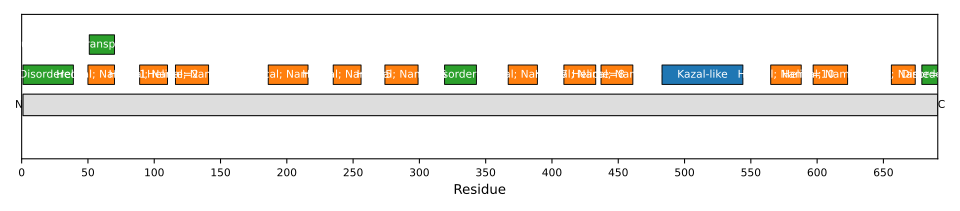
1: Mediates the Na(+)-independent transport of steroid sulfate conjugates and other specific organic anions (PubMed:10873595, PubMed:11159893, PubMed:11932330, PubMed:12724351, PubMed:14610227, PubMed:16908597, PubMed:18501590, PubMed:20507927, PubMed:22201122, PubMed:23531488, PubMed:25132355, PubMed:26383540, PubMed:27576593, PubMed:28408210, PubMed:29871943, PubMed:34628357). Responsible for the transport of estrone 3-sulfate (E1S) through the basal membrane of syncytiotrophoblast, highlighting a potential role in the placental absorption of fetal-derived sulfated steroids including the steroid hormone precursor dehydroepiandrosterone sulfate (DHEA-S) (PubMed:11932330, PubMed:12409283). Also facilitates the uptake of sulfated steroids at the basal/sinusoidal membrane of hepatocytes, therefore accounting for the major part of organic anions clearance of liver (PubMed:11159893). Mediates the intestinal uptake of sulfated steroids (PubMed:12724351, PubMed:28408210). Mediates the uptake of the neurosteroids DHEA-S and pregnenolone sulfate (PregS) into the endothelial cells of the blood-brain barrier as the first step to enter the brain (PubMed:16908597, PubMed:25132355). Also plays a role in the reuptake of neuropeptides such as substance P/TAC1 and vasoactive intestinal peptide/VIP released from retinal neurons (PubMed:25132355). May act as a heme transporter that promotes cellular iron availability via heme oxygenase/HMOX2 and independently of TFRC (PubMed:35714613). Also transports heme by-product coproporphyrin III (CPIII), and may be involved in their hepatic disposition (PubMed:26383540). Mediates the uptake of other substrates such as prostaglandins D2 (PGD2), E1 (PGE1) and E2 (PGE2), taurocholate, L-thyroxine, leukotriene C4 and thromboxane B2 (PubMed:10873595, PubMed:14610227, PubMed:19129463, PubMed:29871943, Ref.25). May contribute to regulate the transport of organic compounds in testis across the blood-testis-barrier (Probable). Shows a pH-sensitive substrate specificity which may be ascribed to the protonation state of the binding site and leads to a stimulation of substrate transport in an acidic microenvironment (PubMed:14610227, PubMed:19129463, PubMed:22201122). The exact transport mechanism has not been yet deciphered but most likely involves an anion exchange, coupling the cellular uptake of organic substrate with the efflux of an anionic compound (PubMed:19129463, PubMed:20507927, PubMed:26277985). Hydrogencarbonate/HCO3(-) acts as a probable counteranion that exchanges for organic anions (PubMed:19129463). Cytoplasmic glutamate may also act as counteranion in the placenta (PubMed:26277985). An inwardly directed proton gradient has also been proposed as the driving force of E1S uptake with a (H(+):E1S) stoichiometry of (1:1) (PubMed:20507927)
2: Has estrone 3-sulfate (E1S) transport activity comparable with the full-length isoform 1