Potassium channel subfamily K member 2 (Outward rectifying potassium channel protein TREK-1) (TREK-1 K(+) channel subunit) (Two pore domain potassium channel TREK-1) (Two pore potassium channel TPKC1)
1_MLPSA 6_ SRERP 11_ GYRAG 16_ VAAPD 21_ LLDPK 26_ SAAQN 31_ SKPRL 36_ SFSTK 41_ PTVLA 46_ SRVES 51_ DTTIN 56_ VMKWK 61_ TVSTI 66_ FLVVV 71_ LYLII 76_ GATVF 81_ KALEQ 86_ PHEIS 91_ QRTTI 96_ VIQKQ 101_ TFISQ 106_ HSCVN 111_ STELD 116_ ELIQQ 121_ IVAAI 126_ NAGII 131_ PLGNT 136_ SNQIS 141_ HWDLG 146_ SSFFF 151_ AGTVI 156_ TTIGF 161_ GNISP 166_ RTEGG 171_ KIFCI 176_ IYALL 181_ GIPLF 186_ GFLLA 191_ GVGDQ 196_ LGTIF 201_ GKGIA 206_ KVEDT 211_ FIKWN 216_ VSQTK 221_ IRIIS 226_ TIIFI 231_ LFGCV 236_ LFVAL 241_ PAIIF 246_ KHIEG 251_ WSALD 256_ AIYFV 261_ VITLT 266_ TIGFG 271_ DYVAG 276_ GSDIE 281_ YLDFY 286_ KPVVW 291_ FWILV 296_ GLAYF 301_ AAVLS 306_ MIGDW 311_ LRVIS 316_ KKTKE 321_ EVGEF 326_ RAHAA 331_ EWTAN 336_ VTAEF 341_ KETRR 346_ RLSVE 351_ IYDKF 356_ QRATS 361_ IKRKL 366_ SAELA 371_ GNHNQ 376_ ELTPC 381_ RRTLS 386_ VNHLT 391_ SERDV 396_ LPPLL 401_ KTESI 406_ YLNGL 411_ TPHCA 416_ GEEIA 421_VIENI
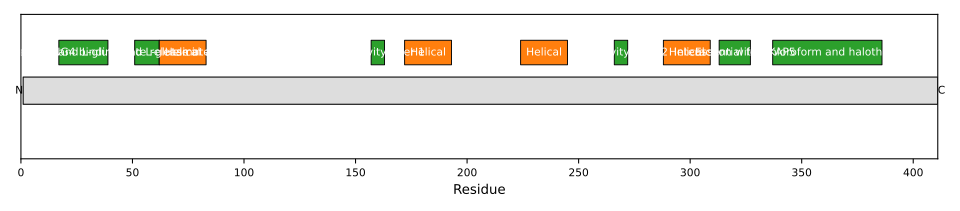
1: K(+) channel that conducts voltage-dependent outward rectifying currents upon membrane depolarization. Voltage sensing is coupled to K(+) electrochemical gradient in an 'ion flux gating' mode where outward but not inward ion flow opens the gate. Converts to voltage-independent 'leak' conductance mode upon stimulation by various stimuli including mechanical membrane stretch, acidic pH, heat and lipids. Reversibly converts between a voltage-insensitive K(+) 'leak' channel and a voltage-dependent outward rectifying K(+) channel in a phosphorylation-dependent manner (By similarity) (PubMed:10321245, PubMed:10784345, PubMed:11319556, PubMed:23169818, PubMed:30573346, PubMed:38605031). Homo- and heterodimerizes to form functional channels with distinct regulatory and gating properties (By similarity). In trigeminal ganglia sensory neurons, the heterodimer of KCNK2/TREK-1 and KCNK18/TRESK inhibits neuronal firing and neurogenic inflammation by stabilizing the resting membrane potential at K(+) equilibrium potential as well as by regulating the threshold of action potentials and the spike frequency (By similarity). At trigeminal A-beta afferent nerves, the heterodimer of KCNK2/TREK-1 and KCNK4/TRAAK is mostly coexpressed at nodes of Ranvier where it conducts voltage-independent mechanosensitive and thermosensitive currents, allowing rapid action potential repolarization, high speed and high frequence saltatory conduction on myelinated nerves to ensure prompt sensory responses (By similarity). In hippocampal astrocytes, the heterodimer of KCNK2/TREK-1 and KCNK1/TWIK-1 allows passive K(+) conductance under basal conditions, but changes ion selectivity and becomes permeable to L-glutamate and Cl(-) ions upon binding to G-protein subunit GNG4 in stimulated astrocytes. Mediates rapid L-glutamate release in response to activation of G-protein-coupled receptors, such as F2R and CNR1 (By similarity). In hippocampal pyramidal neurons, the homodimer of KCNK2/TREK-1 contributes to gamma-aminobutyric acid (GABA) B-induced slow inhibitory postsynaptic potential. Associates with AKAP5 and Gs-protein-coupled receptor B2AR at postsynaptic dense bodies and converts to a leak channel no longer sensitive to stimulation by arachidonic acid, acidic pH or mechanical stress, nor inhibited by Gq-coupled receptors but still under the negative control of Gs-coupled receptors (By similarity). Permeable to other monovalent cations such as Rb(+) and Cs(+) (By similarity)
2: Does not display channel activity but reduces the channel activity of isoform 1 and isoform 2 and reduces cell surface expression of isoform 2