Sphingosine 1-phosphate receptor 2 (S1P receptor 2) (S1P2) (Endothelial differentiation G-protein coupled receptor 5) (Sphingosine 1-phosphate receptor Edg-5) (S1P receptor Edg-5)
1_MGSLY 6_ SEYLN 11_ PNKVQ 16_ EHYNY 21_ TKETL 26_ ETQET 31_ TSRQV 36_ ASAFI 41_ VILCC 46_ AIVVE 51_ NLLVL 56_ IAVAR 61_ NSKFH 66_ SAMYL 71_ FLGNL 76_ AASDL 81_ LAGVA 86_ FVANT 91_ LLSGS 96_ VTLRL 101_ TPVQW 106_ FAREG 111_ SAFIT 116_ LSASV 121_ FSLLA 126_ IAIER 131_ HVAIA 136_ KVKLY 141_ GSDKS 146_ CRMLL 151_ LIGAS 156_ WLISL 161_ VLGGL 166_ PILGW 171_ NCLGH 176_ LEACS 181_ TVLPL 186_ YAKHY 191_ VLCVV 196_ TIFSI 201_ ILLAI 206_ VALYV 211_ RIYCV 216_ VRSSH 221_ ADMAA 226_ PQTLA 231_ LLKTV 236_ TIVLG 241_ VFIVC 246_ WLPAF 251_ SILLL 256_ DYACP 261_ VHSCP 266_ ILYKA 271_ HYFFA 276_ VSTLN 281_ SLLNP 286_ VIYTW 291_ RSRDL 296_ RREVL 301_ RPLQC 306_ WRPGV 311_ GVQGR 316_ RRGGT 321_ PGHHL 326_ LPLRS 331_ SSSLE 336_ RGMHM 341_ PTSPT 346_FLEGN
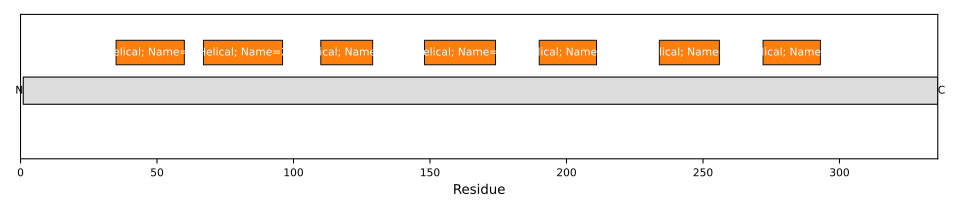
1: Receptor for the lysosphingolipid sphingosine 1-phosphate (S1P) (PubMed:10617617, PubMed:25274307). S1P is a bioactive lysophospholipid that elicits diverse physiological effects on most types of cells and tissues (PubMed:10617617). When expressed in rat HTC4 hepatoma cells, is capable of mediating S1P-induced cell proliferation and suppression of apoptosis (PubMed:10617617). Receptor for the chemokine-like protein FAM19A5 (PubMed:29453251). Mediates the inhibitory effect of FAM19A5 on vascular smooth muscle cell proliferation and migration (By similarity). In lymphoid follicles, couples the binding of S1P to the activation of GNA13 and downstream inhibition of AKT activation leading to suppression of germinal center (GC) B cell growth and migration outside the GC niche