Zinc finger and BTB domain-containing protein 7A (Factor binding IST protein 1) (FBI-1) (Factor that binds to inducer of short transcripts protein 1) (HIV-1 1st-binding protein 1) (Leukemia/lymphoma-related factor) (POZ and Krueppel erythroid myeloid ontogenic factor) (POK erythroid myeloid ontogenic factor) (Pokemon) (Pokemon 1) (TTF-I-interacting peptide 21) (TIP21) (Zinc finger protein 857A)
1_MAGGV 6_ DGPIG 11_ IPFPD 16_ HSSDI 21_ LSGLN 26_ EQRTQ 31_ GLLCD 36_ VVILV 41_ EGREF 46_ PTHRS 51_ VLAAC 56_ SQYFK 61_ KLFTS 66_ GAVVD 71_ QQNVY 76_ EIDFV 81_ SAEAL 86_ TALMD 91_ FAYTA 96_ TLTVS 101_ TANVG 106_ DILSA 111_ ARLLE 116_ IPAVS 121_ HVCAD 126_ LLDRQ 131_ ILAAD 136_ AGADA 141_ GQLDL 146_ VDQID 151_ QRNLL 156_ RAKEY 161_ LEFFQ 166_ SNPMN 171_ SLPPA 176_ AAAAA 181_ ASFPW 186_ SAFGA 191_ SDDDL 196_ DATKE 201_ AVAAA 206_ VAAVA 211_ AGDCN 216_ GLDFY 221_ GPGPP 226_ AERPP 231_ TGDGD 236_ EGDSN 241_ PGLWP 246_ ERDED 251_ APTGG 256_ LFPPP 261_ VAPPA 266_ ATQNG 271_ HYGRG 276_ GEEEA 281_ ASLSE 286_ AAPEP 291_ GDSPG 296_ FLSGA 301_ AEGED 306_ GDGPD 311_ VDGLA 316_ ASTLL 321_ QQMMS 326_ SVGRA 331_ GAAAG 336_ DSDEE 341_ SRADD 346_ KGVMD 351_ YYLKY 356_ FSGAH 361_ DGDVY 366_ PAWSQ 371_ KVEKK 376_ IRAKA 381_ FQKCP 386_ ICEKV 391_ IQGAG 396_ KLPRH 401_ IRTHT 406_ GEKPY 411_ ECNIC 416_ KVRFT 421_ RQDKL 426_ KVHMR 431_ KHTGE 436_ KPYLC 441_ QQCGA 446_ AFAHN 451_ YDLKN 456_ HMRVH 461_ TGLRP 466_ YQCDS 471_ CCKTF 476_ VRSDH 481_ LHRHL 486_ KKDGC 491_ NGVPS 496_ RRGRK 501_ PRVRG 506_ GAPDP 511_ SPGAT 516_ ATPGA 521_ PAQPS 526_ SPDAR 531_ RNGQE 536_ KHFKD 541_ EDEDE 546_ DVASP 551_ DGLGR 556_ LNVAG 561_ AGGGG 566_ DSGGG 571_ PGAAT 576_DGNFT
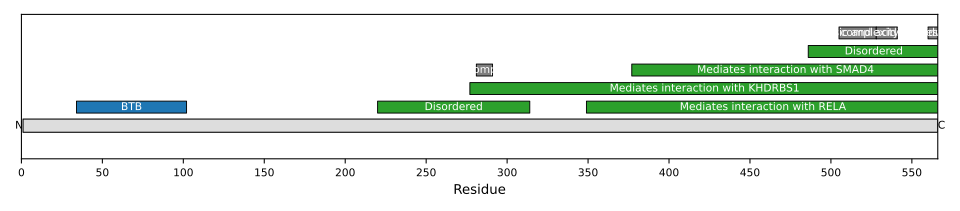
1: Transcription factor that represses the transcription of a wide range of genes involved in cell proliferation and differentiation (PubMed:14701838, PubMed:17595526, PubMed:20812024, PubMed:25514493, PubMed:26455326, PubMed:26816381). Directly and specifically binds to the consensus sequence 5'-[GA][CA]GACCCCCCCCC-3' and represses transcription both by regulating the organization of chromatin and through the direct recruitment of transcription factors to gene regulatory regions (PubMed:12004059, PubMed:17595526, PubMed:20812024, PubMed:25514493, PubMed:26816381). Negatively regulates SMAD4 transcriptional activity in the TGF-beta signaling pathway through these two mechanisms (PubMed:25514493). That is, recruits the chromatin regulator HDAC1 to the SMAD4-DNA complex and in parallel prevents the recruitment of the transcriptional activators CREBBP and EP300 (PubMed:25514493). Collaborates with transcription factors like RELA to modify the accessibility of gene transcription regulatory regions to secondary transcription factors (By similarity). Also directly interacts with transcription factors like SP1 to prevent their binding to DNA (PubMed:12004059). Functions as an androgen receptor/AR transcriptional corepressor by recruiting NCOR1 and NCOR2 to the androgen response elements/ARE on target genes (PubMed:20812024). Thereby, negatively regulates androgen receptor signaling and androgen-induced cell proliferation (PubMed:20812024). Involved in the switch between fetal and adult globin expression during erythroid cells maturation (PubMed:26816381). Through its interaction with the NuRD complex regulates chromatin at the fetal globin genes to repress their transcription (PubMed:26816381). Specifically represses the transcription of the tumor suppressor ARF isoform from the CDKN2A gene (By similarity). Efficiently abrogates E2F1-dependent CDKN2A transactivation (By similarity). Regulates chondrogenesis through the transcriptional repression of specific genes via a mechanism that also requires histone deacetylation (By similarity). Regulates cell proliferation through the transcriptional regulation of genes involved in glycolysis (PubMed:26455326). Involved in adipogenesis through the regulation of genes involved in adipocyte differentiation (PubMed:14701838). Plays a key role in the differentiation of lymphoid progenitors into B and T lineages (By similarity). Promotes differentiation towards the B lineage by inhibiting the T-cell instructive Notch signaling pathway through the specific transcriptional repression of Notch downstream target genes (By similarity). Also regulates osteoclast differentiation (By similarity). May also play a role, independently of its transcriptional activity, in double-strand break repair via classical non-homologous end joining/cNHEJ (By similarity). Recruited to double-strand break sites on damage DNA, interacts with the DNA-dependent protein kinase complex and directly regulates its stability and activity in DNA repair (By similarity). May also modulate the splicing activity of KHDRBS1 toward BCL2L1 in a mechanism which is histone deacetylase-dependent and thereby negatively regulates the pro-apoptotic effect of KHDRBS1 (PubMed:24514149)