Interleukin-33 (IL-33) (Interleukin-1 family member 11) (IL-1F11) (Nuclear factor from high endothelial venules) (NF-HEV) [Cleaved into: Interleukin-33 (95-270); Interleukin-33 (99-270); Interleukin-33 (109-270)]
1_MKPKM 6_ KYSTN 11_ KISTA 16_ KWKNT 21_ ASKAL 26_ CFKLG 31_ KSQQK 36_ AKEVC 41_ PMYFM 46_ KLRSG 51_ LMIKK 56_ EACYF 61_ RRETT 66_ KRPSL 71_ KTGRK 76_ HKRHL 81_ VLAAC 86_ QQQST 91_ VECFA 96_ FGISG 101_ VQKYT 106_ RALHD 111_ SSITG 116_ ISPIT 121_ EYLAS 126_ LSTYN 131_ DQSIT 136_ FALED 141_ ESYEI 146_ YVEDL 151_ KKDEK 156_ KDKVL 161_ LSYYE 166_ SQHPS 171_ NESGD 176_ GVDGK 181_ MLMVT 186_ LSPTK 191_ DFWLH 196_ ANNKE 201_ HSVEL 206_ HKCEK 211_ PLPDQ 216_ AFFVL 221_ HNMHS 226_ NCVSF 231_ ECKTD 236_ PGVFI 241_ GVKDN 246_ HLALI 251_ KVDSS 256_ ENLCT 261_ENILF
1: Cytokine that binds to and signals through the IL1RL1/ST2 receptor which in turn activates NF-kappa-B and MAPK signaling pathways in target cells (PubMed:16286016, PubMed:19841166). Involved in the maturation of Th2 cells inducing the secretion of T-helper type 2-associated cytokines (PubMed:17853410, PubMed:18836528). Also involved in activation of mast cells, basophils, eosinophils and natural killer cells (PubMed:17853410, PubMed:18836528). Acts as an enhancer of polarization of alternatively activated macrophages (PubMed:19841166). Acts as a chemoattractant for Th2 cells, and may function as an 'alarmin', that amplifies immune responses during tissue injury (PubMed:17853410, PubMed:18836528). Induces rapid UCP2-dependent mitochondrial rewiring that attenuates the generation of reactive oxygen species and preserves the integrity of Krebs cycle required for persistent production of itaconate and subsequent GATA3-dependent differentiation of inflammation-resolving alternatively activated macrophages (By similarity)
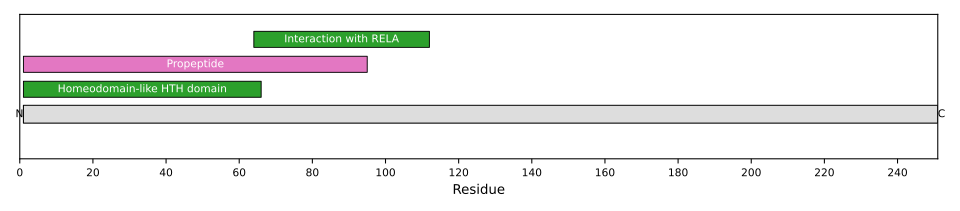
2: In quiescent endothelia the uncleaved form is constitutively and abundantly expressed, and acts as a chromatin-associated nuclear factor with transcriptional repressor properties, it may sequester nuclear NF-kappaB/RELA, lowering expression of its targets (PubMed:21734074). This form is rapidely lost upon angiogenic or pro-inflammatory activation (PubMed:18787100)