Claudin-1 (Senescence-associated epithelial membrane protein)
1_MANAG 6_ LQLLG 11_ FILAF 16_ LGWIG 21_ AIVST 26_ ALPQW 31_ RIYSY 36_ AGDNI 41_ VTAQA 46_ MYEGL 51_ WMSCV 56_ SQSTG 61_ QIQCK 66_ VFDSL 71_ LNLSS 76_ TLQAT 81_ RALMV 86_ VGILL 91_ GVIAI 96_ FVATV 101_ GMKCM 106_ KCLED 111_ DEVQK 116_ MRMAV 121_ IGGAI 126_ FLLAG 131_ LAILV 136_ ATAWY 141_ GNRIV 146_ QEFYD 151_ PMTPV 156_ NARYE 161_ FGQAL 166_ FTGWA 171_ AASLC 176_ LLGGA 181_ LLCCS 186_ CPRKT 191_ TSYPT 196_ PRPYP 201_ KPAPS 206_SGKDY
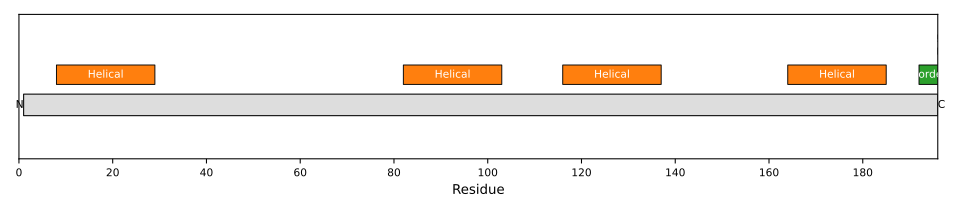
1: Claudins function as major constituents of the tight junction complexes that regulate the permeability of epithelia. While some claudin family members play essential roles in the formation of impermeable barriers, others mediate the permeability to ions and small molecules. Often, several claudin family members are coexpressed and interact with each other, and this determines the overall permeability. CLDN1 is required to prevent the paracellular diffusion of small molecules through tight junctions in the epidermis and is required for the normal barrier function of the skin. Required for normal water homeostasis and to prevent excessive water loss through the skin, probably via an indirect effect on the expression levels of other proteins, since CLDN1 itself seems to be dispensable for water barrier formation in keratinocyte tight junctions (PubMed:23407391)
2: (Microbial infection) Acts as a co-receptor for hepatitis C virus (HCV) in hepatocytes (PubMed:17325668, PubMed:20375010, PubMed:24038151). Associates with CD81 and the CLDN1-CD81 receptor complex is essential for HCV entry into host cell (PubMed:20375010). Acts as a receptor for dengue virus (PubMed:24074594)