Zinc finger protein SNAI1 (Protein snail homolog 1) (Protein sna)
1_MPRSF 6_ LVRKP 11_ SDPNR 16_ KPNYS 21_ ELQDS 26_ NPEFT 31_ FQQPY 36_ DQAHL 41_ LAAIP 46_ PPEIL 51_ NPTAS 56_ LPMLI 61_ WDSVL 66_ APQAQ 71_ PIAWA 76_ SLRLQ 81_ ESPRV 86_ AELTS 91_ LSDED 96_ SGKGS 101_ QPPSP 106_ PSPAP 111_ SSFSS 116_ TSVSS 121_ LEAEA 126_ YAAFP 131_ GLGQV 136_ PKQLA 141_ QLSEA 146_ KDLQA 151_ RKAFN 156_ CKYCN 161_ KEYLS 166_ LGALK 171_ MHIRS 176_ HTLPC 181_ VCGTC 186_ GKAFS 191_ RPWLL 196_ QGHVR 201_ THTGE 206_ KPFSC 211_ PHCSR 216_ AFADR 221_ SNLRA 226_ HLQTH 231_ SDVKK 236_ YQCQA 241_ CARTF 246_ SRMSL 251_ LHKHQ 256_ESGCS
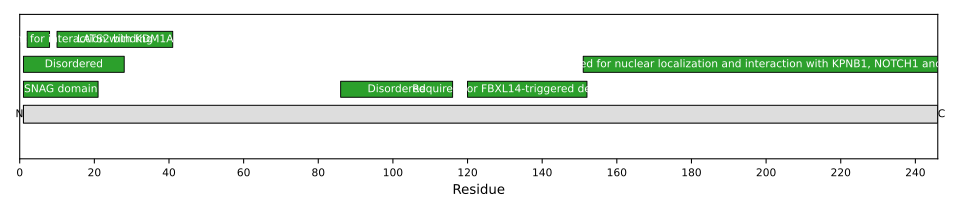
1: Involved in induction of the epithelial to mesenchymal transition (EMT), formation and maintenance of embryonic mesoderm, growth arrest, survival and cell migration (PubMed:10655587, PubMed:15647282, PubMed:20389281, PubMed:20562920, PubMed:21952048, PubMed:25827072). Binds to 3 E-boxes of the E-cadherin/CDH1 gene promoter and to the promoters of CLDN7 and KRT8 and, in association with histone demethylase KDM1A which it recruits to the promoters, causes a decrease in dimethylated H3K4 levels and represses transcription (PubMed:10655587, PubMed:20389281, PubMed:20562920). The N-terminal SNAG domain competes with histone H3 for the same binding site on the histone demethylase complex formed by KDM1A and RCOR1, and thereby inhibits demethylation of histone H3 at 'Lys-4' (in vitro) (PubMed:20389281, PubMed:21300290, PubMed:23721412). During EMT, involved with LOXL2 in negatively regulating pericentromeric heterochromatin transcription (PubMed:16096638). SNAI1 recruits LOXL2 to pericentromeric regions to oxidize histone H3 and repress transcription which leads to release of heterochromatin component CBX5/HP1A, enabling chromatin reorganization and acquisition of mesenchymal traits (By similarity). Associates with EGR1 and SP1 to mediate tetradecanoyl phorbol acetate (TPA)-induced up-regulation of CDKN2B, possibly by binding to the CDKN2B promoter region 5'-TCACA-3 (PubMed:20121949). In addition, may also activate the CDKN2B promoter by itself (PubMed:20121949)