Serine/threonine-protein kinase Chk2 (EC 2.7.11.1) (CHK2 checkpoint homolog) (Cds1 homolog) (Hucds1) (hCds1) (Checkpoint kinase 2)
1_MSRES 6_ DVEAQ 11_ QSHGS 16_ SACSQ 21_ PHGSV 26_ TQSQG 31_ SSSQS 36_ QGISS 41_ SSTST 46_ MPNSS 51_ QSSHS 56_ SSGTL 61_ SSLET 66_ VSTQE 71_ LYSIP 76_ EDQEP 81_ EDQEP 86_ EEPTP 91_ APWAR 96_ LWALQ 101_ DGFAN 106_ LECVN 111_ DNYWF 116_ GRDKS 121_ CEYCF 126_ DEPLL 131_ KRTDK 136_ YRTYS 141_ KKHFR 146_ IFREV 151_ GPKNS 156_ YIAYI 161_ EDHSG 166_ NGTFV 171_ NTELV 176_ GKGKR 181_ RPLNN 186_ NSEIA 191_ LSLSR 196_ NKVFV 201_ FFDLT 206_ VDDQS 211_ VYPKA 216_ LRDEY 221_ IMSKT 226_ LGSGA 231_ CGEVK 236_ LAFER 241_ KTCKK 246_ VAIKI 251_ ISKRK 256_ FAIGS 261_ AREAD 266_ PALNV 271_ ETEIE 276_ ILKKL 281_ NHPCI 286_ IKIKN 291_ FFDAE 296_ DYYIV 301_ LELME 306_ GGELF 311_ DKVVG 316_ NKRLK 321_ EATCK 326_ LYFYQ 331_ MLLAV 336_ QYLHE 341_ NGIIH 346_ RDLKP 351_ ENVLL 356_ SSQEE 361_ DCLIK 366_ ITDFG 371_ HSKIL 376_ GETSL 381_ MRTLC 386_ GTPTY 391_ LAPEV 396_ LVSVG 401_ TAGYN 406_ RAVDC 411_ WSLGV 416_ ILFIC 421_ LSGYP 426_ PFSEH 431_ RTQVS 436_ LKDQI 441_ TSGKY 446_ NFIPE 451_ VWAEV 456_ SEKAL 461_ DLVKK 466_ LLVVD 471_ PKARF 476_ TTEEA 481_ LRHPW 486_ LQDED 491_ MKRKF 496_ QDLLS 501_ EENES 506_ TALPQ 511_ VLAQP 516_ STSRK 521_ RPREG 526_ EAEGA 531_ ETTKR 536_PAVCA
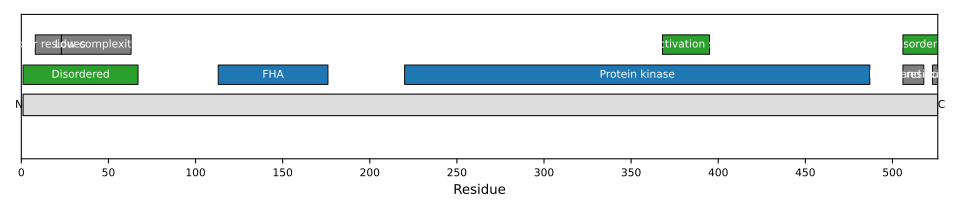
1: Serine/threonine-protein kinase which is required for checkpoint-mediated cell cycle arrest, activation of DNA repair and apoptosis in response to the presence of DNA double-strand breaks. May also negatively regulate cell cycle progression during unperturbed cell cycles. Following activation, phosphorylates numerous effectors preferentially at the consensus sequence [L-X-R-X-X-S/T] (PubMed:37943659). Regulates cell cycle checkpoint arrest through phosphorylation of CDC25A, CDC25B and CDC25C, inhibiting their activity. Inhibition of CDC25 phosphatase activity leads to increased inhibitory tyrosine phosphorylation of CDK-cyclin complexes and blocks cell cycle progression. May also phosphorylate NEK6 which is involved in G2/M cell cycle arrest. Regulates DNA repair through phosphorylation of BRCA2, enhancing the association of RAD51 with chromatin which promotes DNA repair by homologous recombination. Also stimulates the transcription of genes involved in DNA repair (including BRCA2) through the phosphorylation and activation of the transcription factor FOXM1. Regulates apoptosis through the phosphorylation of p53/TP53, MDM4 and PML. Phosphorylation of p53/TP53 at 'Ser-20' by CHEK2 may alleviate inhibition by MDM2, leading to accumulation of active p53/TP53. Phosphorylation of MDM4 may also reduce degradation of p53/TP53. Also controls the transcription of pro-apoptotic genes through phosphorylation of the transcription factor E2F1. Tumor suppressor, it may also have a DNA damage-independent function in mitotic spindle assembly by phosphorylating BRCA1. Its absence may be a cause of the chromosomal instability observed in some cancer cells. Promotes the CCAR2-SIRT1 association and is required for CCAR2-mediated SIRT1 inhibition (PubMed:25361978). Under oxidative stress, promotes ATG7 ubiquitination by phosphorylating the E3 ubiquitin ligase TRIM32 at 'Ser-55' leading to positive regulation of the autophagosme assembly (PubMed:37943659)
2: (Microbial infection) Phosphorylates herpes simplex virus 1/HHV-1 protein ICP0 and thus activates its SUMO-targeted ubiquitin ligase activity