Cytochrome c oxidase subunit 2 (EC 7.1.1.9) (Cytochrome c oxidase polypeptide II)
1_MAHAA 6_ QVGLQ 11_ DATSP 16_ IMEEL 21_ ITFHD 26_ HALMI 31_ IFLIC 36_ FLVLY 41_ ALFLT 46_ LTTKL 51_ TNTNI 56_ SDAQE 61_ METVW 66_ TILPA 71_ IILVL 76_ IALPS 81_ LRILY 86_ MTDEV 91_ NDPSL 96_ TIKSI 101_ GHQWY 106_ WTYEY 111_ TDYGG 116_ LIFNS 121_ YMLPP 126_ LFLEP 131_ GDLRL 136_ LDVDN 141_ RVVLP 146_ IEAPI 151_ RMMIT 156_ SQDVL 161_ HSWAV 166_ PTLGL 171_ KTDAI 176_ PGRLN 181_ QTTFT 186_ ATRPG 191_ VYYGQ 196_ CSEIC 201_ GANHS 206_ FMPIV 211_ LELIP 216_ LKIFE 221_MGPVF
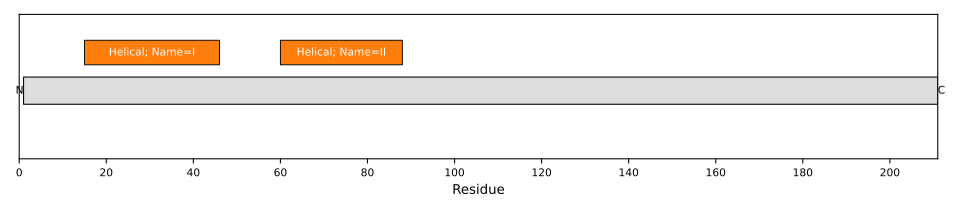
1: Component of the cytochrome c oxidase, the last enzyme in the mitochondrial electron transport chain which drives oxidative phosphorylation. The respiratory chain contains 3 multisubunit complexes succinate dehydrogenase (complex II, CII), ubiquinol-cytochrome c oxidoreductase (cytochrome b-c1 complex, complex III, CIII) and cytochrome c oxidase (complex IV, CIV), that cooperate to transfer electrons derived from NADH and succinate to molecular oxygen, creating an electrochemical gradient over the inner membrane that drives transmembrane transport and the ATP synthase. Cytochrome c oxidase is the component of the respiratory chain that catalyzes the reduction of oxygen to water. Electrons originating from reduced cytochrome c in the intermembrane space (IMS) are transferred via the dinuclear copper A center (CU(A)) of subunit 2 and heme A of subunit 1 to the active site in subunit 1, a binuclear center (BNC) formed by heme A3 and copper B (CU(B)). The BNC reduces molecular oxygen to 2 water molecules using 4 electrons from cytochrome c in the IMS and 4 protons from the mitochondrial matrix