ATP synthase subunit a (F-ATPase protein 6)
1_MNENL 6_ FASFI 11_ APTIL 16_ GLPAA 21_ VLIIL 26_ FPPLL 31_ IPTSK 36_ YLINN 41_ RLITT 46_ QQWLI 51_ KLTSK 56_ QMMTM 61_ HNTKG 66_ RTWSL 71_ MLVSL 76_ IIFIA 81_ TTNLL 86_ GLLPH 91_ SFTPT 96_ TQLSM 101_ NLAMA 106_ IPLWA 111_ GTVIM 116_ GFRSK 121_ IKNAL 126_ AHFLP 131_ QGTPT 136_ PLIPM 141_ LVIIE 146_ TISLL 151_ IQPMA 156_ LAVRL 161_ TANIT 166_ AGHLL 171_ MHLIG 176_ SATLA 181_ MSTIN 186_ LPSTL 191_ IIFTI 196_ LILLT 201_ ILEIA 206_ VALIQ 211_ AYVFT 216_ LLVSL 221_YLHDN
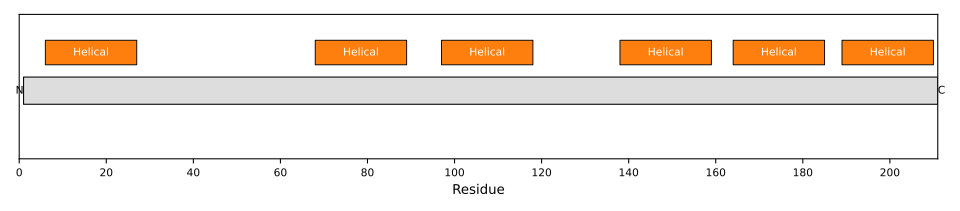
1: Subunit a, of the mitochondrial membrane ATP synthase complex (F(1)F(0) ATP synthase or Complex V) that produces ATP from ADP in the presence of a proton gradient across the membrane which is generated by electron transport complexes of the respiratory chain (Probable). ATP synthase complex consist of a soluble F(1) head domain - the catalytic core - and a membrane F(1) domain - the membrane proton channel (PubMed:37244256). These two domains are linked by a central stalk rotating inside the F(1) region and a stationary peripheral stalk (PubMed:37244256). During catalysis, ATP synthesis in the catalytic domain of F(1) is coupled via a rotary mechanism of the central stalk subunits to proton translocation (Probable). With the subunit c (ATP5MC1), forms the proton-conducting channel in the F(0) domain, that contains two crucial half-channels (inlet and outlet) that facilitate proton movement from the mitochondrial intermembrane space (IMS) into the matrix (PubMed:37244256). Protons are taken up via the inlet half-channel and released through the outlet half-channel, following a Grotthuss mechanism (PubMed:37244256)