Transforming growth factor beta-1 proprotein [Cleaved into: Latency-associated peptide (LAP); Transforming growth factor beta-1 (TGF-beta-1)]
1_MPPSG 6_ LRLLL 11_ LLLPL 16_ LWLLV 21_ LTPGR 26_ PAAGL 31_ STCKT 36_ IDMEL 41_ VKRKR 46_ IEAIR 51_ GQILS 56_ KLRLA 61_ SPPSQ 66_ GEVPP 71_ GPLPE 76_ AVLAL 81_ YNSTR 86_ DRVAG 91_ ESAEP 96_ EPEPE 101_ ADYYA 106_ KEVTR 111_ VLMVE 116_ THNEI 121_ YDKFK 126_ QSTHS 131_ IYMFF 136_ NTSEL 141_ REAVP 146_ EPVLL 151_ SRAEL 156_ RLLRL 161_ KLKVE 166_ QHVEL 171_ YQKYS 176_ NNSWR 181_ YLSNR 186_ LLAPS 191_ DSPEW 196_ LSFDV 201_ TGVVR 206_ QWLSR 211_ GGEIE 216_ GFRLS 221_ AHCSC 226_ DSRDN 231_ TLQVD 236_ INGFT 241_ TGRRG 246_ DLATI 251_ HGMNR 256_ PFLLL 261_ MATPL 266_ ERAQH 271_ LQSSR 276_ HRRAL 281_ DTNYC 286_ FSSTE 291_ KNCCV 296_ RQLYI 301_ DFRKD 306_ LGWKW 311_ IHEPK 316_ GYHAN 321_ FCLGP 326_ CPYIW 331_ SLDTQ 336_ YSKVL 341_ ALYNQ 346_ HNPGA 351_ SAAPC 356_ CVPQA 361_ LEPLP 366_ IVYYV 371_ GRKPK 376_ VEQLS 381_NMIVR
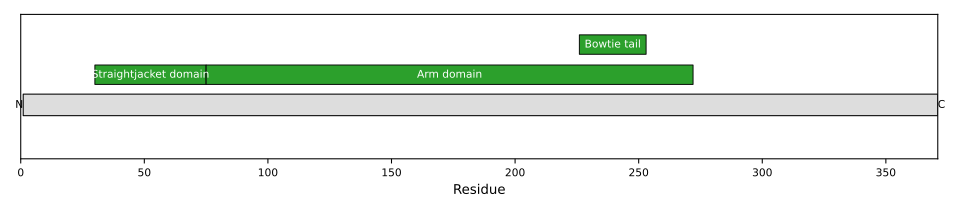
1: Transforming growth factor beta-1 proprotein: Precursor of the Latency-associated peptide (LAP) and Transforming growth factor beta-1 (TGF-beta-1) chains, which constitute the regulatory and active subunit of TGF-beta-1, respectively
2: Required to maintain the Transforming growth factor beta-1 (TGF-beta-1) chain in a latent state during storage in extracellular matrix (PubMed:28117447). Associates non-covalently with TGF-beta-1 and regulates its activation via interaction with 'milieu molecules', such as LTBP1, LRRC32/GARP and LRRC33/NRROS, that control activation of TGF-beta-1 (PubMed:19651619, PubMed:19750484, PubMed:2022183, PubMed:22278742, PubMed:8617200, PubMed:8939931). Interaction with LRRC33/NRROS regulates activation of TGF-beta-1 in macrophages and microglia (Probable). Interaction with LRRC32/GARP controls activation of TGF-beta-1 on the surface of activated regulatory T-cells (Tregs) (PubMed:19651619, PubMed:19750484, PubMed:22278742). Interaction with integrins (ITGAV:ITGB6 or ITGAV:ITGB8) results in distortion of the Latency-associated peptide chain and subsequent release of the active TGF-beta-1 (PubMed:22278742, PubMed:28117447)
3: Multifunctional protein that regulates the growth and differentiation of various cell types and is involved in various processes, such as normal development, immune function, microglia function and responses to neurodegeneration (By similarity). Activation into mature form follows different steps: following cleavage of the proprotein in the Golgi apparatus, Latency-associated peptide (LAP) and Transforming growth factor beta-1 (TGF-beta-1) chains remain non-covalently linked rendering TGF-beta-1 inactive during storage in extracellular matrix (PubMed:29109152). At the same time, LAP chain interacts with 'milieu molecules', such as LTBP1, LRRC32/GARP and LRRC33/NRROS that control activation of TGF-beta-1 and maintain it in a latent state during storage in extracellular milieus (PubMed:19651619, PubMed:19750484, PubMed:2022183, PubMed:22278742, PubMed:8617200, PubMed:8939931). TGF-beta-1 is released from LAP by integrins (ITGAV:ITGB6 or ITGAV:ITGB8): integrin-binding to LAP stabilizes an alternative conformation of the LAP bowtie tail and results in distortion of the LAP chain and subsequent release of the active TGF-beta-1 (PubMed:22278742, PubMed:28117447). Once activated following release of LAP, TGF-beta-1 acts by binding to TGF-beta receptors (TGFBR1 and TGFBR2), which transduce signal (PubMed:20207738). While expressed by many cells types, TGF-beta-1 only has a very localized range of action within cell environment thanks to fine regulation of its activation by Latency-associated peptide chain (LAP) and 'milieu molecules' (By similarity). Plays an important role in bone remodeling: acts as a potent stimulator of osteoblastic bone formation, causing chemotaxis, proliferation and differentiation in committed osteoblasts (By similarity). Can promote either T-helper 17 cells (Th17) or regulatory T-cells (Treg) lineage differentiation in a concentration-dependent manner (By similarity). At high concentrations, leads to FOXP3-mediated suppression of RORC and down-regulation of IL-17 expression, favoring Treg cell development (By similarity). At low concentrations in concert with IL-6 and IL-21, leads to expression of the IL-17 and IL-23 receptors, favoring differentiation to Th17 cells (By similarity). Stimulates sustained production of collagen through the activation of CREB3L1 by regulated intramembrane proteolysis (RIP) (PubMed:25310401). Mediates SMAD2/3 activation by inducing its phosphorylation and subsequent translocation to the nucleus (PubMed:25893292, PubMed:29483653, PubMed:30696809). Positively regulates odontoblastic differentiation in dental papilla cells, via promotion of IPO7-mediated translocation of phosphorylated SMAD2 to the nucleus and subsequent transcription of target genes (By similarity). Can induce epithelial-to-mesenchymal transition (EMT) and cell migration in various cell types (PubMed:25893292, PubMed:30696809)