Interleukin-1 alpha (IL-1 alpha) (Hematopoietin-1)
1_MAKVP 6_ DMFED 11_ LKNCY 16_ SENEE 21_ DSSSI 26_ DHLSL 31_ NQKSF 36_ YHVSY 41_ GPLHE 46_ GCMDQ 51_ SVSLS 56_ ISETS 61_ KTSKL 66_ TFKES 71_ MVVVA 76_ TNGKV 81_ LKKRR 86_ LSLSQ 91_ SITDD 96_ DLEAI 101_ ANDSE 106_ EEIIK 111_ PRSAP 116_ FSFLS 121_ NVKYN 126_ FMRII 131_ KYEFI 136_ LNDAL 141_ NQSII 146_ RANDQ 151_ YLTAA 156_ ALHNL 161_ DEAVK 166_ FDMGA 171_ YKSSK 176_ DDAKI 181_ TVILR 186_ ISKTQ 191_ LYVTA 196_ QDEDQ 201_ PVLLK 206_ EMPEI 211_ PKTIT 216_ GSETN 221_ LLFFW 226_ ETHGT 231_ KNYFT 236_ SVAHP 241_ NLFIA 246_ TKQDY 251_ WVCLA 256_ GGPPS 261_ ITDFQ 266_ILENQ
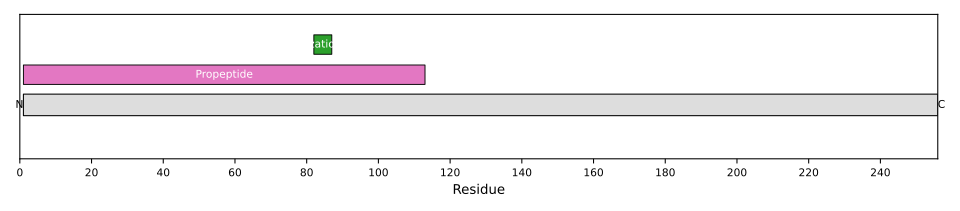
1: Cytokine constitutively present intracellularly in nearly all resting non-hematopoietic cells that plays an important role in inflammation and bridges the innate and adaptive immune systems (PubMed:26439902). After binding to its receptor IL1R1 together with its accessory protein IL1RAP, forms the high affinity interleukin-1 receptor complex (PubMed:17507369, PubMed:2950091). Signaling involves the recruitment of adapter molecules such as MYD88, IRAK1 or IRAK4 (PubMed:17507369). In turn, mediates the activation of NF-kappa-B and the three MAPK pathways p38, p42/p44 and JNK pathways (PubMed:14687581). Within the cell, acts as an alarmin and cell death results in its liberation in the extracellular space after disruption of the cell membrane to induce inflammation and alert the host to injury or damage (PubMed:15679580). In addition to its role as a danger signal, which occurs when the cytokine is passively released by cell necrosis, directly senses DNA damage and acts as a signal for genotoxic stress without loss of cell integrity (PubMed:26439902)