Polymeric immunoglobulin receptor (PIgR) (Poly-Ig receptor) (Hepatocellular carcinoma-associated protein TB6) [Cleaved into: Secretory component]
1_MLLFV 6_ LTCLL 11_ AVFPA 16_ ISTKS 21_ PIFGP 26_ EEVNS 31_ VEGNS 36_ VSITC 41_ YYPPT 46_ SVNRH 51_ TRKYW 56_ CRQGA 61_ RGGCI 66_ TLISS 71_ EGYVS 76_ SKYAG 81_ RANLT 86_ NFPEN 91_ GTFVV 96_ NIAQL 101_ SQDDS 106_ GRYKC 111_ GLGIN 116_ SRGLS 121_ FDVSL 126_ EVSQG 131_ PGLLN 136_ DTKVY 141_ TVDLG 146_ RTVTI 151_ NCPFK 156_ TENAQ 161_ KRKSL 166_ YKQIG 171_ LYPVL 176_ VIDSS 181_ GYVNP 186_ NYTGR 191_ IRLDI 196_ QGTGQ 201_ LLFSV 206_ VINQL 211_ RLSDA 216_ GQYLC 221_ QAGDD 226_ SNSNK 231_ KNADL 236_ QVLKP 241_ EPELV 246_ YEDLR 251_ GSVTF 256_ HCALG 261_ PEVAN 266_ VAKFL 271_ CRQSS 276_ GENCD 281_ VVVNT 286_ LGKRA 291_ PAFEG 296_ RILLN 301_ PQDKD 306_ GSFSV 311_ VITGL 316_ RKEDA 321_ GRYLC 326_ GAHSD 331_ GQLQE 336_ GSPIQ 341_ AWQLF 346_ VNEES 351_ TIPRS 356_ PTVVK 361_ GVAGG 366_ SVAVL 371_ CPYNR 376_ KESKS 381_ IKYWC 386_ LWEGA 391_ QNGRC 396_ PLLVD 401_ SEGWV 406_ KAQYE 411_ GRLSL 416_ LEEPG 421_ NGTFT 426_ VILNQ 431_ LTSRD 436_ AGFYW 441_ CLTNG 446_ DTLWR 451_ TTVEI 456_ KIIEG 461_ EPNLK 466_ VPGNV 471_ TAVLG 476_ ETLKV 481_ PCHFP 486_ CKFSS 491_ YEKYW 496_ CKWNN 501_ TGCQA 506_ LPSQD 511_ EGPSK 516_ AFVNC 521_ DENSR 526_ LVSLT 531_ LNLVT 536_ RADEG 541_ WYWCG 546_ VKQGH 551_ FYGET 556_ AAVYV 561_ AVEER 566_ KAAGS 571_ RDVSL 576_ AKADA 581_ APDEK 586_ VLDSG 591_ FREIE 596_ NKAIQ 601_ DPRLF 606_ AEEKA 611_ VADTR 616_ DQADG 621_ SRASV 626_ DSGSS 631_ EEQGG 636_ SSRAL 641_ VSTLV 646_ PLGLV 651_ LAVGA 656_ VAVGV 661_ ARARH 666_ RKNVD 671_ RVSIR 676_ SYRTD 681_ ISMSD 686_ FENSR 691_ EFGAN 696_ DNMGA 701_ SSITQ 706_ ETSLG 711_ GKEEF 716_ VATTE 721_ STTET 726_ KEPKK 731_ AKRSS 736_ KEEAE 741_ MAYKD 746_ FLLQS 751_ STVAA 756_EAQDG
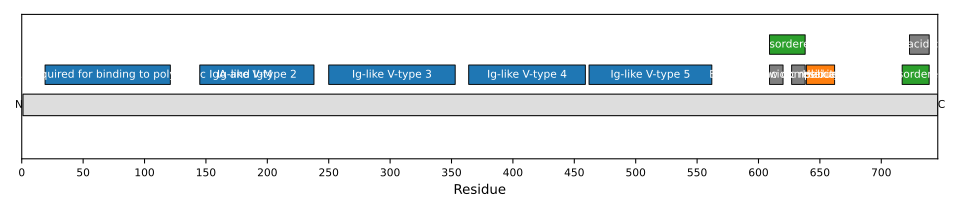
1: Mediates selective transcytosis of polymeric IgA and IgM across mucosal epithelial cells. Binds polymeric IgA and IgM at the basolateral surface of epithelial cells. The complex is then transported across the cell to be secreted at the apical surface. During this process, a cleavage occurs that separates the extracellular (known as the secretory component) from the transmembrane segment
2: Through its N-linked glycans ensures anchoring of secretory IgA (sIgA) molecules to mucus lining the epithelial surface to neutralize extracellular pathogens (PubMed:12150896). On its own (free form) may act as a non-specific microbial scavenger to prevent pathogen interaction with epithelial cells (PubMed:16543244)